reflections on my month-long trip to The Crossroads of the Americas
by Brian Ballard Quass, the Drug War Philosopher
February 28, 2026
During our stifling walk through Taboga Island on a typical summer day in Panama in February 2026, our resident tour guide brought us to the oceanside house of Francisco Pizarro, where the Conquistador lived the good life with the help of his encomienda of 150 indigenous slaves before setting off to conquer Peru, not once, but twice. I was startled to learn that a house with such a name even existed on the so-called "Island of Flowers," let alone that it was located on a street that unapologetically boasted the same controversial name. My astonishment only grew when our guide informed our small group of day trippers that the house is still in the hands of Pizarro's descendants to this very day. "What?", I thought to myself. "Did not the indigenous people of Peru successfully demand the removal of the equestrian statue of Pizarro from the Lima capital in 2003? Why is this house and street tolerated by the Mestizo population of the island, given their tangible connections with the peoples whom the Spaniard decimated for nepotic gain, the encomiendas thus generated being shared with his three equally ruthless brothers?"
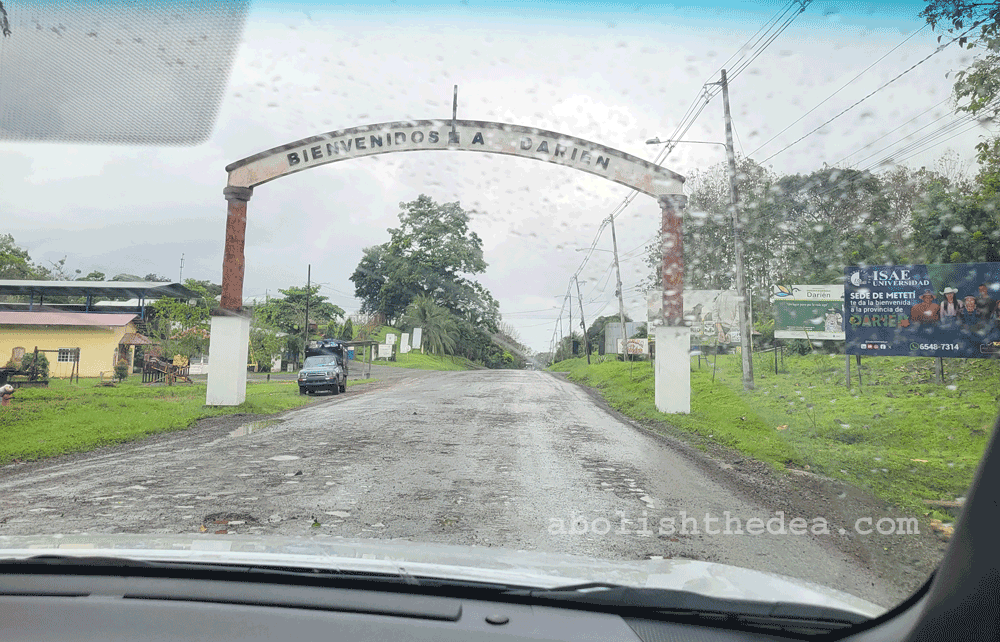
Welcome sign entering Agua Fria, first town in Darien Province when heading east on Route 1. The real welcome is a kilometer ahead when the Gestapo -- er, Panama police -- sniff about your car for the Divine Plant of the Inca.
I highlight this part of my recent month-long stay in Panama because Francisco Pizarro is the very "type" of the modern Drug Warrior. He is the type of the modern westerner, who, like a bull in a China shop, interferes in the lives of strangers about which he prides himself on knowing nothing whatsoever, in a self-righteous attempt to make the locals conform to his own ways of "being in the world": a world in which the only acceptable drugs are tobacco and alcohol and the only acceptable religion is Christianity. Moreover, the answers to the above questions tell us a lot about the ongoing unwillingness of modern westerners to learn from the past when it comes to our colonial impulses, of which drug prohibition is the modern exemplar par excellence. Take that Lima statue, for instance. Subsequent research reveals that the bronze statue by American sculptor Charles Cary Rumsey was actually reintroduced into the Lima Capital in 2025, indicating that the war between interpretations of history is ongoing and that westerners and indigenous peoples are still at odds over the lessons that should be drawn from that history.
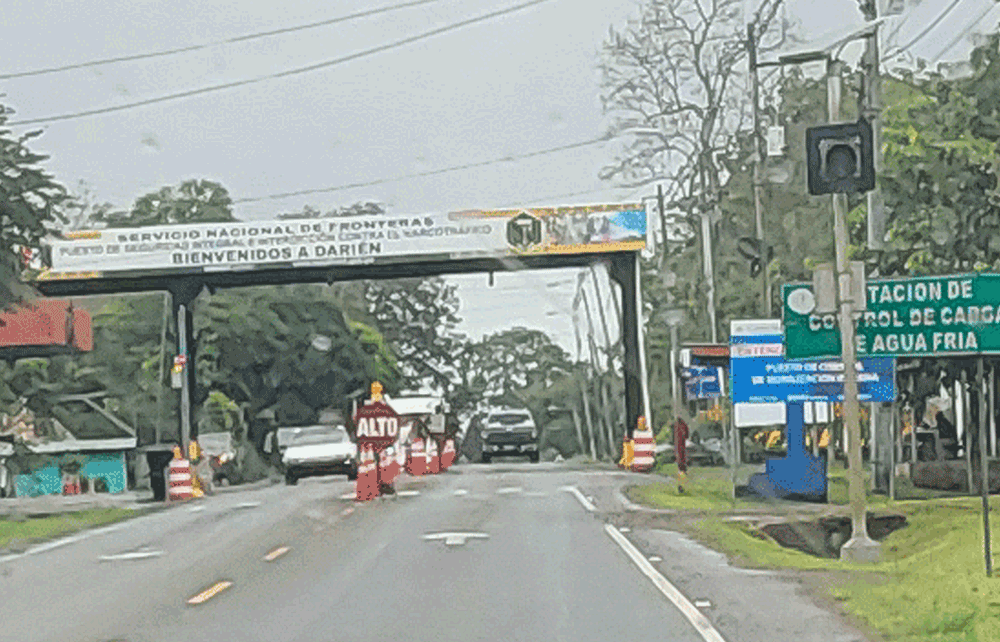
He we are 'welcomed' to the Darien Province by Panamanian police officers, nosing about for any evidence of the Divine Plant of the Incas. This is the kind of Gestapo checkpoint that drug prohibition has brought to the 'democratic' world.
Nor was this the only occasion on which I was reminded of colonialist drug policies in Panama. Our travels on the country's very limited highway system brought us to at least a half a dozen checkpoints where, like everybody else, we were eyed with de rigueur suspicion by Panamanian Police as being potential carriers of contraband, with the subtext always being the potential that we were carrying the divine plant of the Inca. Such stops remind me of how the Drug War has turned all interaction with police into potential conflicts -- because the police are officially obliged to be prudish snoops who always have the unspoken goal of "catching us out" when it comes to our use of medicines of which politicians disapprove, and above all our use of cocaine, which must be fiercely suppressed by the west for multiple reasons, none of which have anything to do with human health. To the contrary, the west outlaws cocaine in order to: 1, maintain government control over mind and mood medicine; 2, provide an excuse for invading Latin American countries at will; and 3, "justify" police brutality and otherwise busybody tactics in the name of suppressing the use of the divine plant of the Inca and its thoroughly demonized alkaloid, cocaine, which Freud himself understood to be a powerful cure for depression.
But it was not until my arrival in the Darien Province that I saw the fanatical prejudices of the drug-hating west on full display. Shortly after passing a deceptively friendly sign that welcomed us to Agua Fria, the first tiny town in the Province, our rental-car was stopped by a trio of gun-toting Panamanian cops sporting battle fatigues and sour faces, who demanded to know where we thought we were going and why. Unfortunately, my Spanish skills were not up to the task of conveying my various motivations and interests in traveling thither, ranging as they did from ecological, to historical, to ethnographical in nature. My cousin, for his part, just wanted to go to the Darien Gap so that he could say that he had done so, and I found that explanation hard to communicate to an impatient and skeptical "soldado" with a machine-gun in his hands. I wanted to say: "We just wanted to see if the stories that we had read about Gestapo police tactics in the Darien Province were really true. Now that you have answered that question for us in the affirmative, we make so bold as to bid you adieu. And now if you'll be so kind as to take that gun out of my face, we will turn around and make our three-hour trip back to our Panama City digs on Route 1. Speaking of which, this section of the so-called Pan-American Highway has long bumpy stretches of completely unpaved "tramos" every few kilometers. Has your highway department never heard of 'paving as you go?'"
Thank God I am not yet fluent in Spanish, for it is just possible that such an harangue on my part would not have gone over well with the camouflaged grumps. But I thank them nevertheless for proving my thesis, a conjecture that the rest of my Panama trip was already tending to strongly support: namely, that drug prohibition leads to the Nazification of local police forces. And what is drug prohibition anyway but the modern expression of the cavalier mindset of the war-hungry Francisco Pizarros of the world. This is why the police checkpoints in Panama depress me so, because the local population should know better than to tolerate such crackdowns, especially since they are mandated by a foreign country with a vested interest in destroying the divine plant of the Inca and re-making Panama in its own image. Like most westerners, the locals have yet to understand that drug prohibition is just western colonialism by other means, no matter how the villains of the piece rage against the strawman of "woke" narratives, as if there was something wrong with westerners learning from the mistakes of their past.
Ten Tweets
against the hateful war on US
What is the end game of the drug warrior? A world in which no one wants drugs? That's not science. It's the drug-hating religion of Christian Science. You know, the American religion that outsources its Inquisition to drug-testing labs.
Even the worst forms of "abuse" can be combatted with a wise use of a wide range of psychoactive drugs, to combat both physical and psychological cravings. But drug warriors NEED addiction to be a HUGE problem. That's their golden goose.
The December Scientific American features a story called "The New Nuclear Age," about a trillion-dollar plan to add 100s of ICBM's to 5 states, which an SA editorial calls "kick me" signs. This Neanderthal plan comes from pols who think that compassion-boosting drugs are evil!
The drug war is a whole wrong way of looking at the world. It tells us that substances can be judged "up" or "down," which is anti-scientific and blinds us to endless beneficial uses.
Even prohibition haters have their own list of drugs that they feel should be outlawed. They're missing the point. We should not drugs "up or down" any more than we should judge penicillin or aspirin in that way.
The Drug War is the most important evil to protest, precisely because almost everybody is afraid to do so. That's a clear sign that it is a cancer on the body politic.
Prohibition turned habituation into addiction by creating a wide variety of problems for users, including potential arrest, tainted or absent drug supply, and extreme stigmatization.
The drug war outlaws everything that could help both prevent addiction and treat it. And then they justify the war on drugs by scaring people with the specter of addiction. They NEED addiction to keep the drug war going.
Even when laudanum was legal in the UK, pharmacists were serving as moral adjudicators, deciding for whom they should fill such prescriptions. That's not a pharmacist's role. We need an ABC-like set-up in which the cashier does not pry into my motives for buying a substance.
First we outlaw all drugs that could help; then we complain that some people have 'TREATMENT-RESISTANT DEPRESSION'. What? No. What they really "have" is an inability to thrive because of our idiotic drug laws.
3:51 PM · Jul 15, 2024










 (up)
(up)