How the Claire Brosseau case almost gave me a coronary
by Brian Ballard Quass, the Drug War Philosopher
February 17, 2026
I have still not recovered from reading Stephanie Nolen's January article in the New York Times in which a 48-year-old depressed Canadian entertainer is demanding her right to avail herself of assisted suicide.1 She demands that the State help her to use drugs that will bring about her death. And what State is this? The self-same State that denies her the use of drugs that could make her want to live! My jaw is still down on the floor! Could a person be more bamboozled by drug-war lies and misrepresentations than is Claire in making this request? It makes you wonder what Claire's grade school teachers taught her (or failed to teach her) about the basic principles of human agency upon which democratic countries were ostensibly founded.
And yet this was just the first of two jaw-dropping surprises that I was to encounter in the Times article.
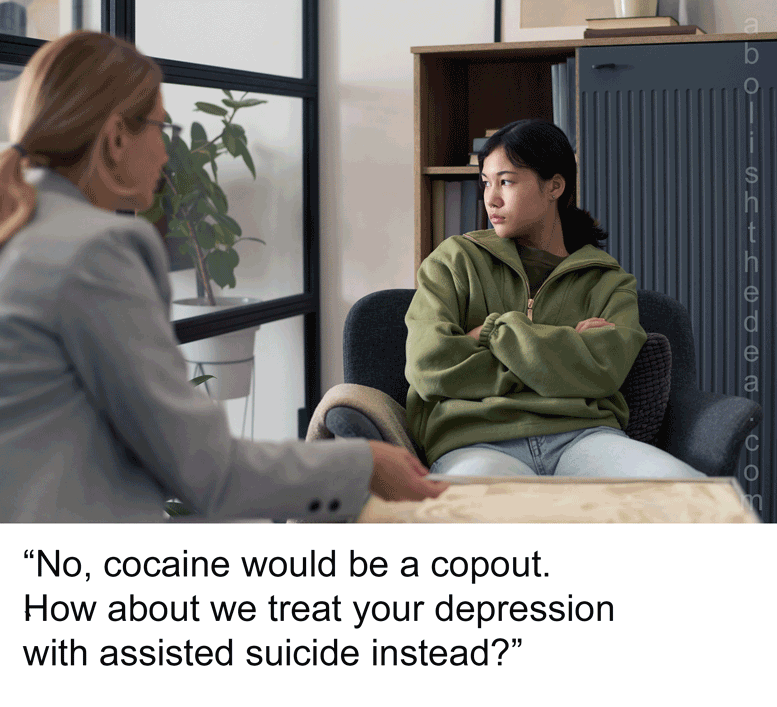
Our crazed attitude about drugs has now resulted in the ultimate absurd outcome, where psychiatrists are advocating assisted suicide for their patients without advocating for their right to use medicines that would cheer them up in a trice!
The author does not even mention the topic of drug prohibition, the deadly government policy which is keeping Claire depressed in the first place! What?!
As Redd Foxx used to say after hearing a shocking avowal: "Elizabeth, I'm comin' to join ya!"2
But then philosopher Whitehead warned us about this in the introduction to his lecture series on The Concept of Nature.
"The substantial reason for rejecting a philosophical theory is the 'absurdum' to which it reduces us." --Alfred North Whitehead, Concept of Nature3
If we can consider the collection of contradictory and ad-hoc presuppositions of the modern Drug Warrior to constitute a philosophy, then it is clearly a philosophy that we must reject, for it reduces us to a plethora of absurd outcomes when we take it seriously, and nowhere is this more obvious than in the case of Claire Brosseau. The Drug War "philosophy," or mindset, has now placed us in a world in which the government denies us the right to treat our own health while yet offering to kill us if that deprivation should make life unbearable for us. It has placed us in a world in which psychiatrists and lawyers will help us to exercise this wholly novel "right" to state-assisted suicide while yet refusing to fight for our far more obvious, time-honored and fundamental right to take care of our own health as we see fit!
We live in just such a world today. This is made clear by the fact that the subject of drug prohibition is never even mentioned by any of the pundits or reporters who write on the topic of assisted suicide. And so the policy of drug prohibition is impervious to criticism, for the simple reason that westerners do not acknowledge that drug prohibition even exists, apparently under the childishly naive assumption that it has no practical effects in the real world.
But then Stephanie Nolen and the psychiatrists whom she quotes are in good company when they pretend that drug prohibition has nothing to do with major social issues. It was drug prohibition which first brought brutal gunfire to America's inner cities, and yet the community groups which protest that violence refuse to mention that inconvenient truth.
Likewise with the organizations that claim to fight on behalf of the depressed. Such organizations never mention the fact that drug prohibition outlaws drugs that could cheer people up in a trice!4
Then there are the organizations dedicated to ending school shootings. These organizations never mention the fact that drug prohibition has outlawed the kind of drugs that could help hotheads to feel compassion for their fellow creatures and thereby prevent such needless massacres.
Then there are the organizations that claim to fight Alzheimer's and dementia, but which refuse to mention the fact that drug prohibition outlaws drugs that can sharply focus the mind, some of which can grow new neurons in the brain.
Then there are the organizations opposed to electroshock therapy. They never mention the fact that drug prohibition outlaws drugs that could make shock therapy unnecessary (assuming that it was ever truly necessary in the first place, of course).
Clearly, America's prime imperative is to hate on drugs -- and the solution of all social problems must be postponed or outlawed as necessary in order to keep that priority intact.
We need a scheduling system for psychoactive drugs as much as we need a scheduling system for sports activities: i.e. NOT AT ALL. Some sports are VERY dangerous, but we do not outlaw them because we know that there are benefits both to sports and to freedom in general.
Freud found that cocaine CURED most people's depression and he "got off it" without trouble.
When psychiatrists write about heroin, they characterize dependency as enslavement. When they write about antidepressants, they characterize dependency as a medical duty.
I've been told by many that I should have seen "my doctor" before withdrawing from Effexor. But, A) My doctor got me hooked on the junk in the first place, and, B) That doctor completely ignores the OBVIOUS benefits of indigenous meds and focuses only on theoretical downsides.
"The Legislature deliberately determines to distrust the very people who are legally responsible for the physical well-being of the nation, and puts them under the thumb of the police, as if they were potential criminals."
-- Aleister Crowley on drug laws
Americans heap hypocritical praise on Walt Whitman. What they don't realize is that many of us could be "Walt Whitman for a Day" with the wise use of psychoactive drugs. To the properly predisposed, morphine gives a DEEP appreciation of Mother Nature.
Assisted suicide cannot be discussed meaningfully without discussing the drug prohibition that renders it necessary in the first place.
Westerners have "just said no" to pain relief, mood elevation and religious insight.
It wasn't until western prudery and racism came along that we started to judge people by the substances that they chose to ingest, rather than by their actual behavior in the world.
Mad in America solicits personal stories about people trying to get off of antidepressants, but they will not publish your story if you want to use entheogenic medicines to help you. They're afraid their readers can't handle the truth.










 (up)
(up)