Here's an idea: let's start teaching kids the truth about drugs
by Ballard Quass, the Drug War Philosopher
September 8, 2025
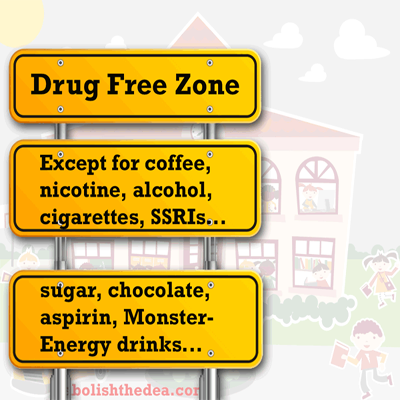
We need to be honest with kids about drugs. Imagine that! We need to stop pretending that drugs are somehow evil in and of themselves without regard for context of use. This is the "Fire bad!" mentality of caveman days and it is unbecoming of a purportedly free and scientifically oriented society. This is the know-nothing attitude that would have us demonize dangerous substances rather than to learn how to use them as wisely as possible for human benefit.
Of course, the main reason that we are not honest with kids about drugs is that we are not honest with ourselves about drugs. We as a society are playing a big game of make-believe in which we pretend that a vast pharmacopoeia of psychoactive drugs can have no beneficial uses whatsoever. It is an exercise in willful ignorance. We hold this view in spite of history, anecdote and common sense, all of which scream out that drug use has obvious psychological benefits. As a result, all our warnings to kids are discounted because young people see that we are giving them a "party line." They know that drugs can inspire and elate. They know that drugs can actually sharpen the mind. They know that drugs have inspired entire religions1. They know that drugs can be used wisely, even in a world in which Drug Warriors are doing everything they can to make drug use as dangerous as possible.
Instead of giving kids ideas about drug use by hauling out caches of hated drugs in an auditorium and demonizing the confiscated substances in real-time -- in a way reminiscent of those two-minute hate sessions in the book "1984," the dystopian novel by George Orwell -- we simply need to teach kids a couple of basic lessons:
1) That they should wait until they are adults to make their own decisions about which, if any, drugs make sense for them at any given time in their life -- including antidepressants 2, coffee, nicotine and alcohol.
2) That they should understand that the real enemy is unwanted dependency, not drugs in the abstract. Instead of creating boogiemen out of every new drug that comes along -- like ice, PCP 3, crack, Fentanyl, and oxy4 -- we need to drive the point home that daily use of such substances can cause dependency. This is not rocket science. It is a simple message that can actually be taught. People use potentially addictive drugs wisely all the time, but we are not allowed to hear about it5. And how do they use them wisely? It's very simple. They merely refrain from using any particular dependence-causing drug on a regular basis. They vary the routine such that they do not become dependent on any one substance6 -- which, of course, is another reason to end prohibition, for it makes it difficult to vary drug use because it limits drug choice to the few substances that a self-interested dealer is willing and able to provide.
All young kids need to know, however, is that they should be educated about drug use before they make drug-use decisions as adults and that safe and beneficial use is, indeed, possible.
Here's hoping you have a Drug-War Free Valentine's Day!
It is not surprising, however, that we do not teach kids to avoid drug dependency, because our entire drug policy actually encourages drug dependency. One in four American women take a Big Pharma med every day of their life -- and they are considered good patients for doing so. This mass pharmacological dystopia came about because we were told that the pills in question were made scientifically and so solved "real" problems. The scientists now tell us that these pills do not fix a chemical imbalance, in fact, they may actually cause one7. In 2022, Noam Shpancer admitted in Psychology Today that "We don't know how antidepressants work.8" To which I would add that, we don't know that they work at all, if by "work" we mean that they help one achieve self-actualization in life as opposed to merely keeping one from committing suicide, in which case a sharp blow on the head with a log would work just as well.
This is ironic, of course. America outlawed opium , partly on the grounds that it could cause unwanted dependencies. Then we went on to create a world in which chemical dependency is the accepted norm -- if only it is provided by a pharmaceutical company. This begs an enormous question: why is it wrong for me to smoke opium at home of an evening while I am considered a good patient for taking a Big Pharma drug every day of my life? Why do we not see that the outlawing of opium smoking in America led to the use of drugs that are far more potentially addictive in nature? At some level, kids recognize this hypocrisy and so all attempts to demonize drugs will fall on deaf ears.
As Thomas Szasz wrote:
"Drug education... is the name we give to the state-sponsored effort to inflame people's hatred and intolerance of other people's drug habits, which is as indecent as it would be to inflame people's hatred and intolerance of other people's religious habits and call it 'religion education.'" -- Our Right to Drugs
CONCLUSION
If we want to teach kids about drugs, we first have to teach ourselves as adults: We need to learn that substances are only good or bad in connection with how they are used: for what reason, at what dose, in which circumstances. We need to realize that it is anti-scientific tyranny to outlaw drugs for everybody merely because they could be misused by the young people whom we refuse to teach about safe use. In doing so, we throw all potential beneficiaries of such substances under the bus, while, of course, turning inner cities into a shooting gallery and destroying the rule of law in Latin America.
Of course, most readers have been shielded from reports of positive use for a lifetime. So I will end this essay with an illustrative hypothetical, to remind them that beneficial drug use is indeed possible. Imagine, then, if we actually allowed the suicidal to use the kinds of drugs that inspired the following user reports in the book "Pihkal" by Alexander Shulgin9.
"A glimpse of what true heaven is supposed to feel like... Next day, same sense of serene, quiet joy/beauty persisted for most of the day. A true healing potential."
"I was caught up with the imagery, and there was an overriding religious aspect to the day."
"This is total energy, and I am aware of my every membrane. This has been a marvelous experience, very beautiful, joyous, and sensuous."
"The euphoria grows in intensity for several hours and remains for the rest of the day making this one of the most enjoyable experiences I have ever had."
And these are the kinds of drugs that we are told have no positive uses for anybody, ever. No wonder our kids do not believe us when we lecture them about drugs. We are gaslighting them about drug effects10. Worse yet, we are withholding these godsend medicines from the depressed, thereby promoting suicide 11 and the completely unnecessary use of brain-damaging shock therapy!
To reiterate: adults need to grow up before they can hope to send kids a coherent message about drugs. Unfortunately, the big lesson of drug education is that unwanted dependency is the real drug problem -- and that is a message that adults will find hard to accept. Dependency is the name of the game for all legal mind and mood medicine in the 21st century! And let us not forget how this dependency came about: it came about thanks to drug prohibition, which gave self-interested Big Pharma 1213 a monopoly on mind and mood medicine -- a monopoly which they promptly used to turn 1 in 4 American women into lifetime customers by developing drugs that are harder to kick than heroin1415.
I speak from experience. Someday the Effexor 16 that I am on will surely be recognized as the hardest drug to kick in the world. Nor was I ever told that the drug would turn me into an eternal patient. When this fact became clear, the psychiatrist flipped the script and told me that I had a medical duty to take the drug for a lifetime. This is a drug that is harder to kick than opium . In "Opium for the Masses," Jim Hogshire explains that the physical aspect of an unwanted opium 17 dependency can be overcome in one week, and relatively painlessly at that, with the help of various chemicals. The biochemical downsides of Effexor withdrawal, on the other hand, can last for years -- and it is unclear if they will ever disappear. My own psychiatrist told me that Effexor has a 95% recidivism rate 18 for long-term users who attempt to kick the drug.
And yet even Effexor is not the real villain of this piece. Getting off Effexor is only a nightmare because of drug prohibition. If we re-legalized psychoactive medicine, there are plenty of drugs (like the ones mentioned in the above quotations) that could get me through the withdrawal process by helping me to obfuscate and transcend the downsides of that process. This is psychological common sense. Unfortunately, our Drug Warriors are committed to gaslighting 19 Americans about such obvious drug benefits, and this is a habit that they will have to overcome if they wish to become credible teachers on such topics.
We might as well fight for justice for Christopher Reeves: he was killed because someone was peddling that junk that we call horses. The question is: who sold Christopher that horse?! Who encouraged him to ride it?!
The U.S. government created violence out of whole cloth in America's inner cities with drug prohibition -- and now it is using that violence as an excuse to kick the people that they themselves have knocked down.
This hysterical reaction to rare negative events actually creates more rare negative events. This is why the DEA publicizes "drug problems," because by making them well known, they make the problems more prevalent and can thereby justify their huge budget.
These are just simple psychological truths that drug war ideology is designed to hide from sight. Doctors tell us that "drugs" are only useful when created by Big Pharma, chosen by doctors, and authorized by folks who have spent thousands on medical school. (Lies, lies, lies.)
I don't believe in the materialist paradigm upon which SSRIs were created, according to which humans are interchangeable chemical robots amenable to the same treatment for human sadness. Let me use laughing gas and MDMA and coca and let the materialists use SSRIs.
The search for SSRIs has always been based on a flawed materialist premise that human consciousness is nothing but a mix of brain chemicals and so depression can be treated medically like any other physical condition.
Antidepressants might be fine in a world where drugs were legal. Then it would actually be possible to get off them by using drugs that have inspired entire religions. In the age of prohibition, however, an antidepressant prescription is usually a life sentence.
The term "drugs" is no more objective than the term "scabs." Both are meant to defame the things that they connote.
The Drug Warriors say: "Don't tread on me! (That said, please continue to tell me what plants I can use, how much pain relief I can get, and whether my religion is true or not.)"
Wade Davis wrote in Rolling Stone that cocaine was outlawed because 400 people consumed toxic doses worldwide. SO WHAT?! 178,000 people die from alcohol every year in America alone.









 We need to be honest with kids about drugs. Imagine that! We need to stop pretending that drugs are somehow evil in and of themselves without regard for context of use. This is the "Fire bad!" mentality of caveman days and it is unbecoming of a purportedly free and scientifically oriented society. This is the know-nothing attitude that would have us demonize dangerous substances rather than to learn how to use them as wisely as possible for human benefit.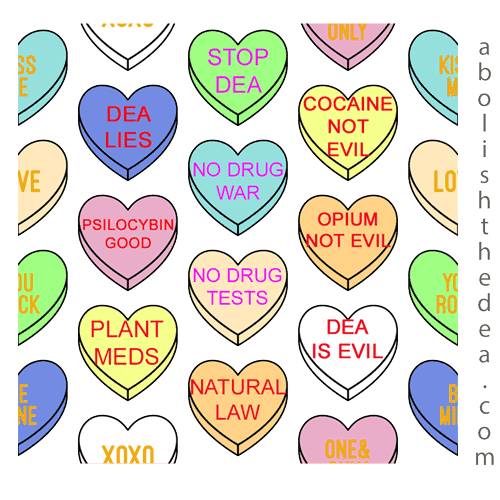

 (up)
(up)