Pity the time traveler who arrives from the 1600s, bristling with a new idea for a science-fiction story:
Time-Traveler: "Hey, I've got this cool idea for a story in which some future despotic government goes out and burns plants to keep the populace from using those substances to improve their minds! I'm gonna call it 'Fahrenheit 452!'"
Me: "Sorry, dude, but that's not science-fiction."
Time-Traveler: "What? Maybe you don't hear so good. I said it's a story about government going out and getting rid of therapeutic plants!"
Me: "Right, and that's exactly what our government does today!"
Time-Traveler: "You're kidding me? I thought I traveled forward in this time machine, not backwards."
Me: "Hey, where are you going?"
Time-Traveler: "Back to my ship -- I'm gonna visit the Earth 200 years from now and see if they've finally got it right."
Americans are childish about drugs. We blame our problems on inanimate objects and burn other countries' plants so that we can feel safe at home. We need to grow up and learn to use nature's bounty wisely for human benefit.
Discussion Questions for Students
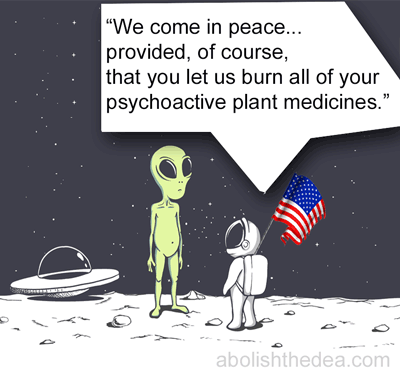
1) What is the satirical message of this short drama?
2) What does it tell us about the mentality behind drug prohibition and the War on Drugs?
3) Imagine you traveled forward in time to a world in which horses were outlawed because politicians focused only on the downsides of horseback riding -- like the fact that equestrian sports are the number-one cause of traumatic brain injury in the sporting world. How would you go about trying to convince the horse prohibitionists that they were being silly? Could you succeed, given that everybody in that future society had been taught from childhood to say no to horses? Let's assume that their media had kept them from seeing, reading, or hearing any depictions of beneficial "horse use" as well.
For Further Study
The Drug War Philosopher occasionally illustrates the incoherence of Drug War ideology with the help of science-fiction. See, for instance, his philosophical send-up of the 2022 movie Moonfall, in which he takes a young alien to task for his naive faith in the ability of his humanoid species to 'get along' without the help of some serious empathogens (given the hate-filled propensities of that species' nearest biological cousins, that is, videlicet Earthlings).
What do you think makes science-fiction such a purebred stalking horse for drug-law reformers when it comes to snapping the suspenders off of the cocky challengers on the Prohibitionist side of the jousting field? Hint: when science-fiction authors are not evoking a Mad Max dystopia, they are generally promoting the idea (as 'twere by implication) that technology brings happiness, than which nothing could be more silly, of course, with the possible exception of the idea of the modern drug researchers that laughing gas could not help the depressed. In other words, the DWP would fain task the science-fiction author with psychological naivete. "I mean, come on!" he would essentially say, "Let's be REAL, people!"
Ten Tweets
against the hateful war on US
There are definitely good scientists out there. Unfortunately, they are either limited by their materialist orthodoxy into showing only specific microscopic evidence or they abandon materialism for the nonce and talk the common psychological sense that we all understand.
Many psychonauts (like Terence McKenna) praise psychedelics while demonizing other psychoactive substances. No substance is bad in itself. All substances have some use at some dose for some reason for some people in some circumstance.
"Can I use poppies, coca, laughing gas, MDMA?" "NO," says the materialist, "We must be SCIENTIFIC! We must fry your brain and give you a lobotomy and make you a patient for life with the psychiatric pill mill! That's true SCIENCE!"
I just can't believe... [image]
Even prohibition haters have their own list of drugs that they feel should be outlawed. They're missing the point. We should not drugs "up or down" any more than we should judge penicillin or aspirin in that way.
The Partnership for a Death Free America is launching a campaign to celebrate the 50th year of Richard Nixon's War on Drugs. We need to give credit where credit's due for the mass arrest of minorities, the inner city gun violence and the civil wars that it's generated overseas.
If there were no other problem with antidepressants, they would be wrong for the simple reason that they make a user dependent for life -- not as a bug (as in drugs like opium) but rather as a feature: that's how they "work," by being administered daily for a lifetime.
Drugs that sharpen the mind should be thoroughly investigated for their potential to help dementia victims. Instead, we prefer to demonize these drugs as useless. That's anti-scientific and anti-patient.
Drug prohibition is superstitious idiocy.
It is based on the following crazy idea:
that a substance that can be misused by a white young person at one dose for one reason must not be used by anybody at any dose for any reason.
Health is not a quality, it's a balance. To decide drug legality based on 'health' grounds thus opens a Pandora's box of different points of view.









 1) What is the satirical message of this short drama?

 (up)
(up)