There's 'No Escape' from the downsides of drug prohibition
A philosophical review of the 2015 action thriller starring Owen Wilson and Pierce Brosnan
by Brian Ballard Quass, the Drug War Philosopher
December 11, 2025
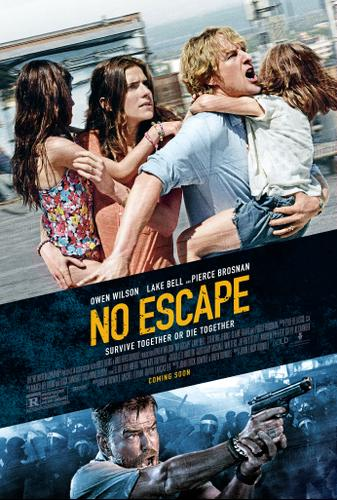
In the 2015 action thriller "No Escape," Owen Wilson stars as Jack, an American expat whose family is threatened by the sudden unleashing of rabid anti-western sentiment in some fictitious Arab country. After having improbably escaped with his wife and two young daughters from two high-rises, both of them surrounded by an angry mob, the middle-aged engineer receives some last-minute help from a scruffy and enigmatic British "tourist" named Hammond, played by Pierce Brosnan.
In the 2015 movie 'No Escape', the safest place in the city was the opium den, where people were not interested in murdering Americans wholesale. Opium smoker also do not beat their wives, as do beer drinkers.
But I will leave the movie review to the professional critics, the vast majority of whom never complain about cinematic drug bashing nor the violation of Constitutional norms in the name of fighting against the politically created boogieman called "drugs."1 I am just a philosopher who wishes to make a point about America's counterproductive attitude about drugs by asking a simple question about the movie "No Escape," to wit:
QUESTION: Where does Hammond take the family in order to ensure their safety?
ANSWER: To an opium den, of course!!
>>>firebad<<
But of course there was method to Hammond's madness. Hammond hadn't lived amongst the hoi polloi here for nothing. He understood that opium smokers did not go out and search for victims to line up on the road in order to run them down with a truck. No, nightly opium smokers were generally content with living their own lives, thank you very much. They had no great burning desire to fire a machine-gun from a helicopter at a rooftop full of scurrying American tourists, children included. An opium den was indeed the safest place in the bullet-riddled town.
How ironic! The plot of this movie basically happened in real life back in 1979 during the Iran Hostage Crisis. There was a rabid upswelling of anti-American sentiment in Tehran at that time as well. And guess who outlawed opium in Iran, the opium whose use could have moderated the screaming ferocity of those young men who paraded in front of the cameras while burning American flags? Opium was outlawed -- need I say -- by the hated Shah of Iran at the "request" of the United States of America!
And so brainwashed Americans ask, "Why are these people so hateful in their protests?" It is precisely because Americans prefer hatred to drug use. It is as simple as that.
The locals were responding to what they perceived as interference in their lives from America. Little did they realize that the greatest American interference of all was our decision on their behalf to outlaw their time-honored use of opium, thereby denying them a godsend medicine whose use could moderate their rage and turn it down more constructive pathways. There can be no greater interference in a person's life than for someone else to tell them how they are allowed to FEEL about their world!
And so, as so often happens in world affairs, Americans were hoisted by their own petard thanks to their childish, ahistorical and superstitious attitude toward time-honored substances.
AFTERTHOUGHT
I must remind the reader here that the Summers of Love on both sides of the Atlantic were outlawed by drug prohibitionists. They saw nothing good about peace, love and understanding. 23 All they saw were people using evil drugs -- LSD on this side of the Atlantic in the 1960s and Ecstasy on the British side in the 1990s 45. They hated drugs just like the cave people hated fire: they wanted to fear dangerous substances rather than to learn how to use them wisely for the benefit of human beings.
The fact is, Americans are so bamboozled by a lifetime of drug-bashing that they actually prefer gunfire, violence and the destruction of civil liberties over the use of time-honored medicines like opium!
And yet even the most open-minded Americans have been brainwashed into calling opium a "hard drug." Of course it's hard. It's hard because it works -- just like cocaine -- and that means the medical establishment is terrified of it! The medical industry would be downsized by 50% if opium and cocaine were re-legalized, and the industry will fight that common-sense desiderata with every penny in their well-funded healthcare advocacy campaigns on corporate-owned media. And yet it's not just opium and cocaine6 we're talking about here: all dangerous substances -- like fire and Botox -- can be used wisely, notwithstanding the slanderous defeatism of the Drug Warriors, who would have Americans remain children for life when it comes to drugs. That's why I have to see a doctor every three months of my life for a refill of a drug that I have been taking for 40 long years: because I STILL cannot be trusted to use the drug wisely without medical oversight7!
But that is drug prohibition for you: it is an exercise in infantilization. It brings about the complete disempowerment of Americans when it comes to taking care of their own health as they see fit, which, believe it or not, was historically considered the most basic of human rights! Thomas Jefferson knew, moreover, that we had a natural right to the plants and fungi that grow at our very feet.
"The earth, and all that is therein, is given to men for the support and comfort of their being.8"
These are the words of Jefferson's "go-to" man on the subject of natural law, John Locke, in his Second Treatise of Government.
And so drug prohibition is a crime twice over: first, it denies us our natural right to heal, and it denies us our natural right to the bounty of Mother Nature.
Drug prohibition is thus nothing less than a crime against humanity.
This is the "Oprah fallacy," which has led to so much suffering. She told women they were fools if they accepted a drink from a man. That's crazy. If we are terrified by such a statistically improbable event, we should be absolutely horrified by horses and skateboards.
If there were no other problem with antidepressants, they would be wrong for the simple reason that they make a user dependent for life -- not as a bug (as in drugs like opium) but rather as a feature: that's how they "work," by being administered daily for a lifetime.
Getting off antidepressants can make things worse for only one reason: because we have outlawed all the drugs that could help with the transition. Right now, getting off any drug basically means becoming a drug-free Christian Scientist. No wonder withdrawal is hard.
Drug Warriors should be legally banned from watching or reading Sherlock Holmes stories, since in their world, it is a crime for such people as Sherlock Holmes to exist, i.e., people who use medicines to improve their mind and mood.
Here is a typical user report about a drug that the DEA tells us has no positive uses whatsoever:
"There is a profoundness of meaning inherent in anything that moves." (reported in "Pikhal" by Alexander Shulgin)
"Judging" psychoactive drugs is hard. Dosage counts. Expectations count. Setting counts. In Harvey Rosenfeld's book about the Spanish-American War, a volunteer wrote of his visit to an "opium den": "I took about four puffs and that was enough. All of us were sick for a week."
Someone should stand outside Jefferson's estate and hand out leaflets describing the DEA's 1987 raid on Monticello to confiscate poppy plants. That raid was against everything Jefferson stood for. The TJ Foundation DISHONORED JEFFERSON and their visitors should know that!
I'm told antidepressant withdrawal is fine because it doesn't cause cravings. Why is it better to feel like hell than to have a craving? In any case, cravings are caused by prohibition. A sane world could also end cravings with the help of other drugs.
If Fentanyl kills, then alcohol slaughters. Drug prohibition is the real killer.
This pretend concern for the safety of young drug users is bizarre in a country that does not even criminalize bump stocks for automatic weapons.










 (up)
(up)