








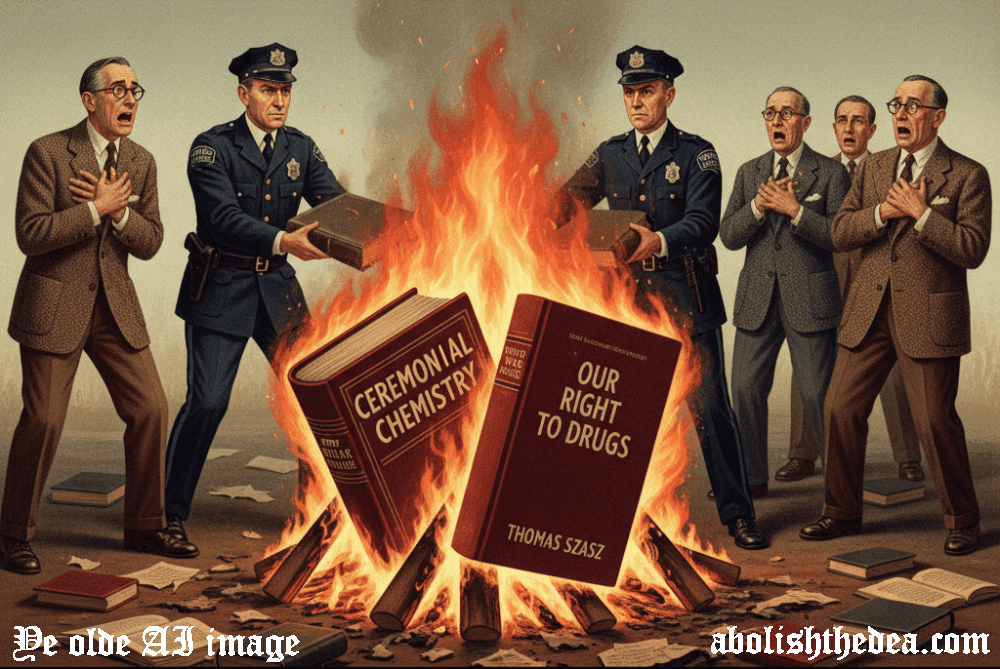
 The depressing thing about reading Thomas Szasz1 today is that it makes me think as follows: If such an intelligent man can so clearly present the facts of the case and not succeed in changing mainstream minds, what chance do I have as a relative dimwit, a thoroughly "unconnected" dimwit at that? For I am sorry to say that the situation since Szasz's time has gotten worse when it comes to America's drug attitudes, not better. This is obvious given the bizarre reaction of pundits of all stripes to the case of Claire Brosseau, the depressed Canadian who is fighting for her right to assisted suicide.2 Had Szasz been around today, he would surely be pointing out the fact that Claire's morbid activism must be seen in light of drug prohibition, which outlaws all the drugs that could cheer Claire up in a trice! The state first outlaws Claire's right to heal, and now Claire demands that the same state help her to die BECAUSE of the depression that the state thus brought about! Claire should be fighting to end drug prohibition which outlaws her right to heal, not arguing for a new recherché right to have the state help her to die!
 Prohibitionists are responsible for the 200,000-plus killed in the US-inspired Mexican drug war in the 21st century.
I thought mycology clubs across the US would be protesting drug laws that make mushroom collecting illegal for psychoactive species. But in reality, almost no club even mentions such species. No wonder prohibition is going strong.
We need a Controlled Prohibitionists Act, to get psychiatric help for those who think that prohibition makes sense despite its appalling record of causing civil wars overseas and devastating inner cities.
Oregon's drug policy is incoherent and cruel. The rich and healthy spend $4,000 a week on psilocybin. The poor and chemically dependent are thrown in jail, unless they're on SSRIs, in which case they're congratulated for "taking their meds."
The outlawing of coca and opium is a crime against humanity.
If I want to use the kind of drugs that have inspired entire religions, fight depression, or follow up on the research of William James into altered states, I should not have to live in fear of the DEA crashing down my door and shouting: "GO! GO! GO!"
DEA Stormtroopers should be held responsible for destroying American Democracy. Abolish the American Gestapo.
Today's doctors are "quacks" because they fail to see any of the many obvious uses for psychoactive substances.
Now drug warriors have nitrous oxide in their sights, the substance that inspired the philosophy of William James. They're using the same tired MO: focusing exclusively on potential downsides and never mentioning the benefits of use, and/or denying that any exist.
Whether we judge people only by the words that they say or only by the substances of which they partake, we are ignoring the most important things: what they really mean and how they really behave.
Prohibitionists are responsible for the 200,000-plus killed in the US-inspired Mexican drug war in the 21st century.
I thought mycology clubs across the US would be protesting drug laws that make mushroom collecting illegal for psychoactive species. But in reality, almost no club even mentions such species. No wonder prohibition is going strong.
We need a Controlled Prohibitionists Act, to get psychiatric help for those who think that prohibition makes sense despite its appalling record of causing civil wars overseas and devastating inner cities.
Oregon's drug policy is incoherent and cruel. The rich and healthy spend $4,000 a week on psilocybin. The poor and chemically dependent are thrown in jail, unless they're on SSRIs, in which case they're congratulated for "taking their meds."
The outlawing of coca and opium is a crime against humanity.
If I want to use the kind of drugs that have inspired entire religions, fight depression, or follow up on the research of William James into altered states, I should not have to live in fear of the DEA crashing down my door and shouting: "GO! GO! GO!"
DEA Stormtroopers should be held responsible for destroying American Democracy. Abolish the American Gestapo.
Today's doctors are "quacks" because they fail to see any of the many obvious uses for psychoactive substances.
Now drug warriors have nitrous oxide in their sights, the substance that inspired the philosophy of William James. They're using the same tired MO: focusing exclusively on potential downsides and never mentioning the benefits of use, and/or denying that any exist.
Whether we judge people only by the words that they say or only by the substances of which they partake, we are ignoring the most important things: what they really mean and how they really behave.


 (up)
(up)