




on behalf of millions of unacknowledged victims of the War on Drugs
by Brian Ballard Quass, the Drug War Philosopher
March 28, 2026
Dear Mr. Sullum,
I am a 67-year-old chronic depressive* who has been turned into a ward of the healthcare state by drug prohibition. Instead of being able to make common-sense, strategic and intermittent use of substances like laughing gas and cocaine, I was shunted off in my late teens onto Big Pharma drugs which turned out to be far harder to kick than heroin 1. This has turned me into a patient for life, with all of the humiliating, time-consuming and expensive baggage that comes with such a designation. I have to sail into Healthcare Harbor every three months of my life, like a modern Ancient Mariner, to tell my life story to complete strangers, all for the privilege of being allowed to purchase yet another supply of an expensive, under-performing, and highly dependence-causing "med." Before every such session, I am asked a litany of humiliating questions, including : "Have you considered suicide since our last visit?" – to which I always want to respond: "Only when I consider how drug prohibition has turned me into a ward of the healthcare state."
This backstory, combined with my passion for philosophy, caused me to resolve eight years ago now to spend the remainder of my life writing essays against drug prohibition from the point of view of a med-dependent American. I naively thought at first that all I had to do was to point out my seemingly blatant disempowerment in order to get the interested parties in the drug prohibition debate to sit up and take notice. I thought I could make it clear to them that the depressed are stakeholders in this debate, and that drug prohibition is nothing less than the outlawing of our right to heal. Instead, I have been ignored by literally everyone to whom I have written on this topic. Everyone. I feel like the child who has discovered that the emperor is wearing no clothes and who is now being shooed away by the adults who refuse to acknowledge that fact. I am writing to you today because I believe that you may be an exception to this rule, that you, at least, might understand what I am saying here, especially since you have no self-interested reason for refusing to do so, unlike members of the healthcare industry, for instance.
I draw that conclusion after reading statements like the following in your insightful book entitled Saying Yes:
One man's acid trip is another's spiritual awakening.
If an unhappy person takes heroin, he is committing a crime. If he takes Prozac, he is treating his depression."
Reformers will not make much progress as long as they agree with defenders of the status quo that drug use is always wrong."
You also conclude that "the stereotypes that drive the War on Drugs will be impossible to sustain" once people begin to speak out, which brings me to my main reason for writing to you today. I have a specific idea that I would like to "run by you," one that could give a voice to the millions of med-dependent Americans like myself, so that we can make it clear to the public that drug prohibition has not only outlawed our right to heal, but that, ironically, it has turned us into drug users for life. Julie Holland writes that 1 in 8 Americans (and 1 in 4 American women) are dependent on the daily use of Big Pharma drugs like SSRIs. By connecting the dots between drug prohibition and this wholesale disempowerment of the depressed with respect to their health care, we could deprive Drug Warriors of one of their biggest implicit arguments: namely, that the only stakeholders in the debate over drug prohibition are the white American young people whom we refuse "on principle" to educate about safe use. No longer would op-ed authors in the New York Times be able to state and/or imply, as they always seem to do, that drug prohibition is a victimless crime.
If you're interested in reading my specific idea for giving a voice to med-dependent Americans like myself, thereby hastening the end of drug prohibition, please let me know and I will follow up promptly with the details. I would love to get your thoughts on my plan. If not, so be it. It certainly would not be the first time that I have written to no avail on this subject. On the bright side, none of my would-be correspondents have as yet had the nerve to respond to my emails by telling me that I should just "shut up and take my meds."
Joking aside, you have my sincere thanks for reading thus far.
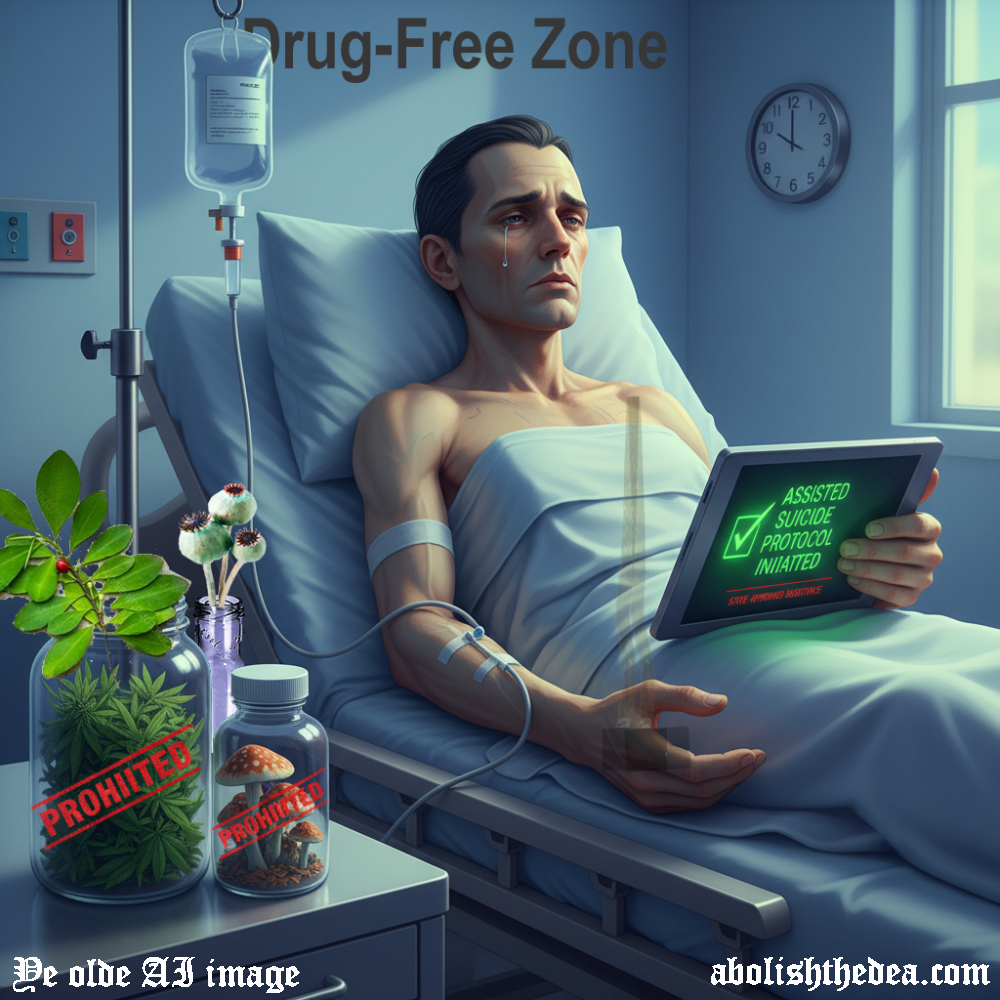
PS I feel that this idea of mine is more important than ever in light of the recent news stories about assisted suicide. Westerners are now so convinced that drugs have no benefits for them that depressed people like Canadian Claire Brosseau are demanding their right to die. They want the state to help to kill them: the same state that forbids them from using drugs that could cheer them up in a trice! Worse yet, the New York Times covered the story without any reference to drug prohibition. I have since written to Claire Brosseau, her psychiatrists, and to the healthcare reporter who covered her story in an attempt to convince them that assisted suicide (especially for the depressed) cannot be discussed meaningfully without also discussing drug prohibition, which outlaws substances whose informed and strategic use could make certain ailments quite livable for certain people. I say this not based on medical studies but based on psychological common sense, something that seems to be in short supply in the reductionist medical establishment of our times. So far, of course, I have received no responses to those emails.
*I use the term "chronic depressive" as a description of my general personality and not in the sense of a discrete illness as listed in the disease-mongering DSM.
I'm told antidepressant withdrawal is fine because it doesn't cause cravings. Why is it better to feel like hell than to have a craving? In any case, cravings are caused by prohibition. A sane world could also end cravings with the help of other drugs.
The Partnership for a Drug Free America should be put on trial for having blatantly lied to Americans in the 1980s about drugs, while using our taxpayer money to do so!
Only a pathological puritan would say that there's no place in the world for substances that lift your mood, give you endurance, and make you get along with your fellow human being. Drugs may not be everything, but it's masochistic madness to claim that they are nothing at all.
NIDA is just a propaganda arm of the U.S. government -- and will remain so until it recognizes the glaringly obvious benefits of drugs -- as well as the glaringly obvious downsides of prohibition. We need a National Institute on Drug Use, not a National Institute on Drug Abuse.
In the Atomic Age Declassified, they tell us that we needed hundreds of thermonuclear tests so that scientists could understand the effects. That's science gone mad. Just like today's scientists who need more tests before they can say that laughing gas will help the depressed. Science today is all about ignoring the obvious.
When folks banned opium, they did not just ban a drug: they banned the philosophical and artistic insights that the drug has been known to inspire in writers like Poe, Lovecraft and De Quincey.
The government makes psychoactive drug approval as slow as possible by insisting that drugs be studied in relation to one single board-certified "illness." But the main benefits of such drugs are holistic in nature. Science should butt out if it can't recognize that fact.
So much harm could be reduced by shunting people off onto safer alternative drugs -- but they're all outlawed! Reducing harm should ultimately mean ending this prohibition that denies us endless godsends, like the phenethylamines of Alexander Shulgin.
Pundits have been sniffing about the "smell" of Detroit lately. Sounds racist -- especially since such comments tend to come from drug warriors, the guys who ruined Detroit in the first place (you know, with drug laws that incentivized profit-seeking violence as a means of escaping poverty).
If I smoke opium nightly, I am a drug scumbag. If I use Big Pharma "meds" every day of my life, I am a good patient.