how drug prohibition rendered 1 in 8 Americans chemically dependent for life
by Brian Ballard Quass, the Drug War Philosopher
October 16, 2025
In the introduction to his exhaustive commentary on The Critique of Pure Reason1, Norman Kemp Smith warns his readers that Kant's definitive viewpoints can only be understood by considering his work as a whole, and that the reader should therefore resist the temptation to consider any of his statements out of context. I feel compelled to extend a similar warning to my readers about my philosophy of drugs. I always do my best to imagine all possible objections to my philosophical positions and to answer them "on the fly," so to speak, in my essays, but I hope that any serious reader will consider my work as a whole before erecting straw men in their mind based on my failure to answer any given potential objection in any given essay. There are so many caveats, explanations, and qualifications that are called for in order for a philosophical maverick to render himself intelligible to a readership that has been indoctrinated in contrary viewpoints since their childhood. One cannot be expected to address them all in every single essay.
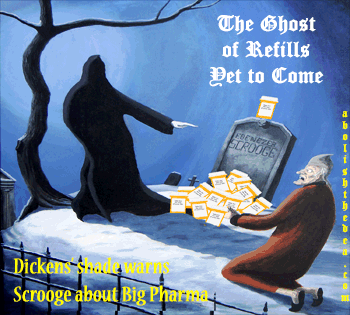
Drug prohibition turns depressed Americans into demoralized wards of the healthcare state by shunting them off onto dependence-causing meds.
But then this is the kind of problem that one must expect when recommending the adoption of a whole new way of looking at the world: one has to anticipate the seemingly endless ways in which they will be misunderstood.
As philosopher Alfred North Whitehead observed:
"In the presentation of a novel outlook with wide ramifications, a single line of communications from premises to conclusions is not sufficient for intelligibility. Your audience will construe whatever you say into conformity with their pre-existing outlook." --Alfred North Whitehead, The Concept of Nature2
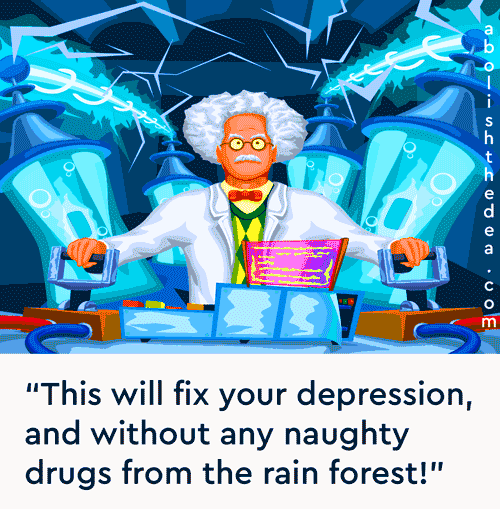
Drug prohibition literally fries the brain. The FDA encourages brain-damaging shock therapy for the severely depressed while our government refuses to let us use godsend medicines that could cheer us up in a trice, and without brain damage!
This is especially true when it comes to discussing the surprisingly fraught topic of antidepressants and drugs. The "pre-existing outlooks" in this case are often passionate ones, indeed, considering that many of my readers are taking antidepressants every day of their life. Such readers will have a tendency to mistake my insights on this subject for a reproach, as will the psychiatrists who prescribe such drugs. And so their critical thinking skills may be compromised on this topic. They might suppose me to be saying any number of things that I have never actually said. They might assume, for instance, that I am against the use of antidepressants. This, of course, is true in a sense, but only when qualified by a variety of crucial caveats. In discussing such questions, we must always take into account the maxim of Montesquieu that "Le mieux est le mortel ennemi du bien," i.e, that "the best is the enemy of the good." In an ideal world, such drugs would be avoided whenever possible (at least for the treatment of depression) insofar as they foster an extreme form of chemical dependence that turns the depressed user into a Big Pharma patient for life. But that does not mean that current users of those drugs should change their usage pattern, let alone cease their use altogether -- at least not right now, not in the world as we know it today under drug prohibition, wherein antidepressants are the only game in town*.
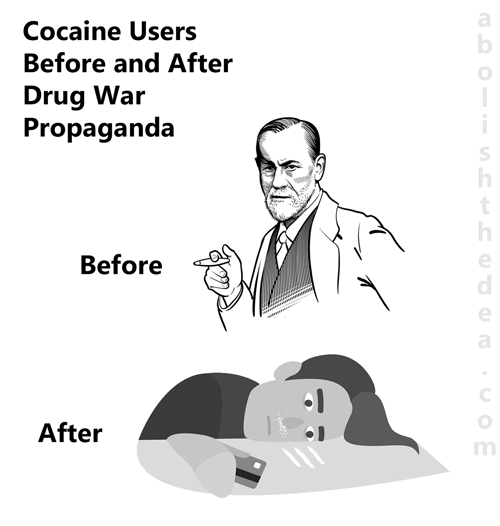
Nor have I ever claimed that Big Pharma antidepressants have no positive effects. I definitely get depression relief from Effexor 3 . The problem is that it has come at the expense of my personal freedom and empowerment. The drug turns out to be literally impossible to "kick" and has therefore turned me into a ward of the healthcare state. (For more on the impossibility of "kicking" Effexor, see my essay entitled "Meds Fry the Brain, not Drugs".4) Moreover, the relief that I receive from the drug is not a "cure" for my depression as I would define that term. I want to live large, not simply to survive. Sigmund Freud knew a REAL cure for depression when he saw it; that's why he insisted on the real politik of cocaine . "My impression," wrote Freud, "has been that the use of cocaine 5 over a long time can bring about lasting improvement." Unfortunately, doctors saw such a panacea as a threat to their business models and so they ignored all benefits of cocaine use. They focused instead with hypocritical indignation on the rare cases of misuse, exactly as if they were to judge alcohol by looking only at alcoholics. They thereby destroyed the reputation of a drug for which dependency is a mere bug, thereby shunting the depressed off onto "meds" for which dependency is an actual feature!
The U.S. FDA approves of drugs whose published side effects include death itself, yet they will not approve of substances that grow at our very feet and which have been considered divine by other cultures!
This has always puzzled me, by the way. We always read about the horrors of being dependent on a drug -- and yet the result of prohibition was to make me dependent on a drug for life! Wasn't that what the whole Drug War was supposed to be about: to keep us from becoming dependent on drugs???
I have heard some doctors defend this status quo by claiming that Effexor does not cause cravings. To which I respond: so what? I may not have had cravings when I attempted to get off of Effexor, but I felt like hell on earth. How exactly is that an improvement over having cravings? I guess it's an improvement because I was not motivated to interrupt the doctor's weekend golf game to pester him for relief! Cocaine does not cause cravings either, except in those statistically rare cases that self-interested doctors are forever fretting about, typically in op-ed pieces wherein they fail to recognize their own vested interest in the continued outlawing of the drug. Sigmund Freud reported that his own use of cocaine was self-limiting, that he developed a seemingly drug-inspired aversion to excessive use. Nor did he have any problems stopping the drug after it had helped him through three of the most productive years of his life6. We would not have heard of Freud today had cocaine not inspired him to transcend his tendency for procrastination and so to publish prolifically.
Had I been taught to use such motivating drugs wisely as a youth, I would have had a fair shot at self-actualization in life. In conjunction perhaps with counseling, such drugs would have helped me to silence the inner voices of self-doubt and masochism and thereby develop virtuous circles of successful behavior in my chosen vocation. I needed real help back then on a timely basis -- not merely a drug that would keep me from committing suicide. And yet modern psychologists do not recognize the existence of such virtuous circles, partly because they are behaviorists obsessed with quantitative data only and partly because they refuse to contradict Drug War orthodoxy according to which drugs must be thought to have no beneficial uses whatsoever. Even had I become one of the statistically rare users who became dependent on such drugs, I would have had the opportunity of "kicking" them later in my life after they had done their job of turning success into a habit for me. Instead, I was shunted off onto a drug that it is literally impossible to kick, ever!!! and whose antidepressant effects pale in comparison to those of the motivating drugs of which I speak.
It's worth noting how drug law plays an insidious role even here! Drug prohibition helps ensure that these drugs are impossible to kick. It is common sense that outlawed drugs could be used strategically to help a user obfuscate and transcend the extreme psychological (and biochemical) downsides of antidepressant withdrawal, rendering that feat actually possible for normal mortals! So we see once again, that the problem is not drugs themselves (or in this case "meds," if you insist), but the social policies that render drugs harmful! So opining on the goodness or badness of drugs like Effexor is beside the point. The real issue is how drug prohibition makes sane drug use impossible.
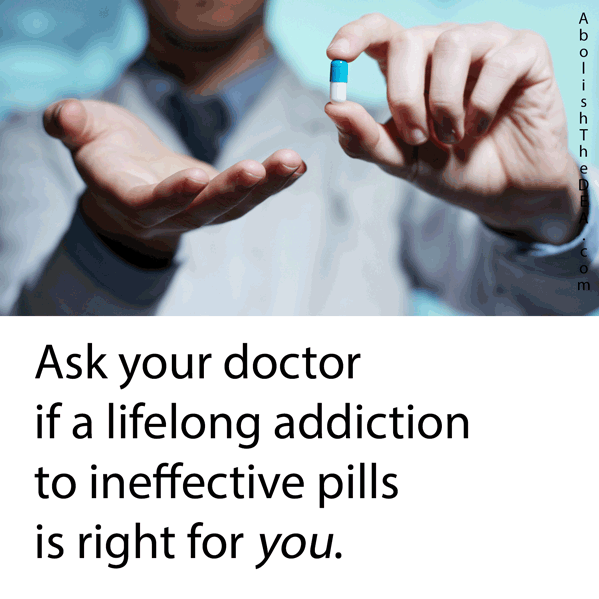
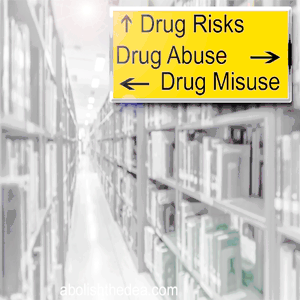
I hope that this essay has helped to clarify my basic stand on Big Pharma antidepressants: namely, that such drugs are not the problem in and of themselves. That is the Drug Warrior's fallacy, to believe that drugs are a problem rather than the social policies that render their use problematic. The real problem is drug prohibition, which turns those drugs into "the only game in town" when it comes to treating depression.
It's little wonder that my essays on this topic are subject to misunderstanding, by the way. Almost all people who discuss antidepressants do so while ignoring the very existence of drug prohibition, thereby rendering everything they say equivocal and problematic. But, of course, they are in good company. Most authors today reckon without drug prohibition8. And so they pronounce ex cathedra on subjects like human consciousness and depression, while completely ignoring the very existence of drugs whose emotional, mental and spiritual effects would cast their topics of choice in a whole new light!
FOOTNOTES AND AFTERWORD
*I have never suggested otherwise, and yet critics in the psychiatric field are trying to shut down free speech on this topic by suggesting that merely discussing these matters openly is to encourage antidepressant users to go cold turkey.
And so the circle is completed. Sixty years ago, it was considered evil to say anything positive about drugs. Today, it is considered equally evil to say anything negative about meds!
Of course, one reason that psychiatrists do not want their patients to get off their meds is because they know it will be nearly impossible for them to do so successfully -- and they fear that someday someone's going to start asking inconvenient questions about that very fact, questions such as: "Why did you ever put them on a drug that is so impossible -- and hellish -- to kick in the first place?!!!"
The answer to that question -- as I have tried to make clear above -- is that drug prohibition turned Big Pharma 910 antidepressants into the only game in town for the depressed! For this and countless other reasons... drug prohibition is the problem 11 , not drugs!
One final proviso about the propriety of antidepressants, and of Effexor in particular:
Although no drug is bad in and of itself, it does not follow that any particular drug will necessarily have sensible uses for human beings. The extreme angst and mental confusion attendant upon Effexor withdrawal raises serious questions about the drug's effect on brain chemistry. It also raises concerns about the brain's seemingly limited ability to return to normal after cessation of use. Unfortunately, these concerns can scarcely even be raised in a society in which money drives the public narrative on such topics. This is a criticism, not just about American drug policy but about America itself, which is another of the endless reasons why the Drug War is nothing less than the great philosophical problem of our time.
Author's Follow-up:
October 17, 2025
I'm sure there are some hale and hearty people out there who lose patience with talk about depression, wondering why "those people don't just lift themselves up by their bootstraps." Well, I have found over a full lifetime now that depression may be best defined as the inability to do precisely that. Depression is insidious in this way, it is a kind of stealth condition (condition, mind, as opposed to an illness like the measles). The fact that one is depressed can only be fully appreciated by looking in the rear view mirror, preferably during a rare moment when one's mood has been dramatically elevated, typically with the help of a drug that REALLY works. Then and only then can one clearly see all the opportunities that one has let slip away because of their depressive tendencies. The effect of these tendences is far too subtle to be noticed in real-time but their devastating consequences become clear in moments of mood-elevated hindsight.
Case in point: As a youth, I was "slipped" a psychedelic at a party, thanks to which I suddenly clearly saw all the opportunities that life had to offer -- and I actually began to grieve for the vast swaths of time that I had seemingly wasted in introverted blindness to so many possibilities.
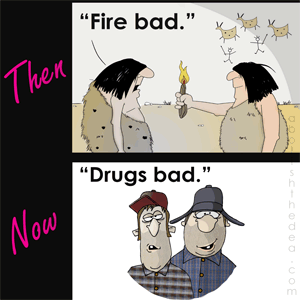
This is not to say that drugs are the whole answer, of course, but rather that specifics matter: the real issue is: what drugs, for what reason, when used by what person, in what circumstances, etc. etc. etc. Life is complicated, after all, and it is childish to decide a priori that drugs in general are somehow bad for everybody, in and of themselves and without regard for context. Penicillin is not "the answer" when it comes to physical maladies, neither is aspirin. But they do not have to be. They can be used sensibly in certain contexts and unnecessarily in others. The details matter. The details are what healthcare (mental, spiritual and physical) should be all about. And yet the childish Drug Warrior would have us save our brain power. They tell us to forget all those pesky details and to scapegoat psychoactive drugs instead as the root of all evil. And so brainwashed Americans have been taught to say things like "Fentanyl 12 kills!" and "Crack kills!" -- which is the philosophical equivalent of saying "Fire kills!" like the Chicken Littles of yore. All such statements would have us superstitiously fear dangerous substances rather than to learn how to use them as wisely as possible for the benefit of humanity.
CONCLUSION: If Drug Warriors really want people like myself to stop "whining" about depression, they can end the problem in an instant by relegalizing our time-honored right to take care of our own health as we see fit! This is not some radical desideratum on my part: this was the natural state of affairs in the world for millennia, until the medical establishment and demagogue politicians formed a de facto alliance to deny Americans the right to take care of their own health as they see fit.
"The right to chew or smoke a plant that grows wild in nature, such as hemp (marijuana), is anterior to and more basic than the right to vote." --Thomas Szasz, Our Right to Drugs --p xvi13
"Imagine how many people would have benefited during the past half-century had the government respected their autonomy and their right to self-medicate." --Jeffrey A. Singer, Your Body, Your Health Care --p. 9714
Author's Follow-up:
November 16, 2025
It is amazingly ironic that Sigmund Freud is known today in the west for time-consuming and expensive psychoanalysis. This can only be because academics and the medical community are controlling the narrative. They themselves profit from time-consuming and expensive psychoanalysis, if not as doctors then as researchers and professors. Any knowledgeable depressed person could tell you, however, that Freud's real discovery was that cocaine was a godsend for the depressed. But then the depressed themselves were never asked how they felt about cocaine. Self-interested doctors demonized the drug because they saw it as a threat to their livelihood. And the result has been the infantilization of human beings when it comes to taking care of their own psychological health.
It is amazing how thoroughly this screaming headline has been given the kibosh by modern publishers. One reads nothing about the infantilization of so-called "patients" in America. Teachers and professors ignore Freud's cocaine use, or else dismiss it with a contemptuous sneer -- in lockstep with the intolerant Drug War etiquette taught them in grade school. No one makes the connections between drug law and the outlawing of our right to take care of our own health as we see fit. This is because drug prohibitionists have brainwashed Americans into believing the only stakeholders in the drug debate are the white American young people whom we refuse to educate about safe use. In reality, drug prohibition runs roughshod over the rights of all sorts of other stakeholders who are given no voice in these matters.
Occasionally, I hear some naive drug pundits discussing whether there will be more deaths if legalization takes place. This is a very misconceived question, indeed. There will obviously be FAR LESS DEATHS over time as we begin to render criminal organizations irrelevant and develop "best use" guidelines based on actual experience. How could this be otherwise given that drug prohibition, according to some estimates, has killed over half a million people in America alone since 1971 15? Do we really think that the eradication of gangs and cartels is going to increase gun-related deaths? Do we really think that safe-use education and quality control is going to INCREASE drug-related deaths?! I know that drug prohibitionists do not believe in the value of education -- but surely even they would not go so far as to say that education is a weapon of mass destruction!
It is common sense that legalization would lower drug-related death tolls around the world. What the pundits are really asking is: "Will there be more deaths of the white American young people whom we have been artificially protecting from a drug-filled world by crafting laws that trample on the rights of minority communities around the globe? 16" Americans have basically been using minorities and foreigners as human shields to "protect themselves" from drugs so they will obviously be nervous about restoring the rights of their former victims. One thinks of the Spartans asking the naive question: "Will freeing the Helots cause us problems?!" The answer to all such questions is: "Possibly in the short-term, but then you never had a right to profit from the misery of others in the first place!"
There are times when it is clearly WRONG to deny kids drugs (whatever the law may say). If your child is obsessed with school massacres, he or she is an excellent candidate for using empathogenic meds ASAP -- or do we prefer even school shootings to drug use???
The drug war has created a whole film genre with the same tired plots: drug-dealing scumbags and their dupes being put in their place by the white Anglo-Saxon establishment, which has nothing but contempt for altered states.
AI is inherently plagiaristic technology. It tells us: "Hey, guys, look what I can do!" -- when it should really be saying, "Hey, guys, look how I stole all your data and repackaged it in such a way as to make it appear that I am the genius, not you!"
Racist drug warriors make cities dangerous with drug prohibition -- then they use that danger as an excuse to send in the National Guard.
In 1886, coca enthusiast JJ Tschudi referred to prohibitionists as 'kickers.' He wrote: "If we were to listen to these kickers, most of us would die of hunger, for the reason that nearly everything we eat or drink has fallen under their ban."
If Fentanyl kills, then alcohol slaughters. Drug prohibition is the real killer.
Conservatives say they're against Big Government -- but they let bureaucrats decide what medicines they can use.
Self-medication is not a dirty word. It has always been a fundamental right to take care of one's own health -- until the medical establishment demonized the practice for obvious financial reasons.
Someday the world will realize that Freud's real achievement was his discovery of the depression-busting power of cocaine.
ECT is like euthanasia. Neither make sense in the age of prohibition.









 In the introduction to his exhaustive commentary on The Critique of Pure Reason1, Norman Kemp Smith warns his readers that Kant's definitive viewpoints can only be understood by considering his work as a whole, and that the reader should therefore resist the temptation to consider any of his statements out of context. I feel compelled to extend a similar warning to my readers about my philosophy of drugs. I always do my best to imagine all possible objections to my philosophical positions and to answer them "on the fly," so to speak, in my essays, but I hope that any serious reader will consider my work as a whole before erecting straw men in their mind based on my failure to answer any given potential objection in any given essay. There are so many caveats, explanations, and qualifications that are called for in order for a philosophical maverick to render himself intelligible to a readership that has been indoctrinated in contrary viewpoints since their childhood. One cannot be expected to address them all in every single essay.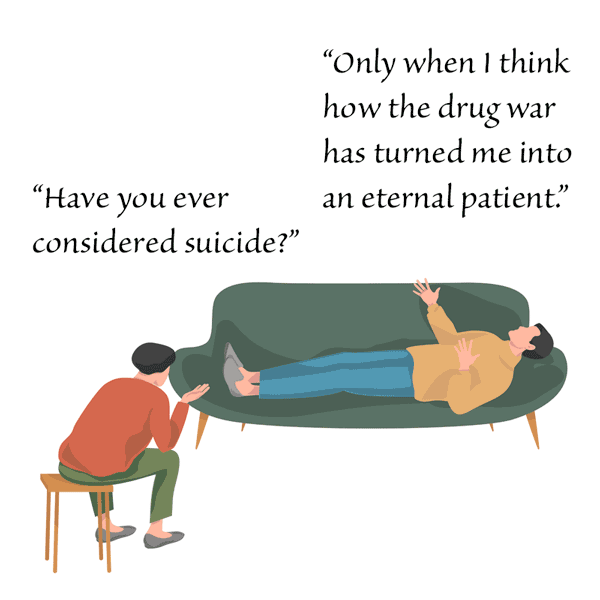
 I hope that this essay has helped to clarify my basic stand on Big Pharma antidepressants: namely, that such drugs are not the problem in and of themselves. That is the Drug Warrior's fallacy, to believe that drugs are a problem rather than the social policies that render their use problematic. The real problem is drug prohibition, which turns those drugs into "the only game in town" when it comes to treating depression.
 Case in point: As a youth, I was "slipped" a psychedelic at a party, thanks to which I suddenly clearly saw all the opportunities that life had to offer -- and I actually began to grieve for the vast swaths of time that I had seemingly wasted in introverted blindness to so many possibilities.
  It is amazingly ironic that Sigmund Freud is known today in the west for time-consuming and expensive psychoanalysis. This can only be because academics and the medical community are controlling the narrative. They themselves profit from time-consuming and expensive psychoanalysis, if not as doctors then as researchers and professors. Any knowledgeable depressed person could tell you, however, that Freud's real discovery was that cocaine was a godsend for the depressed. But then the depressed themselves were never asked how they felt about cocaine. Self-interested doctors demonized the drug because they saw it as a threat to their livelihood. And the result has been the infantilization of human beings when it comes to taking care of their own psychological health.
 (up)
(up)