what the movie The Reluctant Astronaut tells us about drug prohibition
by Brian Ballard Quass, the Drug War Philosopher
October 12, 2025
Whenever anyone tells me not to glorify drug use 1 , I think of the 1967 movie "The Reluctant Astronaut" starring Don Knotts. Knotts plays Roy Fleming, the acrophobic title character who gets a job at the NASA Space Center thanks to an application submitted by his doting but unrealistic father, an Army vet with a penchant for exaggerating his own achievements in World War I. Unfortunately, the job in question turns out to be that of a janitor apprentice, but Roy conceals that fact for fear of disappointing his father and becoming a laughing stock back home. The ruse is eventually exposed, however, after Dad makes an unannounced visit to the Center with his two war buddies.
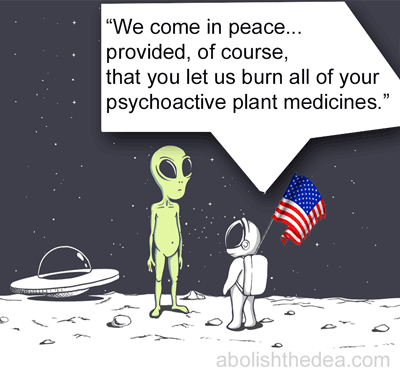
Americans are childish about drugs. We blame our problems on inanimate objects and burn other countries' plants so that we can feel safe at home. We need to grow up and learn to use nature's bounty wisely for human benefit.
Roy buys some time by donning a borrowed space suit and giving his fellow townsfolk a tour of the facilities, but the truth comes out after he inadvertently ignites a rocket sled that he is pompously demonstrating, resulting in the activation of the ejection seat and his subsequent parachute landing in the nearby desert. Rescue personnel soon arrive, along with Mr. Donelli, Roy's phlegmatic boss. Roy's clueless visitors are there as well, already eager to praise the flustered showoff for his bravery in accomplishing this seemingly pointless impromptu mission -- until a firefighter asks Donelli who Roy is. "I'm ashamed to say," quoth he, "that he is one of my janitor apprentices!"
The penny finally drops for the improbably naive trio from back home. They finally realize that Roy is... well, a nobody.
FADE TO BLACK
In the next scene, the thoroughly humiliated Roy does what any American movie character would do in such a case: he drowns his sorrows at the nearest watering hole, which in this case turns out to be The Blast-Off Bar.
Before he has even entered the joint, he hears a noisy male chorus reciting the following countdown, in a raucous imitation of ground control on launch day:
Roy sees, upon entering, that this incantation has a purpose: it is intended to stiffen the resolve of a tippler in the proper performance of a drinking ritual. As his drinking buddies surround him and bellow out the countdown, the designated toper is expected to drop a brimful shot glass into the equally full glass of beer that he is holding and then swallow the entire contents in one long gulp as the onlookers drawl out the word "BLAST-OFF!!!!"
Yes, this macho chorus line is actually encouraging this guy to get dead drunk! To get plastered! To get wasted! And everybody's laughing! Everybody's smiling! Everybody's having a great time!
And this in a world in which it is considered wrong to glorify drugs???!!!
Please!
One immediately thinks of Carl Hart's complaint in "Drug Use for Grown-Ups,2" that there is endless tolerance for drinkers -- to the point that we actually celebrate drunkenness and celebrate the use of peer pressure to bring it about! And yet zero tolerance is extended toward those who would use other drugs -- other drugs, I might add, which are almost always far less inherently dangerous than liquor.
And so Roy Fleming gets absolutely wasted! And starts slurring and mispronouncing words! Ha ha ha! How funny, right?
Say rather, how monstrously hypocritical!
Now, I have nothing against drinking. I have raised my OWN elbow on more than one occasion. But it really bothers me to see these self-satisfied, white, macho men, ostensive Christians at that, whole-heartedly and, as it were, "full-throatedly" exploiting their right to booze -- while my right to substances that would actually improve my cognitive abilities without causing a hangover is ruthlessly suppressed!
This is how your D.A.s celebrate their victories in court. After a busy day of throwing minorities in jail for selling and using less dangerous drugs than alcohol, they head to the local bar to get plastered.
And yet the irony is that by their own logic, they themselves should be in jail for partaking of the most dangerous drug of all! By their own logic, their property should be confiscated after so much as one beer bottle is found on-site. By their own logic, they should be denied a job if a test of any kind could establish that they have drunk alcohol at ANY TIME in the past. ANY TIME. And finally, by their own logic, all patriotic movie critics should slam "The Reluctant Astronaut" -- and any other movie that depicts such blatant glorification of a drug that kills 178,000 Americans a year3.
This is not to say that I hate the movie. Don Knotts is not necessarily hilarious at any given moment, but there is a sort of low-key humor generated by his trademark frazzled demeanor which keeps the whole picture enjoyable throughout. It's a sort of "slow burn," if you will, as favorably contrasted with the unpredictable fireworks of the Lou Costellos of the world, those comedians who may elicit a belly laugh in one scene, only to irritate in the next by running a supposedly comic scenario into the ground with over-the-top antics. But I see such movies 45 in a new light after having spent the last eight years reflecting on drug prohibition from a philosophical point of view. I can no longer watch the rights of drinkers being thus normalized and promoted without reflecting on the monstrous hypocrisy of the War on Drugs.
Nor do I grudge the beer drinkers their little rituals. If you wish to play beer pong, by all means, play.
And yet, forgive me for asking:
What does it say about America that our most popular social games are those that bring about mental impairment -- while the use of drugs that improve the mind is considered to be a felony?!
Daily opium use is no more outrageous than daily antidepressant use. In fact, it's less outrageous. It's a time-honored practice and can be stopped with a little effort and ingenuity, whereas it is almost impossible to get off some antidepressants because they alter brain chemistry.
I could tell my psychiatrist EXACTLY what would "cure" my depression, even without getting addicted, but everything involved is illegal. It has to be. Otherwise I would have no need of the psychiatrist.
Wanna show drug warriors the error of their ways? Legalize all less dangerous drugs than alcohol and then deny work to those who test positive for liquor and confiscate their property if beer cans are found on-site.
Americans think that fighting drugs is more important than freedom. We have already given up on the fourth amendment. Nor is the right to religion honored for those who believe in indigenous medicines. Pols are now trying to end free speech about drugs as well.
Drug Prohibition is a crime against humanity. It outlaws our right to take care of our own health.
Prohibitionists have blood on their hands. People do not naturally die in the tens of thousands from opioid use, notwithstanding the lies of 19th-century missionaries in China. It takes bad drug policy to accomplish that.
If Fentanyl kills, then alcohol massacres. The problem is drug prohibition, not drugs.
Using the billions now spent on caging users, we could end the whole phenomena of both physical and psychological addiction by using "drugs to fight drugs." But drug warriors do not want to end addiction, they want to keep using it as an excuse to ban drugs.
If Americans want less government, they should get rid of the Drug War Industrial Complex, rather than abandoning democracies around the world and leaving a vacuum for Russia and China to fill.
Drug Warriors never take responsibility for incentivizing poor kids throughout the west to sell drugs. It's not just in NYC and LA, it's in modest-sized towns in France. Find public housing, you find drug dealing. It's the prohibition, damn it!
Unless otherwise indicated, no AI is used in the creation of site content. These essays represent the original ideas of their author and not the ideas that the author SHOULD have based on an algorithmic parsing of existing data. For more on this subject, consider the AI-related viewpoints to which the author subscribes as delineated in the New York Times opinion piece entitled "What 370,000 College Essays Tell Us About A.I.’s Effects on Creativity" by Rebecca Winthrop of the Brookings Institution.










 (up)
(up)