








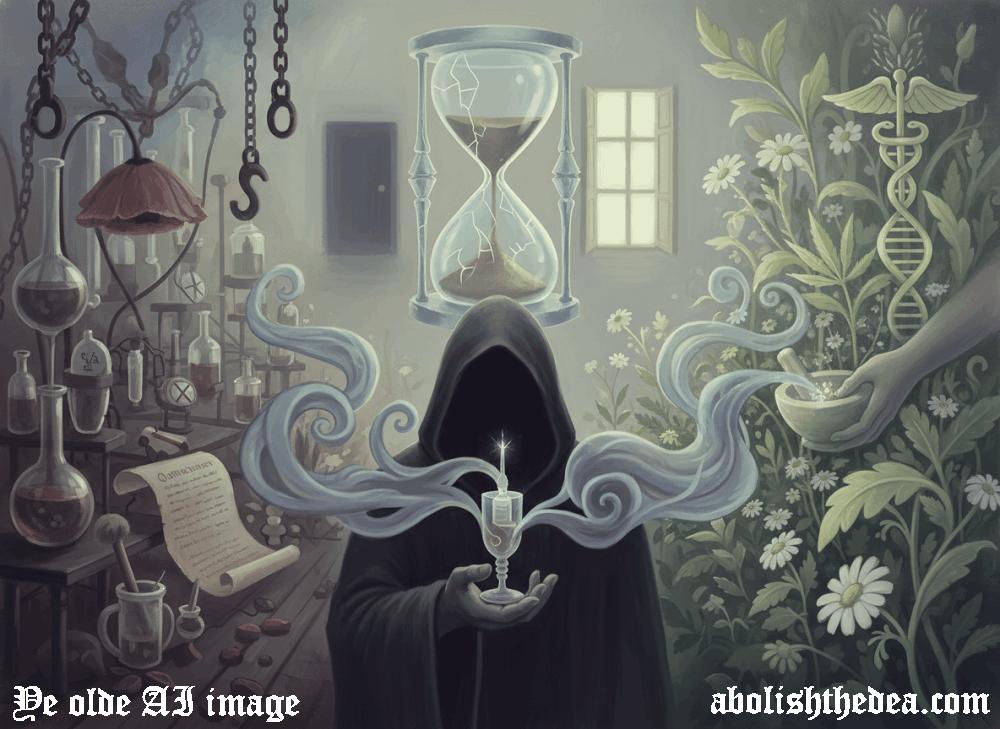
 I do so hate to brag, but there is at point which humility becomes a kind of dishonesty. Know, therefore, that I am the only one in the world who has pointed out that assisted suicide cannot be discussed advisedly without discussing the drug prohibition that renders it necessary. There, I've said it. What's more, drug prohibition denies us the kinds of drugs that might make us want to live. Drug use inspired the Vedic religion and use of the coca leaf was -- and continues to be -- an inspiration to the Inca and their descendants. What does it say about America when I am the only one who connects these facts? And I have not sat on this stuff. I have spread the news to the movers and shakers in the assisted suicide game and no one even acknowledges my letters.
  The Drug War has turned America into the world's first "Indignocracy," where our most basic rights can be vetoed by a misinformed public. That's how scheming racist politicians put an end to the 4th amendment to the US Constitution.
We've got to take the fight TO the drug warriors by starting to hold them legally responsible for having spread "Big Lies" about "drugs." Anyone involved in producing the "brain frying" PSA of the 1980s should be put on trial for willfully spreading a toxic lie.
Using the billions now spent on caging users, we could end the whole phenomena of both physical and psychological addiction by using "drugs to fight drugs." But drug warriors do not want to end addiction, they want to keep using it as an excuse to ban drugs.
A Pennsylvanian politician now wants the US Army to "fight fentanyl." The guy is anthropomorphizing a damn drug! No wonder pols don't want to spend money on education, because any educated country would laugh a superstitious guy like that right out of public office.
Magazines like Psychology Today continue to publish feel-good articles about depression which completely ignore the fact that we have outlawed all drugs that could end depression in a heartbeat.
Heroin versus Antidepressants https://abolishthedea.com/heroin_versus_antidepressants.php
Uruguay wants to re-legalize psilocybin mushrooms -- but only for use in a psychiatrist's office. So let me get this straight: psychiatrists are the new privileged shaman? It's a mushroom, for God's sake. Just re-legalize the damn thing and stop treating us like children.
"The Oprah Winfrey Fallacy": the idea that a statistically insignificant number of cases constitutes a crisis, provided ONLY that the villain of the piece is something that racist politicians have demonized as a "drug."
Psychedelics and entheogens should be freely available to all dementia patients. These medicines can increase neuronal plasticity and even grow new neurons. Besides, they can inspire and elate -- or do we puritans feel that our loved ones have no right to peace of mind?
The press is having a field day with the Matthew Perry story. They love to have a nice occasion to demonize drugs. I wonder how many decades must pass before they realize that people are killed by ignorance and a corrupted drug supply, not by the drugs themselves.
The Drug War has turned America into the world's first "Indignocracy," where our most basic rights can be vetoed by a misinformed public. That's how scheming racist politicians put an end to the 4th amendment to the US Constitution.
We've got to take the fight TO the drug warriors by starting to hold them legally responsible for having spread "Big Lies" about "drugs." Anyone involved in producing the "brain frying" PSA of the 1980s should be put on trial for willfully spreading a toxic lie.
Using the billions now spent on caging users, we could end the whole phenomena of both physical and psychological addiction by using "drugs to fight drugs." But drug warriors do not want to end addiction, they want to keep using it as an excuse to ban drugs.
A Pennsylvanian politician now wants the US Army to "fight fentanyl." The guy is anthropomorphizing a damn drug! No wonder pols don't want to spend money on education, because any educated country would laugh a superstitious guy like that right out of public office.
Magazines like Psychology Today continue to publish feel-good articles about depression which completely ignore the fact that we have outlawed all drugs that could end depression in a heartbeat.
Heroin versus Antidepressants https://abolishthedea.com/heroin_versus_antidepressants.php
Uruguay wants to re-legalize psilocybin mushrooms -- but only for use in a psychiatrist's office. So let me get this straight: psychiatrists are the new privileged shaman? It's a mushroom, for God's sake. Just re-legalize the damn thing and stop treating us like children.
"The Oprah Winfrey Fallacy": the idea that a statistically insignificant number of cases constitutes a crisis, provided ONLY that the villain of the piece is something that racist politicians have demonized as a "drug."
Psychedelics and entheogens should be freely available to all dementia patients. These medicines can increase neuronal plasticity and even grow new neurons. Besides, they can inspire and elate -- or do we puritans feel that our loved ones have no right to peace of mind?
The press is having a field day with the Matthew Perry story. They love to have a nice occasion to demonize drugs. I wonder how many decades must pass before they realize that people are killed by ignorance and a corrupted drug supply, not by the drugs themselves.


 (up)
(up)