If Claire Brosseau commits suicide, she will have been killed by drug prohibition
Why assisted suicide for the depressed cannot be discussed meaningfully without discussing the psychiatric pill mill and the drug prohibition that created it
by Brian Ballard Quass, the Drug War Philosopher
February 8, 2026
When I first started studying the Drug War from a philosophical point of view back in 2019, I was trying to avoid the topic of the psychiatric pill mill altogether because I saw that by questioning that status quo, I would alienate myself from at least half of my potential audience. One in four American women take a Big Pharma med every day of their life, after all, and psychiatrists owe their very jobs to this arrangement1. They were sure to take it as a personal affront if I were to question the foundations upon which they have built their very worlds.
But I soon came to realize that this faith in the psychiatric pill mill is itself an enormous part of the problem. It betrays a naive faith in the power of science to handle emotional and mental issues, a faith that naturally reduces the sense of urgency to end drug prohibition. "What's the hurry?" asks today's science lover. "Science has already solved depression -- even if the 'patient' has to expensively jump from medicine to medicine in a never-ending attempt to make that statement at least appear to be true."
Drug prohibition turns depressed Americans into demoralized wards of the healthcare state by shunting them off onto dependence-causing meds.
Bear in mind that I myself take a Big Pharma drug every day of my life, the difference being, of course, that I alone seem to resent having been disempowered in this way. I alone seem to resent having been turned into a patient for life and shunted off onto a Big Pharma "med" that is far harder to kick than heroin 234.
I should add for the record here that I do not claim that antidepressants do not work at all. They may well keep one from killing themselves -- but that is faint praise indeed! The goal of psychological and spiritual "healing" should be to help one thrive in life, not merely to dull one's perceptions to the point that one can survive the anomie of 21st-century capitalism. But my real complaint is that dependence-causing Big Pharma drugs make no sense whatsoever in a world in which drugs are prohibited, at least not for any friends of the most basic of human freedoms, like the right to control one's own body and mind!
Yes, if Big Pharma drugs were the only game in town when it came to psychoactive medicine, then one could reluctantly say that they're better than nothing, but that's kind of like thanking your totalitarian guard for the breadcrumbs he throws you once a day. Instead of thanking him, we should be pointing out loudly and clearly that we are human beings who should be allowed to eat full healthy meals! But what happens if we complain today? We are told in effect: "What are you complaining about? Breadcrumbs keep you alive, don't they?! What more do you want?! If you keep complaining, you're going to persuade other sick people to stop eating their breadcrumbs!"
The answer of course is that we (or I, at any rate) want freedom -- the same freedom that human beings have had since the Stone Age, to take care of their health as they see fit. We want the right to what John Locke called "the use of the land and all that lies therein."56 We want the ability to use substances that do not turn us into patients for life, with all of the humiliating, expensive and time-consuming baggage that comes with that status.
And why are Big Pharma psychoactive drugs legal in the first place? Clearly, it is because they produce states of mind that politicians can "live with." And I will insist until my dying day that government has no right whatsoever to decide how I should feel in this life. None. And hence drug prohibition is a threefold outrage: an outrage against common sense, an outrage against human dignity, and an outrageous denial of our time-honored right to take care of our own health as we see fit. I say "until my dying day" for the benefit of the bamboozled Drug Warrior who once told me (when I was 65 years old, no less) that my desire to end drug prohibition was just a "phase" that I was going through -- as if it were childish of me to demand my right to Mother Nature's bounty and my right to take care of my health as I deem fit, as if it were childish to maintain the views of the Founding Fathers and Thomas Jefferson himself7
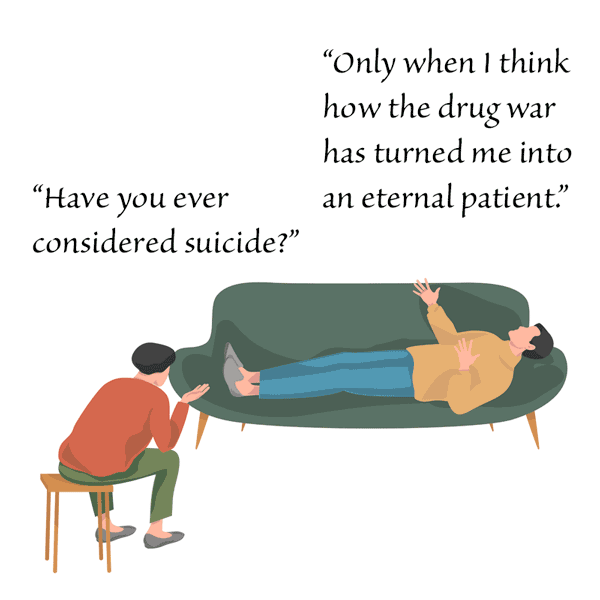
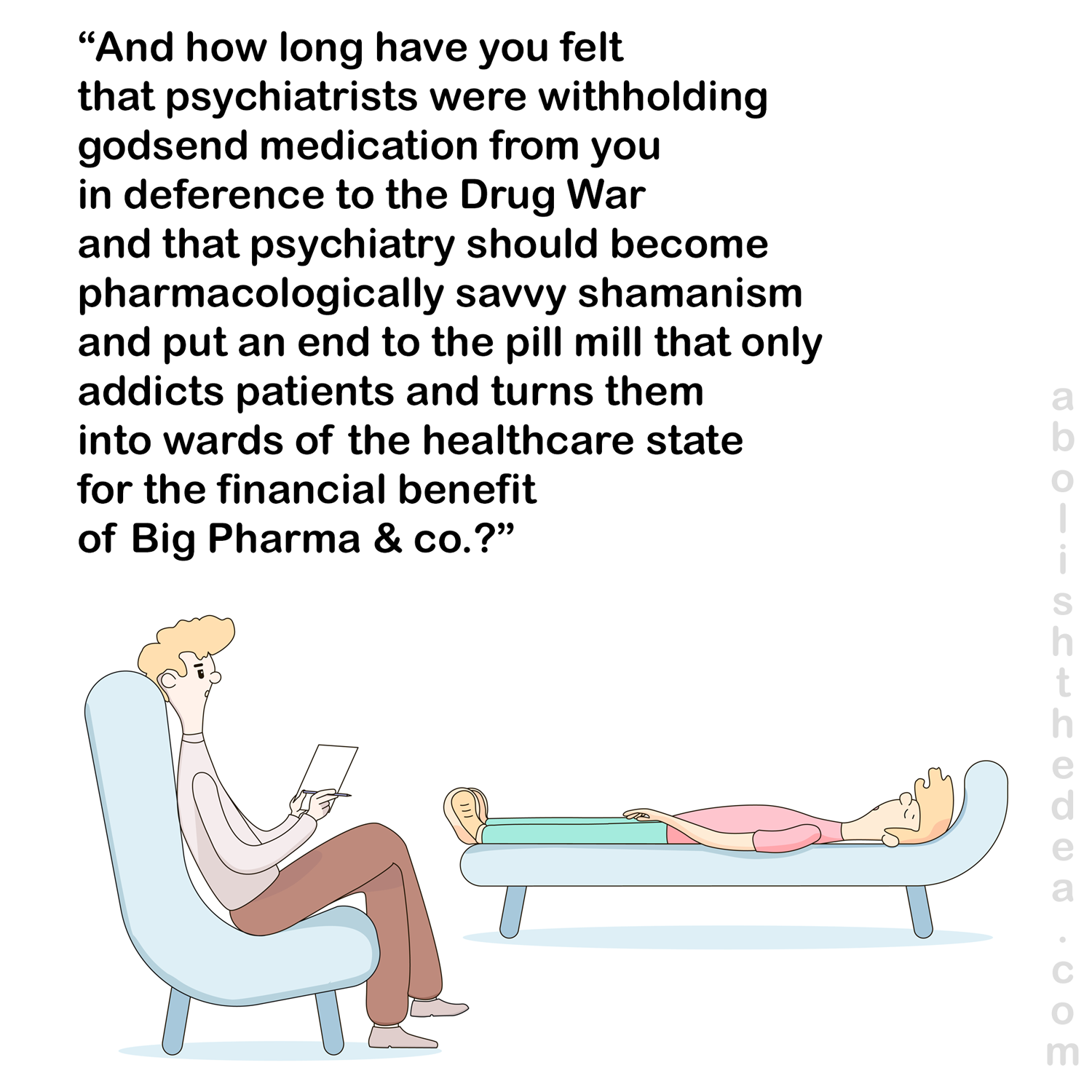
Here's a political cartoon that the New Yorker magazine would not touch with a 10-foot drug-testing kit.
If any reader is growing tired, let me remind them that these are hugely relevant issues that I am raising here. We live in a world in which doctors and pundits are now championing the right of "breadcrumb" eaters to DIE if and when they are depressed by the effects of their government-restricted diet -- and none of these pundits are even mentioning the fact that the government is denying them the right to eat full meals in the first place, when this is the whole problem, without which the assisted suicide that they are now advocating would not be necessary!
I ask myself: How can I make this clear to the Stephanie Nolens of the world, the New York Times health reporter who "broke" the Claire Brosseau story last week8 and who is now ghosting me -- and so implicitly gaslighting me -- on this whole topic. Apparently, today's so-called "free press" is supporting the myth of scientific triumphalism that has placed lab coats in charge of mind and mood medicine.
When I contact the movers-and-shakers in the assisted suicide movement (especially those who advocate assisted suicide for the depressed), they always talk about the right for assisted suicide outside of all context. They refuse to acknowledge the fact that drug prohibition alone renders assisted suicide necessary (at least in the minds of the Claire Brosseaus of the world). This shows just how clueless North Americans -- including Claire herself -- have become about drugs thanks to censorship of all positive effects.
It is a lie to say that Brosseau could not be helped by drugs. A lie. The truth is rather that we refuse to study drugs from the point of view of psychological common sense. Were we to do so, we would see that there is an embarrassment of mood-elevating riches available for Claire -- even though we have not gotten close to studying such meds from the point of view of common sense. Indeed, the vast majority of depressed could be essentially "cured" by the use of just one drug alone: namely, the alkaloid called cocaine from the time-honored divine plant of the Incas910.
Unfortunately, the medical establishment is blinded to common sense by materialism, reductionism, lies, misrepresentations -- and above all, self-interest -- and so will gaslight us by making the metaphysical claim that any drug that OBVIOUSLY works does not REALLY work. To which I would reply: Well, let me use a drug that does not REALLY work while you continue to look for the holy grail of the cure for human sadness under a microscope.
Imagine the size of this bamboozlement! We believe so much in the powers of science that we would rather have the depressed kill themselves than to advocate for their right to use alternatives -- which means, of course, ending drug prohibition. And yet I alone seem to have drawn the obvious connection between the Claire Brosseau case and drug prohibition. But all the concerned parties to whom I have written seem to regard drug prohibition as an irrelevant issue!
There is only one good thing about this bizarre status quo: it boosts my ego. My head swells when I realize that I am so much smarter than these people in this one area. For almost all the professionals in North America (lawyers, doctors, psychiatrists, etc.) are like Don Quixote. That latter character, it will be remembered, was extremely intelligent and perceptive -- until, that is, the topic of 'knight errantry' came up, after which he uttered complete nonsense, proving himself to be completely out of touch with reality.
North American professionals are the same way when it comes to drugs: they see subtle problems with the most astute reasoning -- yet bring up the subject of drugs, and they are instantly blinded to the existence of all the 6,000-pound gorillas in the room. You simply cannot convince them of any downsides to drug prohibition at all -- and yet they have superlative vision when it comes to discovering new unprecedented "rights" that they can champion in order to help drug prohibitionists "save face" by giving them an enormous Mulligan for the deaths that they are causing -- now with the help of the very people whom they have denied the use of godsend medicines.
Talk about false states of consciousness! Bamboozled North Americans now believe so strongly in the supposed evil of drugs that they literally want to die rather than to use them for human benefit.
But, of course, even those against assisted suicide for the depressed are talking nonsense. The real issue is not assisted suicide at all but the drug prohibition, without which the depressed could kill themselves peaceably at home -- or, better yet, discover one of thousands of once-shunned medicines which (alone or in combination, in some psychologically obvious protocol) could make them want to live!
Afterword
Some people will say that the Effexor/Venalfaxine I am on can be quit based on their own experience, even after long-term use. Maybe so, but then what is their experience? Those who say so will have been originally on that drug and then switched to yet another Big Pharma drug with a similar method of action. While this is technically "getting off" of Effexor, it is not what I am referring to. Moreover, Effexor withdrawal is insidious, based on my own experience. I went for almost a year slowly tapering the drug and everything was going fine until I was down to very low doses. One day, I was suddenly hit with the worst depression I had ever experienced in my life, far worse than that I had ever encountered before using the drug. Not only could I find no reason to live, I could find no reason to even move. Only returning to the drug at higher doses brought me back to life, at least to the point where I recovered my own sense of personal agency.
In "Anatomy of an Epidemic," Robert Whitaker theorized that antidepressants may cause the chemical imbalances that they purport to fix.11 I don't know if that theory is true, but it would go a long way toward explaining the fact that getting off the drug seems to be all but impossible -- as, indeed, the drug has a 95% recidivism rate 12 for long-term users according to my previous psychiatrist, whom I fear was fired for his candor on the subject with myself, a mere patient. I was supposed to take my meds like a good patient. No need to inform me about any inconvenient truths which might make me question the pill mill paradigm itself, which, after all pays the doctors' bills while keeping us coming back for more -- more charges, more infantilization on the child's side of the big mahogany desk, more waits at the pharmacy and more pills to be taken of which we are, of course, heartily sick and tired, but then who cares about the opinions of patients: merely voicing them openly will risk having you fired as a patient for questioning your psychiatrist's integrity.
It is possible (perhaps even likely) that Effexor could be kicked completely --but clearly only with the help of one or more of the many drugs that inspire and elate, all of which we have outlawed in the name of keeping our children safe -- the same children whom we refuse to educate about safe use. So the potential misuse of a vast minority of potentially irresponsible Americans overrides the right to health for hundreds of millions -- nay, BILLIONS -- around the globe -- BILLIONS -- all because Americans refuse to behave like grownups when it comes to drug use. They can cope with every other dangerous activity on earth: gun firing, alcohol drinking, and car driving -- but when it comes to drugs, they are frightened little cavemen, shouting prehistoric alarms like "Fentanyl kills!" and "Crack kills!", which are, of course the philosophical equivalent of shouting "Fire bad!"
In the 2015 movie "No Escape," the only place that was safe from anti-American hysteria was an opium den. How ironic that the U.S. forced Iran to outlaw opium.
Drug prohibition is superstitious idiocy.
It is based on the following crazy idea:
that a substance that can be misused by a white young person at one dose for one reason must not be used by anybody at any dose for any reason.
Q: Why are we never told about the potential benefits of drugs?
A: Follow the money.
The Drug War is based on a huge number of misconceptions and prejudices. Obviously it's about power and racism too. It's all of the above. But every time I don't mention one specifically, someone makes out that I'm a moron. Gotta love Twitter.
I'm told antidepressant withdrawal is fine because it doesn't cause cravings. Why is it better to feel like hell than to have a craving? In any case, cravings are caused by prohibition. A sane world could also end cravings with the help of other drugs.
"If England [were to] revert to pre-war conditions, when any responsible person, by signing his name in a book, could buy drugs at a fair profit on cost price... the whole underground traffic would disappear like a bad dream." -- Aleister Crowley
Drug prohibition is the perfect racist crime. It brought gunfire to inner cities, yet those who seek to end the gunfire pretend that drug prohibition has nothing to do with it.
It's really an insurance concern, however, disguised as a concern for public health. Because of America's distrust of "drugs," a company will be put out of business if someone happens to die while using "drugs," even if the drug was not really responsible for the death.
The scheduling system is a huge lie designed to give an aura of "science" to America's colonialist disdain for indigenous medicines, from opium, to coca, to shrooms.
Drug War censorship is supported by our "science" magazines, which pretend that outlawed drugs do not exist, and so write what amount to lies about the supposed intransigence of things like depression and anxiety.











 (up)
(up)