





No one would need assisted suicide if we ended drug prohibition: what Claire Brosseau's case tells us about the warped mindset of the west when it comes to drugs
An open letter to New York Times reporter Stephanie Nolen
Yesterday, the New York Times published an article about Canadian entertainer Claire Brosseau's fight for her supposed right to have the government help her to die, as a sort of ultimate cure for her seemingly ineradicable depression1. Claire does not realize that drug prohibition has outlawed all the drugs that could let her die peacefully without so much as a "by your leave" from her government or the medical industry. Moreover, many of these same drugs could make her want to live! In other words, Claire should not be fighting for her "right" to have the government help her die: she should be fighting for her right to take care of her own health, which is the most fundamental of human rights, after all, and one that is tacitly presupposed by all the others. As Thomas Szasz points out, that right "is anterior to and more basic than the right to vote."2
Here is a letter that I sent yesterday on this topic to Times health reporter Stephanie Nolen, the author of the article in question.
My letter to Times Reporter Stephanie Nolen
Dear Stephanie:
I pray you will read this message. I have a "take" on these subjects that routinely leaves me "ghosted" by the media.
I am a 67-year-old philosopher who has been studying the west's attitude about drugs for the last seven years. One of my conclusions has been that westerners "reckon without drug prohibition." They take it as a natural thing that we outlaw almost all psychoactive medicines, and therefore they fail to see facts that would otherwise be quite evident to them. Your story about Claire Brosseau, if you'll pardon me, is a case in point. The issue in the Claire Brosseau case should not be the right to die, but the time-honored right for the depressed to take care of their own health as they see fit. In other words, we should be having a national debate about drug prohibition, not about assisted suicide.
The right to take care of one's own health has always been a fundamental right in all countries, until the healthcare industry, in lockstep with racist politicians, strove to demonize panaceas like coca and opium for self-interested reasons. Claire would have the right to die today if she were simply allowed to use Mother Nature's medicines, especially opiates -- a time-honored right that ended in the early 1900s when racist politicians outlawed such drugs for xenophobic reasons -- with doctors piling on with anti-drug op-ed pieces for obvious financial reasons. Young people were not dying in the streets when opiates were legal in America, however; it took drug prohibition to accomplish that by creating a market for stronger, unregulated opiates.
Of course, without drug prohibition, Claire would have also had the right to live fully, since there are hundreds of drugs that we know about, even today, that could be used wisely with psychologically obvious protocols to keep most people from committing suicide. We do not realize this, partly because of media censorship, and partly because our Christian Science government will not spend a penny on developing common-sense protocols for using drugs that inspire and elate. You say "she tried drugs," as if that whole approach failed, but "drugs" is a vast category of substances that have been slandered and demonized by racist politicians and about which we have been shielded from all reports of positive use345. These substances have nothing in common as a class except that they tend to inspire and elate -- a sin for which beer-bellied Christian politicians can never forgive them.
Did Claire try laughing gas that gives users glimpses of heaven67? Did she try the kinds of phenethylamines synthesized by Alexander Shulgin8? Did she try the many "teacher plants" of the rainforest that westerners would rather eradicate from the face of the Earth than to use wisely for the benefit of humanity9? Did she try the kinds of drugs that have inspired entire religions10? There are drugs that can cheer us up and inspire us in a trice -- like the cocaine that Sigmund Freud advocated for the depressed11 -- and if Claire does not respond positively to ANY of them, she is a very unique individual, indeed, so much so as to be totally unrepresentative of depressed people in general. Speaking for myself, I would consider it a heaven-sent blessing to be able to use laughing gas, opium or coca, say, once a week. Merely looking forward to the use would cheer me up! This for me is psychological common sense.
Unfortunately, the materialist scientists in the healthcare field of the west do not judge drugs holistically, and so they are allowed to ignore common sense. And so they gaslight the depressed by telling us that such medicines do not "really" work, which is just a metaphysical assertion on their part, based on the supposed correctness of the philosophy of materialism.12 (Apparently, in order to really work, you have to cause a lifelong dependency with regular use, as do many modern antidepressants.) This attitude represents a kind of pharmacological colonialism, given that indigenous people have judged drugs holistically for millennia (the same indigenous people whom the west has conquered and forced to accept alcohol as their drug of choice).
I feel strongly about this because I have skin in this game. As a chronic depressive myself, I too have wanted to die many times -- but I decided to live to spread the news that I have been a victim of drug prohibition -- a message that no one seems ready to hear because they believe that science has "solved" depression and that I should just shut up and take my meds. The Claire Brosseaus of the world are now pointing out (albeit by implication only) that the emperor is wearing no clothes when it comes to the supposed "miracle drugs" of psychiatry. Unfortunately, however, Claire herself has been indoctrinated in the drug-hating religion of the Drug War and so she fails to see that drug prohibition is the real evil here, not her inability to take advantage of a specific law about assisted suicide.
Indeed, if I were to give Claire one piece of advice, it would be that she continue to live, devoting the rest of her time and energy to ending drug prohibition, which denies her the right to heal (to say nothing of her right to die). The depressed need the time-honored right to take care of their own health as they see fit. They do not need some new recherché and unprecedented right to order the government to kill themselves!!!
I used to think that drug prohibition was supposed to save me from horrible drugs like opium and coca, the drugs about which my media never allowed me to see, read or hear anything positive whatsoever. But what did drug prohibition really do? Drug prohibition shunted me off onto a drug that is far harder to kick than heroin 13 -- a drug which is overpriced and underperforming (yet one that is still featured on the Mayo.com website as some kind of miracle worker)! My drug Effexor has a 95% recidivism rate 14 for long-term users. 95%! 15 Compare this with heroin, the drug we love to hate. Only 5% of the heroin-using soldiers in Vietnam needed help getting off the drug when they returned to the States! 5%. (See the Lee Robins study.16)
That's right, our politicians lie to us about drugs... and the few true things that they say are never put in the proper context.
Sigmund Freud knew that cocaine was a godsend for the depressed. He wrote a whole book about it! Unfortunately, the self-interested doctors of his time judged the drug only by its downsides, exactly as if they were to judge alcohol by studying only alcoholics17. As Wade Davis reported last year in Rolling Stone (April 2025)1819, doctors originally blamed cocaine for causing toxicity in 400 users worldwide. 400. Wade implies that this was sufficient reason to outlaw cocaine2021. What Wade fails to realize, however, is that aspirin kills 3,000 people a year in the UK alone! 3,000!22 And that alcohol kills 178,000 in the US alone! 178,000!23
Why are we so worried about those 400 users who were irresponsible or genetically contraindicated as to cocaine use! Why do we not worry at all about the HUNDREDS OF THOUSANDS like myself who suffer the hell of depression totally unnecessarily because our country has outlawed a drug based on the supposed interests of only one demographic! The depressed are never considered stakeholders when westerners talk about drug prohibition! (Of course, Rolling Stone ignored my letter to the editor on this subject -- as well as my follow-up letter in which I politely asked them why they had done so.)
And what about MDMA? This drug brought unprecedented peace and love to the dance floors of Britain in the 1990s and showed great promise in ending PTSD for American soldiers back from Iraq and Afghanistan, and yet the FDA does not consider MDMA to be safe enough for legal use? What? This is the same FDA that thinks that it's safe to have one's brain damaged by shock therapy!24 This is the same FDA that approves of Big Pharma drugs whose publicly advertised side effects include death itself! Wouldn't it break a heart of stone?
The real moral of Brosseau's story is that drug prohibition disempowers patients -- not just about suicide, but about everything!
Take me, for instance. Not only has psychiatry turned me into a ward of the healthcare state, but I cannot even get the Big Pharma drug that I now need (that my biochemistry now REQUIRES) without seeing a nurse who is 1/3rd my age every three months of my life to tell her about my private innermost feelings and to answer a long list of invasive and humiliating questions. I could live to 100 and the healthcare industry would still not consider me adult enough to take my medication (drugs) wisely. I have been turned into a child because of drug prohibition. And when I speak up about it, I am deemed a disrespectful troublemaker, exactly as if I were a first-grader who had talked back to his teachers.
Meanwhile, psychiatrists continue to recommend brain-damaging shock therapy for the depressed -- shock therapy -- when they should be fighting on behalf of their patients' right to heal by demanding the end to drug prohibition, a policy which outlaws all the drugs that could make shock therapy unnecessary!
This absurdity comes to new heights with the Brosseau case. We now want to write new laws that further normalize drug prohibition by pretending that it does not even exist! It is exactly as if we had outlawed antibiotics, and those who were suffering from this law were demanding the right to die, when they should actually be demanding the right to use the drugs that would help them want to live!
Am I the only one who sees the monstrosity of this mindset: that we would actually prefer that a depressed person undergo brain damage and commit suicide than to use the politically created boogieman called "drugs"? Has propaganda and censorship really made westerners that blind to common sense?
Brosseau's psychiatrists should not be fighting for her right to die. They should be fighting for the right of the depressed (and everyone else) to treat their own health as they see fit without the approval of the government and the healthcare industry.
Personally, I consider it to be a crime against humanity that I have spent my entire life now as a ward of the healthcare state thanks to drug prohibition, unable to make wise use of drugs that could cheer me up in a trice, many of which grow at my very feet! This is why I was so disappointed to see that no one -- not even Claire herself -- connects the dots between her own situation and the west's unprecedented wholesale outlawing of psychoactive substances.
Thanks for "listening"...
PS I'm sure I have already overstayed my welcome, but here is some crucial information for the Claire Brosseaus of the world: those who dismiss "drugs" prematurely, as if "drugs" were one specific thing that they have found and tried and discovered to be ineffective in their case.
LAUGHING GAS: William James described how the use of laughing gas gave him glimpses of new realms and new possibilities. He considered it mandatory that we study such states of consciousness to understand the nature of reality itself!25 And yet the FDA wants to treat the gas like a drug, even though it is already shamefully unavailable to the suicidal, as a practical matter. (James' alma mater, Harvard University, has edited James' online bio so his work with nitrous oxide is not even mentioned!26)
COCAINE: Sigmund Freud considered cocaine to be a godsend for the depressed. The Inca and their descendants have chewed the coca leaf nonstop for hundreds of years for endurance, inspiration, to fight hunger pangs, etc. 27
OPIUM: Many doctors in the 1800s considered nightly opium smoking to be a far better habit than the nightly consumption of alcohol. Read "The Truth about Opium" by William Brereton to learn more28. The Anti-Opium Society in England was inspired and motivated by a bald-faced lie of an American missionary who claimed that two million Chinese died each year from smoking opium. The real total was closer to zero. It was certainly far below the death toll that could have been attributed to alcohol back then, either in the States or in England. Opium was considered a panacea by all ancient doctors, including Galen, Paracelsus and Avicenna.
"In Galenic practice the most useful medicine was a theriaca, or antidote, named Electuarium theriacale magnum, a compound composed of several ingredients, among them opium and wine. " --Thomas Szasz, Ceremonial Chemistry: the ritual persecution of drugs, addicts, and pushers29
SOMA: This drug, or drugs, inspired the Vedic -- and hence the Hindu -- religion. 30
PHENETHYLAMINES: Chemist Alexander Shulgin synthesized a variety of phenethylamines in the early 1990s, for which user reports contained such testimony as:
"More than tranquil, I was completely at peace, in a beautiful, benign, and placid place."31
"A glimpse of what true heaven is supposed to feel like... A true healing potential."32
"This is total energy, and I am aware of my every membrane. This has been a marvelous experience, very beautiful, joyous, and sensuous."33

And yet both psychiatrists and their patients seem to think that it's better to damage one's brain or to commit suicide than to use such substances.
Addendum 1
And suppose we let Claire smoke an opium pipe every night or use cocaine daily like Sigmund Freud. Why do we consider that a fate worse than death in a world in which 1 in 4 American women take a Big Pharma med every day of their life... and we tell them that it's their medical duty to do so!!!34
Addendum 2
Claire is really spreading the worst lie yet about drug prohibition. She is helping to normalize drug prohibition even further by telling the depressed that there is no help for some of them, even if drugs were relegalized -- and that is simply not true! It can only be maintained by someone with a shallow grasp of what drugs can do (and have done in the past) for the benefit of human beings -- someone who was raised in a country that harshly suppresses such knowledge, such that libraries are full of books about drug abuse and misuse and almost totally void of books about positive ways to use drugs for psychological benefit. Let's give Claire the same rights that were possessed by Sigmund Freud and Marcus Aurelius and Benjamin Franklin, to use drugs daily for human benefit.
It is impossible that no drugs could help Claire. Impossible. The human brain, as scientists well know, is specifically designed to benefit from drugs. In a world wherein we did not demonize drugs a priori and were patient and compassionate, we would find drug protocols that worked for Claire, in a world I mean where every possible drug (or drug combination) were once again legal to use. Westerners are only now waking up to the fact that the world is full of psychoactive medicines -- a fact that indigenous people have always known. Unfortunately, many modern drug pushers know more about this potential than do materialist psychiatrists35, who have this bizarre idea that symptomatic relief is evil -- as if it were evil to relax at night with a glass of wine36.
What's the result of this viewpoint? 1 in 4 American women are shunted off onto lifetime dependency with the "real" cures of psychiatry.37 No wonder they still want to commit suicide. It is humiliating to be an eternal patient on a drug that VASTLY underperforms all the substances that America has outlawed for racist and political reasons.38
Addendum 3
Psychiatrists on X tell me it's wrong to even discuss antidepressants honestly because it might keep people from taking them. That's very convenient for the doctors, of course, who cannot be challenged for turning their patients into wards of the healthcare state, when they should at least be publicly protesting against drug prohibition in defense of their patients' right to heal! But they seem to have few problems with people suggesting that suicide is better than the use of evil "drugs." Something is very wrong with this picture -- and it is all caused by drug prohibition and the childish (almost willful) ignorance about drugs that it promotes. It is all about our refusal to let westerners make the big decisions about their own health once again, rather than putting those decisions in the hands of psychiatrists and the legal system.
Author's Follow-up:
January 23, 2026
In his introduction to his lecture series entitled "The Concept of Nature," Alfred North Whitehead reminds us that:
"The substantial reason for rejecting a philosophical theory is the 'absurdum' to which it reduces us." 39
If we assume that the west's ad hoc collection of self-contradictory attitudes about psychoactive substances constitutes some kind of theory about drugs, then it is a theory that we must reject at once, for it has reduced us to absurd results. Never has that been clearer than in the case of Claire Brosseau. To see this clearly, let's conduct a little thought experiment. Let's imagine that Claire has her way and her psychiatrists help her to kill herself. How will they do that, exactly? Well, Claire says that she wants to leave this world peacefully, so they will probably give her what Poe might have called "an immoderate dose of morphine," or some other opiate of that kind.
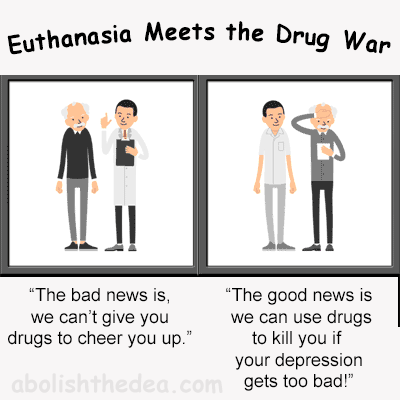
Just stop and consider the irony of that fact for a minute! The doctors will let her use opiates to kill herself, but they will not let her use opiates to cheer herself up! These are the kinds of inverted values that arise in a drug-hating country. This is what happens when you have been taught from childhood to place the hatred of drugs above every other consideration in the world. This is what happens when you outlaw panaceas and place the government in charge of mind and mood medicine. This is the bizarre pass that we come to thanks to the "logic" of drug prohibition.
Jeffrey Singer
I had to write Jeff about the Brosseau story this morning. He is the only American author I know who realizes the obvious: namely, that drug prohibition outlaws our time-honored right to take care of our own health.
Good day, Jeff.
I enjoyed your book [i.e. Your Body, Your Health Care40]. You are one of the few authors on the planet who understands that drug prohibition involves the outlawing of our right to take care of our own health!
I feel that I am the living embodiment of that statement, as drug prohibition has "protected me" from opium and cocaine by shunting me off onto a Big Pharma "med" that is far harder to kick than heroin.
I wonder if you are aware of the Claire Brosseau story in the New York Times, in which the Canadian entertainer demands her right to assisted suicide because of her depression! Like so many news stories, this one strikes a very odd note when you consider it in the context of drug prohibition. Claire has a "false consciousness" if ever there was one: she should not be fighting for a new and recherche right to 'assisted suicide'; she should be fighting for the end to drug prohibition, which prevents her from using drugs that could not only let her die peacefully, but, much more importantly, could actually give her a reason to live! (Of course, she knows almost nothing about such drugs because of the censorship of almost all reports of positive drug use in the media.)
I invite you to read my protest letter to Times health reporter Stephanie Nolen, the author of the article in question:
https://abolishthedea.com/no_one_would_need_assisted_suicide_if_we_ended_drug_prohibition
I have also sent this letter to the two psychiatrists involved in the Brosseau case, one of whom is actually fighting for Claire's right to have doctors help her die. Just imagine the irony here: they will probably end up letting Claire use opiates to kill herself, the same opiates that they will not let her use to cheer herself up! This is the weird pass that we have come to thanks to the outlawing of opium in 1914.
Sorry to take your time, but you're about the only person I know who might not ignore my ideas out of hand. I am sure that Stephanie will not respond to my concerns, let alone publish any part of my letter -- at least if past experience is any judge.
Jeff was nice enough to respond, and quickly at that, which is a small miracle in my controversial line of work. Dr. Singer informs me that he has written a number of articles on the subject of assisted suicide, and specifically the Medical Aid in Dying Law (MAID) that has now been passed by 12 U.S. states. Below please find a link to those articles, followed by my response to some of the issues that they raise, explicitly or otherwise.
"Autonomy at the end of a person’s life"41
"Dr. Kevorkian Was Convicted of Murder 25 Years Ago Today."42
Thanks for sharing those links, Jeff.
You make some good points about the need for patient autonomy, with which I completely agree.
But I come at these issues from a very different place, with a sense of urgency as a kind of "patient malgre lui," and so I have a different focus. I ask why many of these people became patients in the first place. The outlawing of just two drugs -- cocaine and opium -- left severe pain, shyness and anxiety (and a host of other conditions, including the common cold itself) untreatable at home. And so the medical field welcomed these people with open arms and created whole new insurance-covered pathologies in the DSM to process and care for them, turning many of them into patients for life with dependence-causing "meds."
Drug prohibition has kept me from using drugs that could work wonders with my attitude toward life -- wonders! -- and I know this from personal experience -- and yet I was forced to become a ward of the healthcare state thanks to drug law, reliant on drugs that were immensely dependence-causing and did not perform any wonders at all. The best that can be said for these "meds" is that they kept me from committing suicide, but I would not have been interested in suicide had I been allowed to use drugs that would have helped me succeed in life at my chosen profession. I am still asked every three months (after 35 years of office visits) if I have considered suicide over the last three months, to which I always want to respond: "Only when I consider the fact that drug prohibition has turned me into a ward of the healthcare state."
Here is where my materialist critics start talking about the need for "real" cures, as if symptomatic help from "drugs" is illegitimate. But this search for "real" cures has led to the greatest mass dependency of all time (tobacco excepted), on antidepressants that were billed as scientific, but which Noam Shpancer at Psychology Today now tells us "work" for completely unknown reasons43. Richard Whitaker even suggests that these drugs cause the chemical imbalances that they were meant to fix44. I don't know if that is true, but it might account for the fact that many of these drugs are so difficult to quit for long-term users.
But thanks again for sharing. I think I am getting a better idea of why I am ignored by most drug-law reformers.
Many reformers seem to think that materialist science has "sorted" depression, as the Brits would say. Carl Hart even starts his book [Drug Use for Grown-Ups45] by saying that the drugs that he uses for recreation should not be used for mental and psychological improvement, and that we should see our doctors for such help, the same doctors who have turned me into a ward of the healthcare state. I find Carl's statement impossible to believe. It runs counter to my personal experience, and even what I might call my psychological common sense. Happiness helps. Looking forward to happiness helps. Relaxation helps. Even if these things cannot be depicted on a bar chart. Even a nightly beer helps one's overall "mental health" if it relaxes one – and if one can look forward to such relaxation, for even the anticipation of upcoming relaxation helps!
Just one more comment if I may and then I'll leave you be. The last thing I want to do is alienate one of the few people in the world who will actually respond to my emails!
I feel that drug prohibition is the 6,000-pound gorilla in the room. It is, I feel, a hugely relevant subject when discussing various social ills, and yet no one mentions it. We are thereby giving Drug Warriors an enormous "Mulligan" for a long list of crimes.
Consider, for instance, the problem with inner-city violence. Guns began flooding America's streets thanks first to liquor prohibition and then to drug prohibition. As Heather Ann Thompson wrote in the Atlantic in 2014:
"Without the War on Drugs, the level of gun violence that plagues so many poor inner-city neighborhoods today simply would not exist." --Heather Ann Thompson, Inner-City Violence in the Age of Mass Incarceration46
And yet almost none of the anti-gun violence groups in inner cities even MENTION drug prohibition. And when I politely suggest that they do so, they ignore my emails.
Then there are the groups that are against suicide. None of them mention the drug prohibition which has outlawed substances that could end suicidal ideation in a trice! They too ignore my emails.
Then there are the groups that are against the use of shock therapy. None of them mention the drug prohibition which keeps patients from using drugs (like cocaine and others) that could make shock therapy unnecessary. They never respond to my emails.
Then there are the groups that are against school shootings. None of them mention drug prohibition which outlaws empathogens like MDMA that could make hotheads actually care about their fellow human beings. They ghost me as well.
Then there are the groups that are against Alzheimer's disease. None of them mention the fact that drug prohibition outlaws drugs that are known to create new neurons in the brain – not to mention drugs that sharply increase cognitive function and so could be godsends for seniors experiencing mental decline. These groups ignore me as well.
Although you do not specifically mention drug prohibition in your articles about assisted suicide, I was happy to see that you called for the right to go outside the healthcare system. And you do NOT ignore me! (Thanks again.)
I don't have any particular horse in the race when it comes to assisted suicide (although I generally favor your views as I understand them) – my focus is on what I take to be the gorilla in the room, the fact that the issue would not even arise had Americans the freedoms that were available to them before 1914.
I can guess why I am being ignored by most activists, however. The mainstream believes that scientists are the experts when it comes to drugs and so we must wait for them to conclude that a given drug is okay to use. This viewpoint is very naïve, however, because the first thing a materialist scientist does in studying a drug is to ignore any and all obvious benefits – benefits that would be apparent to a child – and look under a microscope instead to see if the drug is "really" working according to some biochemical theory. This is why Dr. Robert Glatter wrote a piece in Forbes magazine in 2021 questioning whether laughing gas could help the depressed47. Laughing gas! Even Reader's Digest knows that laughter is the best medicine.
Of course, I understand that people like Deb Roberson (the inspiration behind MAID, or the Medical Assistance in Dying act48) have to deal with the world as it is, not as it should be. She was suffering from an aggressive cancer, after all, and she did not have time to change America's whole mindset about drugs and so end drug prohibition: she simply wanted the right to die peacefully, GIVEN the fact that drug prohibition exists. I understand that. However, if we never even mention the fact that drug prohibition is the original source of our social ills, then we will never end drug prohibition, which is the real problem, let alone hold it responsible for the endless list of social problems that it causes. We will be like the miser who "fixes" the holes in his walls by hanging pictures over them... at least until the wall finally collapses from excessive perforation.
Finally, regarding the justification for the re-legalization of drugs – especially Mother Nature's medicines – I prefer to make the positive argument that these are basic rights (the right to take care of one's health and the Lockean right to the use of 'the land and all that lies therein') and therefore need not be justified on the basis of a harm/benefit analysis, any more than the freedom of speech should be justified on such a basis. It is the unprecedented policy of wholesale drug prohibition that should be subjected to a harm/benefit analysis, and such an analysis would, conducted fairly, end drug prohibition at once, seeing as it has destroyed inner cities around the globe and turned millions of the depressed into patients for life.
Again, sincere thanks for discussing these issues with me and I hope that my vehemence on these topics has not caused me to "come across" as rude or disrespectful. If so, my apologies!
PS Here's another concern that I have with the harm/benefit approach to drug re-legalization: it is never done fairly. A true harm/benefit analysis of drug use would consider such things like the harm of NOT re-legalizing a drug. What happens if we do NOT re-legalize a drug that inspires compassion, given that we live in a world on the brink of nuclear destruction? What happens if we do NOT re-legalize a drug that could cheer up the suicidally depressed in a trice? But then the depressed (like pain patients) are not considered to be stakeholders in the debate about drug re-legalization because politicians can trust them to suffer in bamboozled silence behind closed doors.
And the list of such questions is limited only by the imagination. This is why GK Chesterton claimed in connection with liquor prohibition that a bureaucrat would have to become God in order to determine what is healthy for a given person49. There is, after all, such a dizzying array of seemingly limitless variables involved in deciding if the use of a specific substance is "healthy" for a given person in a given situation. This is why Drug Warriors ignore details and teach us instead to associate drugs with hated demographics: like opium with the Chinese, hemp (er, I mean "marijuana") with Hispanics, cocaine with Blacks, and psychedelics with "hippies" and other damned "peace lovers." We are taught not to associate drug use with a real-life unique individual but rather with a fashionable category of scapegoat.
Hence the following quote from Thomas Szasz:
"If we argue from principle, then it is moot whether drug prohibition works, because it is problematic what should count as its 'working.' The very existence of such a mass movement of scapegoating-- uniting a diverse people in a common hatred-- may be regarded as evidence that, simply put, it is working." --Thomas Szasz, Our Right to Drugs --p. 11050
Author's Follow-up:
January 24, 2026
I have noted above how Americans (and anglophones in general) refuse to connect drug prohibition with the many evils that it causes. They literally reckon without drug prohibition whenever they discuss social problems. However, I have yet to mention the most troubling way that drug prohibition is ignored today, for academics reckon without the Drug War as well. And so our scientists, philosophers and social pundits draw conclusions about the world (sometimes about the nature of reality itself) in what Whitehead might have called their wilful "ignoration" of all positive uses for psychoactive medicines. This is why Harvard University does not even mention laughing gas in their online biography of William James, the founder of their psychology department, even though James clearly states that his philosophical outlook was changed forever by the use of that substance5152. No, James' life has to be updated so as not to offend the drug-hating sensibilities of today's drug-bashing politicians -- although, to be fair, a sort of sneaking mistrust of psychoactive medicines seems to have been front-loaded into the western mindset long before the Conquistadors first started scoffing at the "teacher plants" of the Inca.
Nor am I talking about the suppression of research on only niche or recherche topics. Drug prohibition prevents us from analyzing the claims of Immanuel Kant regarding epistemology and the nature of human consciousness53545556. When one considers those claims in the light of James' research with nitrous oxide, fundamental philosophical issues immediately arise. Kant, after all, seems to have presupposed a one-size-fits-all consciousness for sober rationalists, against which all other mindsets were to be judged as inconsequential madness. His categories were all based on this assumption. James, however, concluded that nature was not so simplistic and niggardly as to provide us with only one way of seeing the world, with only one form of "real" consciousness. As he wrote in The Varieties of Religious Experience":
"The whole drift of my education goes to persuade me that the world of our present consciousness is only one out of many worlds of consciousness that exist, and that those other worlds must contain experiences which have a meaning for our life also." --William James 5758
I am not attempting to construct an argument here on any side of these issues. I am merely pointing out that these issues are extremely "fraught" and that they should therefore be discussed and researched openly in academia -- not hushed up in deference to modern drug attitudes. Nor do we simply impede progress on these issues when we do so. We rather unfairly privilege the reigning doctrine of materialism by ruling all contrary evidence out of court.
But let me be specific about the kinds of issues that might be raised by considering Kant in light of James' studies on consciousness. In light of the latter's work, one might ask the question: could it be that human beings themselves can have different forms of consciousness thanks to their differing biochemistries? We are all on drugs all the time, after all, insofar as that is the meaning of the term 'biochemistry.' This might go a long way toward explaining the existence of the William Blakes of the world, or of the visionary saints. Could it be that the biochemistry of some rare individuals predispose them for mental experiences that others can invoke only by the purposeful introduction of certain chemicals into their biochemistry? Again, I am not championing such a view here; I am merely offering it as one sample of the research topics that naturally arise when we consider Immanuel Kant's work in light of James' views on consciousness.
Here is one view that I will gladly take credit for, however: I believe that academics, at least as a group, have a duty to protest drug prohibition in the name of academic freedom. And yet they refuse to do so, no doubt for the same reasons as those who are "fighting" the social problems described above: they all have a prior commitment to the drug-hating ideology of the west. The government has told them since childhood that drugs are evil, and they have come to believe it. Either that or they are just plain scared to speak up, which is understandable, of course, insofar as they are living under a kind of Christian Science Sharia, a time in which any and all democratic safeguards can be discarded at will by the government provided only that they invoke the modern boogieman called drugs.
The extent of this brainwashing about drugs was brought home to me a couple of years ago when I attempted to rally philosophers at Harvard University and Oxford to protest the FDA's plans to treat laughing gas as a drug -- or in other words to make it less available and less safe to use than ever, whether for philosophical research or as a sort of psychoactive "epi pen" for quickly reversing suicidal ideation in the minds of the deeply depressed. I pointed out, in well over one hundred personal emails, that the use of nitrous oxide had shaped the philosophical views of William James and that we therefore owed it to both James and the cause of academic freedom itself to tell the FDA to drop their efforts to treat the substance as a "drug."59 I urged them to remind the politicians that there are far more stakeholders in the drug criminalization racket than simply the young people whom we refuse to educate about safe drug use.60
Any reader who has gotten this far in this extended essay will not be surprised to learn the results of my efforts: not one single philosopher to whom I wrote on this topic saw fit to so much as vouchsafe me a response. Not one. It was apparently more than their jobs were worth to speak up on the subject. I have come to think, however, that I should thank them for their indifference. I thereby became the only philosopher in the world to formally protest to the FDA about its plans to treat laughing gas as a drug. I alone stood up to our prohibitionist government on behalf of William James. I alone told that government that academic freedom mattered in a supposedly free country. That's one good thing about the Drug War: it gives relative dullards like myself the chance to be the smartest guy in the room when it comes to the subject of drugs -- not because I have the highest IQ, mind, or GPA, but simply because all the would-be competition is too frightened to compete for that title. I am truly the one-eyed man in the world of the blind.
Of course, philosophers are not the only academics who pretend that drugs are not a fit subject for discussion in their field of choice. This dogmatic negligence is practiced by almost all non-fiction writers. I hate to pick on any one in particular, but I have found that Ronald Hutton's book on witches, "The Witch: A History of Fear from Ancient Times to the Present," offers a great example of the self-censorship of which I speak6162. It is an excellent book, mainly written for academics it seems, but full of fascinating insights about how various cultures have viewed witchcraft and magic through the ages. Unfortunately, his book also inadvertently tells us something about how modern-day westerners view drugs. For Hutton only mentions the word "drugs" once in his book, and then in a pejorative way, by likening the vendors of death-dealing magic potions to drug dealers. He fails to realize that the psychoactive "herbs" that he is forever referencing in his book WERE drugs, in exactly the same sense that the so-called "meds" that we are told to take today are drugs. A psychoactive substance is a psychoactive substance, after all.
I am sure that Hutton always strives to be honest; therefore, the only possible explanation of his blindness on this topic is that he has been duped by a lifetime of drug propaganda, chiefly in the form of the suppression of all positive talk about drug use: he and millions of other authors, of course. But the resulting bias in Hutton's case is particularly unfortunate. His book, after all, is largely about the strategic use of fear by the powers-that-be to demonize vulnerable members of a society, and this is exactly what the Drug War is all about: finding scapegoats for social problems among vulnerable populations! As Thomas Szasz wrote in the introduction to his groundbreaking book entitled Ceremonial Chemistry:
"'Dangerous drugs,' addicts, and pushers are the scapegoats of our modern, secular, therapeutically imbued societies; ...the ritual persecution of these pharmacological and human agents must be seen against the historical backdrop of the ritual persecution of other scapegoats, such as witches, Jews, and madmen. " 63
Author's Follow-up:
January 27, 2026
Almost every conversation that is ever held about assisted suicide is bizarre to me -- because all arguments are based on the assumption that drug prohibition is a natural and unchangeable baseline -- even though it is precisely drug prohibition that has rendered assisted suicide necessary because it has taken away the right of the individual to decide for themselves whether suicide makes sense for them. But I seem to be the only philosopher in the world who sees the obvious connection between drug prohibition and assisted suicide -- and sees moreover that the latter cannot be discussed advisedly without consideration of the former.
The real question we should be discussing, the real issue is: should a person have a right to take care of their own health, or should those decisions always be made by the healthcare employees: as if healthcare employees were also philosopher kings who could tell us whether a given life is worth living or how much laughter could help a given person. Without drug prohibition, the depressed would never have to commit suicide -- not once we began researching and leveraging the power of hundreds (perhaps thousands) of previously demonized medicines (coca, cocaine, phenethylamines, laughing gas, opium, etc.) in common sense protocols to make people want to live.
Author's Follow-up:
January 28, 2026
If anyone wishes to know the extent to which westerners have been brainwashed by drug propaganda, one has to look no further than the Brosseau case. The reaction by pundits (and New York Times reporters) shows that we Americans would actually prefer suicide and shock therapy to the use of cocaine and opium. This is blazingly clear from the fact that no one dares even mention the outlawing of those uplifting drugs in connection with Claire's case, and yet it is precisely the unprecedented wholesale prohibition of such drugs that forces Claire to sue to her government for the right to die peaceably in the first place. Without drug prohibition, everybody could not only kill themselves peaceably, but far more importantly, they could help make themselves wish to live with the strategic employment of the kinds of drugs that have inspired entire religions!
It simply amazes me that I am the only one who makes this argument -- and that my ideas are completely ignored -- which, of course, is yet another demonstration of how thoroughly westerners are in lockstep with the drug-bashing ideology that they have learned since grade school when they received their first teddy bear for saying no to the kinds of drugs that past societies considered to be panaceas.
Let's talk about cocaine in specific here, the drug that Sigmund Freud knew from personal experience to be a godsend for the depressed. The drug was demonized by doctors for obvious financial reasons. They focused only on the misuse of hundreds (see Wade Davis's April 25 story in Rolling Stone6465) while ignoring the needs of MILLIONS of depressed! They, of course, never even asked the millions of depressed what THEY thought about the drug.
I should not be surprised, however, that the New York Times ignores my views on this subject, for their op-ed pieces by doctors over the years have been conducting a demonizing campaign about the godsend alkaloid from the sacred plant of the Inca: that is to say, cocaine. For further information on this ironic but heartbreaking topic, I include below a relevant extract from one of my main ignored essays. I say the topic is heartbreaking, because the lopsided drug-bashing of outlets like the Times have caused chronic depressives like myself to go for an entire lifetime without godsend medicines, meanwhile shunting me off onto Big Pharma drugs that are far harder to kick than heroin.
The following is a related extract about cocaine from my October 2025 essay entitled 'Coverup on Campus'.
Your indoctrination in Drug War ideology may have begun in grade school, but it did not end there. Your university professors continued that indoctrination by refusing to teach you any inconvenient truths about the substances that we have been taught to hate. Take your knowledge of Sigmund Freud6667. You have been taught by your professors to think only of "psychoanalysis" when it comes to Freud, but in a free world, we would be thinking instead about the power of cocaine to end depression. This was Freud's real breakthrough, his acknowledgment that a drug that inspires and elates can be used as an antidepressant. We do not hear about this breakthrough because the powers-that-be have decided FOR us long ago that this belief was a mistake on Freud's part and so future generations need not even know about it.
And so anyone today can claim to be an expert on Freud without even knowing about his advocacy of cocaine for the depressed. Those who catch wind of such advocacy are merely informed by their politically correct professors that Freud's interest in cocaine was a mistake. No proof of this fact need be adduced. Such slander will be readily believed by students who have been brainwashed since childhood in the substance demonizing ideology of the War on Drugs. We see then that Freud is considered a hero in academia, not because he found a practical cure for depression, but rather because his theoretical musings about psychoanalysis have provided fodder for endless remunerative academic projects. The depressed may be as gloomy as ever, but the academics have been promoted to the role of experts when it comes to the parsing and mythologizing of the real-world manifestations of our distress.
And who were the authorities who originally decided FOR us that cocaine use for depression was a non-starter?
Hint: They were not the depressed themselves, whose opinions about cocaine were never even consulted -- not then, not now. (In the materialist west, doctors are the experts on how we feel about the world -- not ourselves.)
No, these "authorities" were the self-interested psychiatrists, psychologists and medical doctors who had a vested interest in demonizing a drug whose use could put them out of business68! If cocaine remained legal, anyone could treat their own depression symptomatically and the mental health field would be devastated -- just as the physical health field would be devastated were opium to be re-legalized for the intermittent treatment of physical pain and discomfort. And what would happen to all the academics who wrote so many impressive (if unreadable) papers on the subject of Oedipus complexes and latent fears of castration? They could no longer create the illusion of profundity through the employment of pedantic circumlocutions and the amassing of superfluous footnotes. And what about the doctors who counseled so many patients for depression? They could no longer entice the public into paying for a lifetime of talk therapy based merely on the possibility of an eventual "breakthrough" of some kind, the precise nature and value of which can never be guaranteed in advance.
This is why the original critics of cocaine use were doctors -- and why they never even bothered to acknowledge the glaringly obvious benefits of the drug for the large majority of users. Cocaine was an existential threat to these professionals. The drug had to be demonized at all costs. And so they wrote hatchet jobs for the press, in which neither they nor their publishers pointed out their obvious conflict of interest in so doing.
A good poster child for this lopsided reporting about drugs is Social Psychologist Henry Lennard, author of a 1972 New York Times article entitled Freud's Disaster With Cocaine69. The op-ed piece contains the kind of argumentation that could only impress a child -- or else an adult who has been brainwashed since grade school in the substance-demonizing ideology of the Drug War. For one searches the article in vain for proof that Freud's interest in cocaine was a mistake, let alone a disaster. Lennard merely cites the fact that a patient of Freud's (one who was already addicted to morphine 70 ) used the drug irresponsibly and became psychologically dependent upon it.
That's it, that's the proof that Freud's advocacy of cocaine was a "disaster."
Now, I ask the reader, have you ever offered a drink to someone who eventually became an alcoholic? If so, did you commit a big mistake -- a disaster, even -- or did you merely provide a potentially beneficial substance to someone who turned out to be incapable of using it wisely, like the vast majority of OTHER drinkers?
And yet the intoxiphobic Lennard perversely tortures this one incident in Freud's life into a supposedly "knock-down" argument, not just against the use of cocaine 71 , but against drug use in general for the treatment of conditions like depression. Not only should we not use cocaine, but we should apparently not use psilocybin, nor opium , nor phenethylamines, nor beta-carbolines, nor even laughing gas -- no, not even if we're desperately depressed like some relatives of mine, on the verge of suicide, and visiting the ER at 3 in the morning in the naive hope of getting some unequivocal relief. As someone who is intimately acquainted with the downsides of neurotic sobriety, I find this drug-hating attitude of Lennard's to be condescending and naive in the extreme. Did Lennard not understand that in some people, the so-called "sober" state is counterproductive, that it works against our interests in life, and that it promotes personal failure through the subtle transmission of defeatist thoughts to the brain? It matters not whether such thoughts are a product of upbringing, genetics, or biochemistry, or -- which is much more likely -- a hopelessly entangled admixture of all three factors. The point is that there exist drugs like cocaine that can clearly help the afflicted to transcend such nefarious and ever-present influences, in light of which fact, Lennard is cruel to support drug prohibition. Cruel! Such a stance on his part amounts to his saying: "I can get along just fine without drugs, thank you very much. Everyone else should be able to do so as well."
But this is mere know-nothing solecism. There is, in fact, no logical reason for Lennard's belief. It is rather a conclusion based (consciously or otherwise) on the drug-hating ideology of Mary Baker Eddy. And it is an anti-indigenous viewpoint into the bargain. Had Lennard been conversant in the field of ethnobotany72, he would have known that all indigenous societies have used drugs for the benefit of humanity. Being surrounded by untrammeled nature, they were well aware of the psychoactive potential of their environment and were determined to exploit it for the use of their people. Only in the long-since bulldozed world of the west do we deem such interest in psychoactive medicines to be pathological and even criminal. And so we pass laws that help to normalize the imperial intolerance of the Francisco Pizarros of the world with respect to native medicine, thereby giving the lie to our politically correct protestations against the colonialist practice of interfering in the affairs of sovereign countries.
To grasp the cock-sure absurdity of Lennard's views, I like to imagine the psychologist standing in the Andean jungle, surrounded on every side by the psychoactive medicines of Mother Nature, chastising the Inca for their time-honored use of the coca leaf and Sapo frog venom and San Pedro cactus and ayahuasca, etc. "Now, I can set each of you up for a $200 visit to a psychotherapist," says Lennard. "He will help you understand why you have this pathological desire for drugs. I'm guessing here that it has something to do with your relationship with your mothers, but don't quote me on that. Let's see now, the first opening I see here is for next Friday at 10 a.m."
This would be funny, were it not for the fact that Lennard's naive views of human psychology (not to mention sociology) still reign in academia. Hence the postulate of this essay: namely, that censorship about drugs reigns supreme, not just in grade school but in university as well.
AFTERWORD
Of course, it will be objected that we should be treating the "real" problem, but we have no business trying to cure human sadness. Human beings are not interchangeable biochemical widgets when it comes to mind and mood. That was the theory behind the creation of those Big Pharma antidepressants which ended up turning 1 in 4 American women into patients for life because of their highly dependence-causing nature. We should rather be creating virtuous circles by allowing the depressed to use substances that improve concentration and performance and promote a hopeful view of life. Why not? Is it wrong for us to relax with a glass of beer at the end of the day? Should we be treating the "real" problems of exhaustion and nervousness with dependence-causing meds instead? Of course not. It's just that doctors have a vested interest in pathologizing cures that leave them out of the loop. They do this by focusing only on drug downsides, exactly as if they were to mention only alcoholics when discussing alcohol. Of course, talking with others can be greatly beneficial in specific cases and psychiatrists at their best are highly empathic individuals and thus valuable resources for that purpose -- but talking and strategic drug use need not be mutually exclusive protocols. Indeed, strategic substance use could empower talk therapy to finally start working as advertised for most people by quieting the inner voice that keeps the troubled "patients" from being honest, not only with their counselors and psychiatrists but also with themselves as well.
Unfortunately, these common-sense ideas read like heresy in the age of drug propaganda, which has taught us to think only of the downsides of drug use. And so we would rather save the "vast minority" of irresponsible users (or "genetically averse" users) rather than allow hundreds of millions of the depressed (or pain patients) to use godsend medicines. The result, of course, is drug prohibition, a policy which so thoroughly disempowers westerners when it comes to taking care of their own health that it constitutes a crime against humanity: a crime based on the patently false idea that the only stakeholders in the drugs debate are the young people whom we refuse to educate about drugs. And it is the depressed and pain patients who suffer the most from drug prohibition, although they have so far been too bamboozled to see their own disempowerment -- as the Brosseau case clearly demonstrates.
And so it's been almost one hundred years now since liquor prohibition ended -- and prohibition is alive and well in the west... for every substance in the world EXCEPT liquor! Surely, westerners -- and particularly Americans -- are exactly like Lieutenant Kaffee in the movie "A Few Good Men": when it comes to drugs, they can't HANDLE the truth!
Letters
Dear Dr. Roberts:
I am a 67-year-old philosopher and chronic depressive. I am writing to you in an effort to point out the 6,000-pound gorilla in the room when it comes to the discussion of mental "illness" and assisted suicide: namely, the fact that assisted suicide for the depressed would not even be an issue if we ended drug prohibition and thereby gave human beings their time-honored right to take care of their OWN health. Drug prohibition outlaws not only drugs that could help us die peacefully, but also drugs that could make us want to LIVE!
Rather than presume on your time, I invite you to read my ever-expanding essay on this topic, and specifically on the case of Claire Brosseau, the Canadian entertainer who is fighting for the right to kill herself -- when, in my view, she should really be fighting for her right to take care of her own health as she sees fit! She should be fighting, that is, for an end to the demonstrably evil policy of drug prohibition, which censors academia, punishes minorities, and erodes the most basic democratic freedoms. (See NYT story a few days back by Times health reporter Stephanie Nolen.)
My politically incorrect essay is entitled:
"No one would need assisted suicide if we ended drug prohibition: what Claire Brosseau's case tells us about the warped mindset of the west when it comes to drugs"
I hope that something that I say on these issues will resonate with you.
Sincerely Yours,
Brian Quass,
one of the millions of depressed who are never considered stakeholders in the drug criminalization debates...
Author's Follow-up:
January 29, 2026
The Claire Brosseau case continues to remind me how thoroughly Americans have been brainwashed by the censorship of all positive uses of drugs in the media. We have been taught to denigrate drug use based on our own conception of who's using them and why. This is how drug prohibition targets socially vulnerable minorities.
As Thomas Szasz wrote:
"Drug education... is the name we give to the state-sponsored effort to inflame people's hatred and intolerance of other people's drug habits, which is as indecent as it would be to inflame people's hatred and intolerance of other people's religious habits and call it 'religion education.'" p. 90 --Thomas Szasz, Our Right to Drugs 73
What Americans do not understand is that the same drugs that are used by our scapegoats and for which we want to punish them are also potential godsends for the depressed and pain patients -- to say nothing of the philosophers who wish to follow up on the work of William James viz. the investigation of reality itself, or those who wish to go on a religious journey by using the kinds of substances that have inspired entire religions.
In other words, we can't have freedom of academia and drug prohibition at the same time. We cannot have freedom of religion and drug prohibition at the same time. And as Claire's case clearly demonstrates, we cannot have the right to heal and drug prohibition at the same time.
Claire's case should be a red flag that we've gone wrong in America when it comes to drugs. As Alfred North Whitehead declared in the introduction of his philosophical lecture series at Trinity College, Cambridge:
"The substantial reason for rejecting a philosophical theory is the 'absurdum' to which it reduces us." -- Concept of Nature74
I know I am now repeating myself in this essay-in-progress, but this is something worth saying over and over again, because it does not seem to be sinking in with the concerned parties: the discussion of assisted suicide for the depressed would not even arise had America not convinced the entire world to institute Drug War Sharia to harshly punish drug use. Therefore, any discussion of assisted suicide -- no matter how learned it might sound or how many degrees the speaker can boast of or how many people may call them 'experts' -- is superficial and misleading if it fails to even mention the fact that drug prohibition brought us to this absurd pass in the first place. Everyone is talking about whether the state has the right to help the depressed (like myself) commit suicide. But this is the wrong question. The question should be: did the government ever have the right in the first place to outlaw all drugs that might make us want to live!
Think of the madness here: the medical establishment first worked with the state to outlaw cocaine, a drug that Freud understood to be a godsend for most people with depression. They thereby threw MILLIONS of depressed under the bus, shunting them off onto Big Pharma meds that are far harder to kick than heroin. And now we are asking that same medical establishment to help kill those whom it denied the right to heal in the first place!
In his book on the Third Reich, Historian William Shirer wrote that:
"No one who has not lived for years in a totalitarian land can possibly conceive how difficult it is to escape the dread consequences of a regime's calculated and incessant propaganda." -- 75
He could just as well have been writing about western society in the age of the Drug War, wherein propaganda, chiefly in the form of censorship, has literally blinded westerners to common sense about drugs, a fact that has become blatantly obvious in the Brosseau case. For if Claire had not been programmed from birth in the drug-hating religion of Christian Science, she would see at once that drug prohibition is the villain of the piece. It is drug prohibition that denies her not only the drugs that could help her die peacefully, but also hundreds of drugs that could make her want to live -- when used in psychologically obvious protocols that materialists and Drug Warriors refuse to even imagine. But westerners are prehistoric when it comes to drugs. Just as the caveman said, "Fire bad!", we say "Fentanyl kills!" or "Crack kills!" In other words, we would rather fear dangerous substances than learn how to use them as wisely as possible for the benefit of humanity.
ASIDE: It's interesting, by the way, that you don't often hear "Cocaine kills!" This is because cocaine use is associated with whites. We hear "Crack kills!" because we have been taught to associate its use with Black Americans in inner cities. That was why cocaine was outlawed in the first place, because racist politicians warned us that Blacks were on the loose, attacking our poor white women in a state of crack-inspired frenzy.
It is wrong to demonize any drug -- for all drugs have potential beneficial uses at some dose, alone or in combination, for somebody, in some circumstance. Even if we know of no such uses at present, it is anti-scientific and just plain childish to declare a drug evil a priori and so rule out any positive uses, ever. What right have we to make that call for future generations? When it comes to coca, our madness has reached new extremes, for America has convinced the UN that the collective goal of humankind should be to wipe the Divine Plant of the Inca from the face of the Earth!
Westerners change the subject when it comes to drugs and thereby give drug prohibition a huge 'mulligan' for all the problems that it causes. Instead of talking about how drug prohibition incentivizes violence, we talk about the need for more investment in our inner cities; instead of talking about how drug prohibition makes shock therapy necessary by outlawing godsend medicines, we talk about the need for patient empowerment; and instead of talking about Claire's right to take care of her own health, we talk about her right to assisted suicide.
Author's Follow-up:
January 30, 2026
The New York Times really owes it to the world to share this side of the story. Let's not forget why Freud's godsend medicine -- and endless other drugs -- are outlawed today and so unavailable to the depressed, even if they're suicidal. It is because papers like the Times demonized drugs for racist and xenophobic reasons. Check out this story published by the New York Times in 1914, the year in which both opium and cocaine were effectively outlawed by the Harrison Narcotics Act: "Negro Cocaine 'Fiends' New Southern Menace."76 This piece was credited to one Edward Huntington Williams, M.D., lending it the air of scientific fact, when it was clearly just blatant racism disguised as a professional medical opinion. Nor is there the slightest suggestion that doctors like Williams had a vested interest in outlawing virtual panaceas like cocaine and opium. I need hardly add that Congress passed the Harrison Narcotics Act without soliciting advice from the depressed or from pain patients, etc. Their sole concern seems to have been the preservation of the genetic purity of the white race.
The fact is, we do not need doctors to tell us if psychoactive drugs are appropriate or useful in any case, even if those doctors are not racists and xenophobes. The efficacy of psychoactive medicine is determined solely by the user, by their unique experience given a vast number of interacting variables that create what we call their experience of life. Doctors are not the experts here. To the contrary, they are self-interested parties that stand to benefit enormously from the outlawing of drugs like coca, cocaine and opium. This is one of many reasons why it's folly to 'follow the science,' for science cannot tell us what a user experiences with the help of a given drug. Science, by its very nature, seeks to control and limit variables, and yet the user experience is the product of a vast array of variables (from personal beliefs to genetics, from upbringing to temperament) that come together to create a unique experience for a unique person. This is why drug prohibition is such anti-scientific folly, for it would have us judge drugs up or down, without regard for the all-important circumstances of use.
So Americans outlaw a drug because they associate it with one single demographic -- failing to realize that in so doing, they outlaw it for ALL demographics.
As Thomas Szasz wrote:
"The laws that deny healthy people 'recreational' drugs also deny sick people 'therapeutic' drugs." 77
Nor is it just the suicidal who suffer in the case of the outlawing of cocaine. Americans wring their hands impotently about mental decline in the elderly, and yet they outlaw a drug that improves mentation dramatically! The elderly and the suicidal should be fighting against drug prohibition and demanding their right to health. Instead, they are increasingly turning to the government to get help in DYING: the same government which refuses to let them use medicines that could make them want to live, many of which grow at their very feet!
It is a sign of the bamboozled times that such common-sense arguments as these are considered heresy and radicalism by our mainstream press. One can only conclude that drug propaganda, especially in the form of the censorship of all positive reports of drug use, has done a real number on Americans. Propaganda works, and that is a worrisome conclusion in the age of oligarchy, when a handful of corporations control the narrative. Propaganda works, especially when you get to them when they're young, as do groups like DARE, that come into America's classrooms and spread the lie that drugs can be judged up or down, without regard to context of use. This is the lie that ensures that the depressed and pain patients are never considered stakeholders in the drugs debate. If you declare drugs evil in advance, then you bypass the rights of all otherwise interested groups and place drug law in the hands of racists and xenophobes, where most politicians want it.
Author's Follow-up:
January 31, 2026
I have, of course, received no replies to my letters to Times health reporter Stephanie Nolen, nor from Claire Brosseau's psychiatrists, one of whom thinks that Claire should have the right to assisted suicide. This is because Americans simply refuse to take into account the effects of drug prohibition in their daily lives. They pretend that drug prohibition is a victimless crime, when it is anything but.
Suppose a despotic government outlawed all food except for bread scraps and water. People began to feel poorly, as the Brits would say: so poorly that many of them wanted to die. Eventually, a few of the more socially conscious individuals began demanding their right to assisted suicide. They wanted to die because of the psychological effects of such a shabby diet that left them apathetic and listless. Suppose a therapist were to agree with them that they, indeed, had a right to assisted suicide.
Would not we say that the therapist is missing a huge point: namely, that the real problem here is the outlawing of everything but bread scraps and water, that what Claire really needs is some fundamental freedoms, the freedom to take care of her own health, not some unprecedented legal right for the state to help her die.
We pretend that drug prohibition can't be a problem, so we create recherche rights, like the right to assisted suicide for the depressed, in order to give drug prohibition a huge Mulligan for depriving us of our right to heal.
This is precisely the case with Claire Brosseau. We have outlawed and demonized all the drugs that could cheer Claire up in a trice, and now we want to give her the right to assisted suicide, when we should actually be protesting in favor of Claire's much more obvious and basic right to take care of her own health as she sees fit! This is the most fundamental of rights, and yet it remains the big fat overweight gorilla in the room. Nobody will notice it. Nobody will mention it.
I am really going to have to form a nonprofit called "Depressed Americans against Drug Prohibition." The mere existence of such a group would remind Americans that our poor little white children are not the only stakeholders when it comes to outlawing drugs: that when we outlaw drugs, we outlaw nothing less than the right of individuals to take care of their own health.
Amazingly, I am still looking for someone with whom these ideas resonate. Everyone is so used to living in the make-believe world where we "work around" drug prohibition, like some obnoxious footstool that has been stupidly place in the middle of the room. No one dares mention the footstool -- let alone move it -- and so they adjust their behavior and steps in such a way that they can pretend that the footstool simply is not there.
Drug prohibition has brought about a lot of evil things -- but this really hits home for me because the Brosseau case sends an evil message to the depressed: namely, that there is no hope for some of them except for death -- when that is simply not true. The hope lies in clawing back their right to the godsends of Mother Nature! The hope lies in ending drug prohibition!
How dare we conclude that a depressed person is out of every other option except for death when we have outlawed hundreds of drugs that inspire and elate -- most of which we as westerners know less than nothing about because our media censors all talk of beneficial drug use?!
The moral thing to do in such a case is to scream out at the top of our lungs: "People like Claire should have the right to take care of their own health!" This would render assisted suicide unnecessary, not just because Claire could then die peacefully with the help of drugs, but because she then might find a reason to LIVE with the help of drugs!
But westerners have been bamboozled from childhood to think of psychoactive medicine as devil spawn: when in reality, there is no difference between meds and drugs: they are all psychoactive substances. It's just that the former have been the beneficiaries of an enormous promotional PR campaign by Big Pharma and the medical industry, whereas the latter have been the subject of nonstop demonization and slanderous inuendo by the media, such that no positive uses of outlawed substances is every acknowledged.
LETTER TO RESEARCHERS AT BMJ JOURNAL OF MEDICAL ETHICS
Dear researchers:
As a chronic depressive and lifetime philosopher, I disagree with the notion that the depressed should be treated like the physically ill when it comes to euthanasia.
My reason is this:
Drug prohibition has outlawed all the drugs that could make the depressed want to LIVE -- especially cocaine, which Freud knew was a godsend for the depressed and which doctors demonized for self-interested reasons, focusing only on misuse.
I think it is therefore crazy to help people die -- without at least acknowledging the fact that we have outlawed the drugs that might make them want to LIVE!
If the state and its doctors REALLY wanted to help the depressed, they would cry out loudly and clearly for their right to access the plant medicines of Mother Nature -- rather than giving them the right to die with the help of the state -- the same state that denies them the right to heal with its drug prohibitions.
https://www.abolishthedea.com/no_one_would_need_assisted_suicide_if_we_ended_drug_prohibition
I feel strongly about this because it is the story of my life: Drug prohibition "saved me" from cocaine by shunting me off onto a Big Pharma med that is far harder to kick than heroin! (In fact, Venlafaxine, according to the NIMH, as a 95% recidivism rate for long-term users).
Author's Follow-up:
February 02, 2026
I am in Panama for a month, learning more about the colonialist mentality behind coca-bashing -- the coca bashing whose end result is that chronic depressives like Claire Brosseau are now calling for their right to die -- all because drug law has outlawed their right to live fully.
Author's Follow-up:
February 04, 2026
The centre is not big enough to bear a school-boy's top
When researching topics like assisted suicide, I have discovered that most of the "recognized experts" on the subject are academics in the medical and/or philosophical fields, whose work is referenced in footnotes to research papers that are hidden behind university firewalls and neither available to nor written for the general public. This is a disturbing situation when one considers how the need for assisted suicide came about in the first place. Assisted suicide (especially for the depressed) only became a "thing" (a discussion topic) thanks to drug prohibition, and the medical industry played a big role in bringing drug prohibition about. For over a century now, western doctors have demonized drugs like opium and coca in newspapers like the New York Times by holding their use to safety standards that they would never apply to any other inherently dangerous activity on earth, not to mountain climbing, not to free diving and not to car driving, to say nothing of alcohol drinking. Only when it comes to drug use do they refuse to recognize any benefits, and they thereby ignore the rights to heal of literally hundreds of millions of denizens of planet Earth.
These are now the same doctors, the same medical industry, who purport to give us the final authoritative word from the Ivory Tower about assisted suicide, the very protocol that they themselves helped to bring about by helping to outlaw time-honored medicines. And so, with their cache of professionalism, they overawe the "people" with footnotes and titles till they reject their own gut instincts and common sense about drugs and say instead with Marcellus in 'Hamlet': "Tell me, he who knows." Imagine the irony here. First the academics support drug prohibition by gaslighting demographics like the depressed, telling them that drugs could not help them. Then, when the outlawing of godsend medicines causes the depressed to demand the right to assisted suicide, these same academics are back on the job, claiming to be experts on that subject as well, saying in effect: "We have determined that drugs cannot help you -- but not to worry: we can now fight for your right to kill yourself if your depression becomes unbearable."
I ask myself why doctors and philosophers in the Ivory Tower (i.e., with research papers hidden behind academic firewalls) cannot see the self-interested absurdity of this arrangement. Once again, we think of Whitehead's admonition, that we must reject those philosophies that lead to absurd results. And what could be more absurd than the idea that doctors and philosophers should be charged with the task of deciding what is bearable for you and I as individuals? This is the ultimate category error, to place academics and scientists in charge of that decision. But then this is what happens when we outlaw the right of human beings to take care of their own mental and psychological health: someone has still got to call the shots, and that someone would have to be GOD to understand what a unique individual really needs in the mental, emotional and psycho-spiritual realm. This is why it was such folly to outlaw medicines in the first place. We end up living in a dystopia in which the state not only decides what substances we can use, but whether we personally have the right to live or die at any moment. This is why drug prohibition is a crime against humanity, because it takes the most basic decisions, both about healthcare and about life itself, out of the hands of the living-breathing unique human being and places it in the hands of the impersonal state.
And yet we are told to trust our doctors when it comes to drugs? This is a self-interested lie if there ever was one. Why should I trust a doctor who is silent about my right to heal? Why should I trust a doctor who advocates drugs that turn me into a patient for life, while yet remaining silent about the fact that drug prohibition has outlawed hundreds of alternatives that would not require my becoming a patient for life?
This is why push-back against the status quo is so hard. How do you complain to doctors who have a vested emotional interest in the status quo, doctors who have been prescribing Big Pharma pills for years, in ignoration of the connection between drug prohibition and the disempowerment of their patients?
I think of Shakespeare's play, "The Winter Tale," in this connection. In Act II, Hermione urges her husband to consider how he will feel when he learns that the jealousy that he is experiencing is unjustified. The King responds as follows:
"No; if I mistake
In those foundations which I build upon,
The centre is not big enough to bear
A school-boy's top."
The psychiatrists of today are in the same position. Should they acknowledge the truth, namely, that drug prohibition has shunted their depressed patients off onto dependence-causing "meds" that are far harder to kick than heroin and thus turned them into patients for life, with all of the demoralizing and expensive baggage that such status implies, then they would surely respond with the modern equivalent of Leontes' speech above when considering the role that they have unwittingly (or unthinkingly) played in the establishment of this dystopia: dystopia for patients, that is, but utopia for physicians and Big Pharma, to whom it has supplied impressive jobs, income, and research opportunities for life.
NOTE: I should not be understood as saying that doctors are culpable here, but rather that the free discussion of these topics naturally leads to the question of how we should regard their ongoing silence with respect to drug prohibition and the fact that it outlaws their patient's right to heal. It also raises the question: why are doctors not speaking up against the extreme dependence-causing nature of antidepressants? Whether they are morally responsible for this silence is an interesting topic, but not one with which I am particularly concerned. My fear is rather that the mere possibility of such culpability must surely dissuade many doctors from even contemplating these issues and hence discussing them openly and objectively. While we need not blame doctors for living in a world filled with mistaken assumptions about drugs and acting accordingly, we can hope that they will speak up when they are made aware of the extreme downsides to the status quo from the point of view of Americans like myself who are sick and tired of being patients for life, dependent on medicines whose lifetime use is far more problematic than the strategic use of naturally occurring medicines like opium and cocaine.
Speaking of which, westerners have been raised on lies about both. The party line about opium is that we addicted the Chinese to the drug -- when, truth be known, the Chinese smoking of opium dates back millennia. Moreover, the nightly smoking of opium was considered by many 19th-century doctors to be far preferable to the nightly drinking of alcohol. And opium, of course, is far less powerful a drug than the opiates that have been created to take its place on the black market. What the west is really guilty of is getting the entire world hooked on nicotine and alcohol -- and then outlawing all the locally used competitors. As for cocaine, Sigmund Freud knew that it was a veritable cure for depression for most people. But no one asked the depressed what they thought about the drug. The "experts" were self-interested doctors who demonized cocaine by judging it only by worst-case uses, exactly as if they were to evaluate alcohol by studying only alcoholics. And so, to save 400 people from cocaine toxicity in the early 20th century, they ignored the rights of hundreds of millions to a depression-free life.
Author's Follow-up:
March 11, 2026
I try to avoid the urge to post on Reddit. Every time I do, I get chastised and rejected by some new bot determined to keep opinions in line with moderator prejudices. I wrote the following for the unpopular opinion reddit, only to be told I don't have a proper reputation to post -- having just created a new reddit handle. So I attempted to post it instead on the so-called TRUE unpopular opinion reddit. It has half the readership, but the moderators claim that their bots are less busybody in nature. I'll believe that when my post appears on their reddit and stays there. Right now it's in purgatory, waiting to be evaluated after I gave my sacred vow that I had followed all of the endless politically-correct rules developed by the moderators, apparently to unsure that no truly unpopular opinions are never voiced. And this, of course, makes me doubtful that the following will be published -- or at least be published for long -- on reddit.
But then I've been ghosted by everybody else. Still, we must appreciate the irony of having an opinion that is too unpopular to be published in a reddit for unpopular opinions. You'd think I was advocating for the medieval torture -- when I am only guilty of preferring that Claire live rather than die.
THE UNPOPULAR OPINION
Depressed Canadian entertainer Claire Brosseau is fighting for her right to assisted suicide. In other words, she is asking the state to help her to die. And what state is that? This is the same state that refuses to allow Claire to use medicines that could make her want to live!
There are hundreds of drugs that could cheer Brosseau up in real-time and inspire her, the same way that laughing gas inspired the philosophy of William James. Anyone who denies this is simply not aware of the state of the art of pharmacology and ethnobotany -- not to mention basic drug history, although the media has done all it can to rewrite that history to align with drug-war prejudices.
Freud considered cocaine to be a godsend for the depressed. But doctors saw it as a threat to their business model and demonized the drug by studying only cases of misuse, exactly as if they were to study alcohol by looking only at alcoholics. They never asked the depressed what THEY thought about cocaine. Chemist Alexander Shulgin synthesized hundreds of phenethylamines in the 1990s that inspired user reports such as "I was completely at peace, in a beautiful, benign, and placid place." And if it were not for the drinking of the psychoactive Soma juice, the Vedic-Hindu religion would not have even been created!
And yet the New York Times article by Stephanie Nolen on Claire's case does not even mention the drug prohibition which has left Claire with no option but death.
I have written to Claire, urging her to stop advocating for her right to assisted suicide and to start advocating instead for her right to take care of her own health as she sees fit -- or in other words, to start advocating for an end to drug prohibition. If all drugs were re-legalized, not only would she be able to kill herself peacefully -- but more importantly, she would be able to use medicines that could make her wish to live!
North Americans are so bamboozled by drug propaganda that they actually now think that it is better to DIE than to use drugs! I am the only person saying otherwise. It is a sign of the times when an opinion like mine should qualify as unpopular.
I only hope that it is not so unpopular as to be banned by this forum. I know nothing of the moderators, but my messages on this topic have been ignored by literally all of the "players" in the Brosseau case, including healthcare reporter Stephanie Nolen and Claire's own psychiatrists, one of whom is actually supporting Claire in her attempt to obtain state-assisted suicide!
Drug prohibition is not a victimless crime! Claire could do the world a big service by pointing this out on behalf of the depressed everywhere. Instead, she seems to have been convinced by a lifetime of drug propaganda that it is better to DIE than to use drugs. This sends a terrible signal to the chronically depressed everywhere. How many of the depressed must be sacrificed on the altar of America's superstitious attitude about drugs?
Drug use is judged by different standards than any other risky activity in the western world. One death can lead to outrage, even though that death might be statistically insignificant.
In a free future, newspapers will have philosophers on their staffs to ensure that said papers are not inciting consequence-riddled hysteria through a biased coverage of drug-related mishaps.
If we cared about the elderly in 'homes', we would be bringing in shamanic empaths and curanderos from Latin America to help cheer them up and expand their mental abilities. We would also immediately decriminalize the many drugs that could help safely when used wisely.
Wade Davis wrote in Rolling Stone that cocaine was outlawed because 400 people consumed toxic doses worldwide. SO WHAT?! 178,000 people die from alcohol every year in America alone.
The UN of today is in an odd position regarding drugs: they want to praise indigenous societies while yet outlawing the drugs that helped create them.
My approach to withdrawal: incrementally reduce daily doses over 6 months, or even a year, meanwhile using all the legal entheogens and psychedelics that you can find in a way likely to boost your endurance and "sense of purpose" to make withdrawal successful.
"Can I use poppies, coca, laughing gas, MDMA?" "NO," says the materialist, "We must be SCIENTIFIC! We must fry your brain and give you a lobotomy and make you a patient for life with the psychiatric pill mill! That's true SCIENCE!"
Most substance withdrawal would be EASY if drugs were re-legalized and we could use any substance we wanted to mitigate negative psychological effects.
Alexander Shulgin is a typical westerner when he speaks about cocaine. He moralizes about the drug, telling us that it does not give him "real" power. But so what? Does coffee give him "real" power? Coke helps some, others not. Stop holding it to this weird metaphysical standard.