




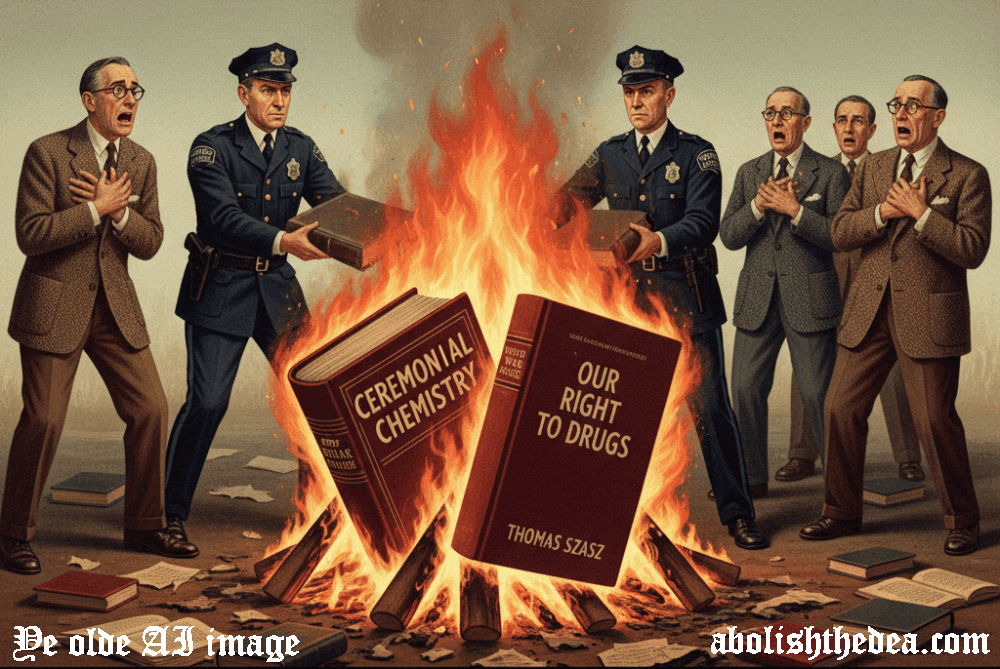
Thomas Szasz1 was an American-Hungarian doctor who saw through the unprecedented madness of America's drug-related attitudes like no one else. He revealed the philosophical inanity of those attitudes in clear language. He has a special place in my heart since he is the only drug pundit who not only answered a letter of mine on the subject of drugs, but responded to it in detail, and in a handwritten letter no less. This was in the 1980s, unfortunately, when I had yet to appreciate the full evil of drug prohibition. I wish our years on earth had aligned more felicitously so that I could bounce my ideas off the man today, rather than to continue tossing them in vain at the brick walls erected by the bamboozled pundits of our time.
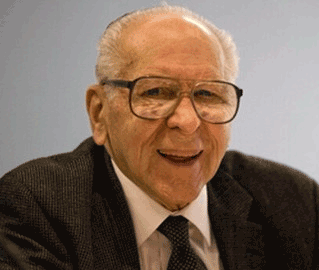
The following are just a few of the insightful citations found in Szasz's philosophical analyses of the origin, nature, and consequences of America's drug-related madness. (See also After Szasz)
It is a grievous mistake to conceptualize certain drugs as a "dangerous enemy" we must attack and eliminate, instead of accepting them as potentially helpful as well as harmful substances, and learning to cope with them competently2. Thomas Szasz, Our Right to Drugs
The right to chew or smoke a plant that grows wild in nature, such as hemp (marijuana), is anterior to and more basic than the right to vote. Thomas Szasz, Our Right to Drugs
How can a person lose the right to his body? By being deprived of the freedom to care for it and to control it as he sees fit. Thomas Szasz, Our Right to Drugs
In the psychiatric drug market, we as a society are saying, "The patient is always wrong": The psychiatrist decides what drug the mental patient "needs" and compels him to consume it, by force if necessary.3 Thomas Szasz, Our Right to Drugs
The principal role of medical, and especially psychiatric, professionals in the administration and enforcement of this system of chemical statism is to act as double agents-- helping politicians to impose their will on the people by defining self-medication as a disease4, and helping the people to bear their privations by supplying them with drugs. Thomas Szasz, Our Right to Drugs
Lacking the usual grounds on which people congregate as a nation, we [Americans] habitually fall back on the most primitive yet most enduring basis for group cohesion, namely, scapegoating. Thomas Szasz, Our Right to Drugs
Although there is no evidence that the American consumer ever complained about the free market in drugs, there is plenty of evidence that his self-appointed protectors complained bitterly and loudly. Thomas Szasz, Our Right to Drugs
Although initially the drug laws were intended to protect people from being "abused" by drugs others wanted to sell them, this aim was soon replaced by that of protecting them from "abusing" drugs they wanted to buy. The government thus succeeded in depriving us not only of our basic right to ingest whatever we choose, but also of our right to grow, manufacture, sell, and buy agricultural products used by man since antiquity. Thomas Szasz, Our Right to Drugs
We live in a society in which people have legal access to loaded guns but not to sterile syringes5. Thomas Szasz, Our Right to Drugs
Unless this clear distinction between vices and crimes be made and recognized by the laws, there can be on earth no such thing as individual right, liberty or property... Thomas Szasz, Our Right to Drugs
Truly we are the redeemer nation, our centuries-old ambivalence toward alcohol seemingly entitling us to assume the role of moral savior not merely of our own people, but of people everywhere. Thomas Szasz, Our Right to Drugs
The various drug-regulatory measures enacted during the prewar years of Roosevelt's presidency... led inexorably to the present situation of virtually complete state control of the drug economy, which I call 'chemical statism' (drug socialism). Thomas Szasz, Our Right to Drugs
It is this longing for a holy utopia that leads to the fateful obliteration of the distinction between vice and crime, and the tragic transformation of the virtue of temperance into the vice of prohibition. Thomas Szasz, Our Right to Drugs
If our love of the Constitution and gratitude for our heritage cannot keep us united as a nation, then hatred of 'dangerous drugs' must do the job. Thomas Szasz, Our Right to Drugs
The laws that deny healthy people 'recreational' drugs also deny sick people 'therapeutic' drugs. Thomas Szasz, Our Right to Drugs
Actually, as a slogan, 'Just say no to drugs' is simply witless, in both senses of that word: It is at once humorless and stupid, leaving unsaid to what drugs, in what doses and under what circumstances one ought to say no. Thomas Szasz, Our Right to Drugs
It was the Reagans who, through the repetition of a moronic anti-drug slogan, taught American children to spy on their parents and denounce them to the police. Thomas Szasz, Our Right to Drugs
Drug education... is the name we give to the state-sponsored effort to inflame people's hatred and intolerance of other people's drug habits, which is as indecent as it would be to inflame people's hatred and intolerance of other people's religious habits and call it 'religion education.' Thomas Szasz, Our Right to Drugs
If we argue from principle, then it is moot whether drug prohibition works, because it is problematic what should count as its 'working.' The very existence of such a mass movement of scapegoating-- uniting a diverse people in a common hatred-- may be regarded as evidence that, simply put, it is working. Thomas Szasz, Our Right to Drugs
There is no scientific basis for any of our 'drug policies' -- a term that, in this context, is a euphemism for prohibiting pharmaceutical and recreational drugs. Warning people about the risks a particular drug poses is the most that science can be made to justify6. Thomas Szasz, Our Right to Drugs
The undertreatment of pain in hospitals is absolutely medieval. Thomas Szasz, Our Right to Drugs
One of the most tragic and publicly least understood side effects of the War on Drugs is that so many sick Americans suffering from painful illnesses are systematically deprived of adequate doses of painkilling drugs because of physicians' well-founded fears of prescribing so-called controlled substances. Thomas Szasz, Our Right to Drugs
The therapeutic state... prevents sane adults from taking the drugs they want, and insane adults from rejecting the drugs they do not want. Thomas Szasz, Our Right to Drugs
More often than not, the effective treatment of pain requires neither clinics nor doctors, but only a free market in drugs. However, such pharmaceutical freedom would make our highly paid pain researchers and pain clinicians unnecessary and unemployed. Thomas Szasz, Our Right to Drugs
When even so staunch a defender of the free market as Milton Friedman regards treatment as the proper response to the drug problem, how can we expect ordinary people to resist this deadly illusion? Thomas Szasz, Our Right to Drugs
Both the Soviet Union and the United States thus became persecutory states-- one determined to find and punish people dealing in real money, epitomized by traffickers in hard currencies; the other determined to find and punish people dealing in pleasure-producing chemicals, epitomized by traffickers in hard drugs. Thomas Szasz, Our Right to Drugs
Step by step, generation after generation, habits of law engendered habits of mind, and vice versa, until in the Soviet Union the idea of a free market in land and houses became unthinkable, and in the United States the idea of a free market in drugs became unthinkable. Thomas Szasz, Our Right to Drugs
If we were true to our political heritage, our aim would be not a 'drug-free America,' but an 'America free of drug laws.' Thomas Szasz, Our Right to Drugs
If my critique of drug controls seems extreme or radical, let me observe that in fact it is neither. It is old-fashioned and, strictly speaking, conservative. I take my stand with the Old and New Testaments, where many sins are enumerated, but using drugs is not one of them. Thomas Szasz, Our Right to Drugs
The less people know what they are talking about, the more likely they are to mistake knowing a term for knowing something about the real world. Thomas Szasz, Psychiatry: The Science of Lies
Formerly, opium was a panacea; now it is the cause and symptom of countless maladies, medical and social, the world over. Thomas Szasz, Ceremonial Chemistry: the ritual persecution of drugs, addicts, and pushers
We are repelled by the opium habit not because it is harmful, but the other way around: we regard it as harmful in order to maintain our justification for prohibiting it7. Thomas Szasz, Ceremonial Chemistry: the ritual persecution of drugs, addicts, and pushers
“Alcohol and Christianity,” said Nietzsche, are “the two great European narcotics.” Thomas Szasz, Ceremonial Chemistry: the ritual persecution of drugs, addicts, and pushers
A physician who is a professor in a medical school here asserts that heroin addiction is like malaria, that heroin is like a parasite, and that the person who sells heroin is like a mosquito. The verminization of the human being8, begun by the Health Ministry of National Socialist Germany, is thus continued— without any public recognition that it is— through the American war on “drug abuse.” Thomas Szasz, Ceremonial Chemistry: the ritual persecution of drugs, addicts, and pushers
The “answer,” then, to our drug problem, insofar as one can meaningfully speak of such an answer, assuredly does not lie in bringing our drug laws in line with so-called scientific information. It lies, instead, in demythologizing and de-ceremonializing our use and avoidance of drugs— something we are unlikely to accomplish without finding another, hopefully more humanly appropriate, vehicle for our symbolic coming together as a community of people. Thomas Szasz, Ceremonial Chemistry: the ritual persecution of drugs, addicts, and pushers
The plain historical facts are that before 1914 there was no “drug problem” in the United States; nor did we have a name for it. Today there is an immense drug problem in the United States, and we have lots of names for it. Which came first: “the problem of drug abuse” or its name? It is the same as asking which came first: the chicken or the egg? Thomas Szasz, Ceremonial Chemistry: the ritual persecution of drugs, addicts, and pushers
If, nevertheless, textbooks of pharmacology legitimately contain a chapter on drug abuse and drug addiction, then, by the same token, textbooks of gynecology and urology should contain a chapter on prostitution; textbooks of physiology, a chapter on perversion; textbooks of genetics, a chapter on the racial inferiority of Jews and Negroes; textbooks of mathematics, a chapter on gambling syndicates; and, of course, textbooks of astronomy, a chapter on sun worship. Thomas Szasz, Ceremonial Chemistry: the ritual persecution of drugs, addicts, and pushers
Presumably some persons have always “abused” certain drugs— alcohol for millennia, opiates for centuries. However, only in the twentieth century have certain patterns of drug use been labeled as “addictions.”9 Thomas Szasz, Ceremonial Chemistry: the ritual persecution of drugs, addicts, and pushers
The single most important issue in coming to grips with the problem of drug use and drug avoidance is, in my opinion, the medical perspective on moral conduct. Thomas Szasz, Ceremonial Chemistry: the ritual persecution of drugs, addicts, and pushers
If the study of drug addiction belongs to pharmacology because addiction has to do with drugs, then the study of baptism belongs to inorganic chemistry because this ceremony has to do with water. Thomas Szasz, Ceremonial Chemistry: the ritual persecution of drugs, addicts, and pushers
As the Christian West once confronted the problem of witchcraft, so now the Scientific World confronts the problem of drugcraft. The one had been as much the product of its own creation as is now the other.10 Thomas Szasz, Ceremonial Chemistry: the ritual persecution of drugs, addicts, and pushers
The American war against the Chinese in the United States was a terrible tragedy— regardless of how often this drama continues to be enacted on the stage of history. Although “we” did not succeed in beating “them” down, at least “we” took away something that “they” treasured and that made life better for “them.” Envious persecutors must be thankful for small victories no less than for large.11 Thomas Szasz, Ceremonial Chemistry: the ritual persecution of drugs, addicts, and pushers
The answer to whether a person finds it easy or difficult to give up a drug habit thus lies not in the drug, but in the use to which the person who takes it puts it, and in the substitutes for it that he can or wants to employ. Thomas Szasz, Ceremonial Chemistry: the ritual persecution of drugs, addicts, and pushers
The foregoing evidence clearly justifies the conclusion that addictions are habits; that habits enable us to do some things, and disable us from doing others; and hence, that we may, indeed must, judge addictions as good or bad according to the value we place on what they enable us to do or disable us from doing. Thomas Szasz, Ceremonial Chemistry: the ritual persecution of drugs, addicts, and pushers
Here, then, is the basic conflict and contradiction between the Muslim and methadone; the former eliminates the problem, and thus the need for the white man and the doctor, by making the Negro self-responsible and self-reliant; the latter makes the white man and the doctor indispensable by making the Negro a permanent medical cripple and a lifelong patient, on the model laid down long ago by Benjamin Rush. Thomas Szasz, Ceremonial Chemistry: the ritual persecution of drugs, addicts, and pushers
The religious war that Malcolm declared and waged, without quite realizing it, was the war against the religion of Medicine. After all, not only the whites, but most of his own black people, and all of the black leaders, believed— and continue to believe— that drug abuse is an illness. Thomas Szasz, Ceremonial Chemistry: the ritual persecution of drugs, addicts, and pushers
Whatever the outcome, I believe it is now clear, and that it will be even clearer in the future, that wherever else these parties may stand on other matters, on drug abuse and drug addiction, the position of organized American medicine and of organized American politics contradicts every principle and practice on which the United States was founded; whereas that of the Black Muslims is in the best American tradition. Thomas Szasz, Ceremonial Chemistry: the ritual persecution of drugs, addicts, and pushers
Medical schools should teach the anatomy of Pandora’s Box no less intensively than they teach the anatomy of other containers with whose contents they expect the educated physician to be familiar. Thomas Szasz, Ceremonial Chemistry: the ritual persecution of drugs, addicts, and pushers
Such is life in the Age of Madness, where the ruling religion is Scientific Medicine. Thomas Szasz, Ceremonial Chemistry: the ritual persecution of drugs, addicts, and pushers
Thomas S. Blair— a physician and the chief of the Bureau of Drug Control of the Pennsylvania Department of Health— gave his essay the wonderfully revealing title “Habit Indulgence in Certain Cactaceous Plants among the Indians.”2 The Indians, of course, had no Journal of the Indian Peyote Association in which they could have published an article on “Habit Indulgence in the Fermented Juice of Certain Grapes among the Americans.” Right from the start, then, the Indians were peyote addicts— while the Americans laughed all the way to the speakeasies. Thomas Szasz, Ceremonial Chemistry: the ritual persecution of drugs, addicts, and pushers
The American Medical Association —the Vatican of the American Medical Church— had picked up the torch dropped by the Spanish Inquisition and has never relinquished its hostility toward non-alcoholic pharmacomythologies. Thomas Szasz, Ceremonial Chemistry: the ritual persecution of drugs, addicts, and pushers
If it were necessary to restrict the choice of drugs to a very few, the great majority of physicians would place the opium alkaloids, particularly morphine, at the head of the list. Morphine is unequalled as an analgesic and its indispensable uses in medicine and surgery are well defined. Thomas Szasz, Ceremonial Chemistry: the ritual persecution of drugs, addicts, and pushers
In February 1970 an editorial in the Syracuse Post-Standard not only heaped lavish praise on Governor Rockefeller’s “$265-million crash program to fight drug addiction,” but also urged “one man in total charge of the program armed with almost dictatorial powers ... a czar, if you will.” The editorial concluded with this revealing warning: “One of the very first things that needs to be done is to rid the State University and the public schools of every faculty member or employee who publicly, or privately, defends the right of students to use any kinds of drugs. . . .” Not even aspirin? Thomas Szasz, Ceremonial Chemistry: the ritual persecution of drugs, addicts, and pushers
The definitions of tobacco and alcohol as agricultural products and of marijuana and opium as dangerous drugs— definitions authenticated by both the United States government and the United Nations— at once illustrate that we live in a pharmacracy, and display its particular values. Thomas Szasz, Ceremonial Chemistry: the ritual persecution of drugs, addicts, and pushers
In Galenic practice the most useful medicine was a theriaca, or antidote, named Electuarium theriacale magnum, a compound composed of several ingredients, among them opium and wine. Thomas Szasz, Ceremonial Chemistry: the ritual persecution of drugs, addicts, and pushers
Although opium remained a medical panacea until the end of the nineteenth century, from the Middle Ages on similar claims were made for other substances as well, especially for alcohol. Thomas Szasz, Ceremonial Chemistry: the ritual persecution of drugs, addicts, and pushers
It has evidently been common law enforcement practice in recent years to deploy undercover narcotics agents posing as patients to doctors’ offices, to entrap physicians into prescribing “controlled substances” illegally. Thomas Szasz, Ceremonial Chemistry: the ritual persecution of drugs, addicts, and pushers
The Harrison Act, passed in 1914, aimed ostensibly at controlling addicts, was actually used to control physicians. Thomas Szasz, Ceremonial Chemistry: the ritual persecution of drugs, addicts, and pushers
It follows that the more man’s view of human nature emphasizes spiritual values, free will, and human differentiation and selfdetermination, the greater will be the scope of controlling conduct through self-control. And the more man’s view of human nature emphasizes material values, scientific determinism, and human equality and perfectibility, the greater will be the scope of controlling conduct through external coercion. Thomas Szasz, Ceremonial Chemistry: the ritual persecution of drugs, addicts, and pushers
The maxim “He who governs least, governs best” not only expresses the basic principle of decency and dignity in statecraft; it also furnishes the only preventive known to mankind against the characteristic crowd madnesses of overcontrol, manifested by the war on witchcraft formerly and by the war on drugcraft today. Thomas Szasz, Ceremonial Chemistry: the ritual persecution of drugs, addicts, and pushers
For people have used and avoided drugs— and especially drugs that affect behavior— during all of recorded history. All this time it never occurred to anyone to regard another person who uses drugs differently than he does as “sick” —any more than it would have occurred to anyone to regard someone who worshipped differently as 'sick.' Thomas Szasz, Ceremonial Chemistry: the ritual persecution of drugs, addicts, and pushers
The capitalists and therapeutists, overcome with compassion (genuine or pretended) for the suffering of addicted people due to their illness, and with sympathy for their boundless craving for drugs, find the incarnation of their enemy in the “dangerous drug” and the “pusher.” Since they too condemn what people in fact crave, there remains only one way for them to mitigate their frustration: by eliminating the very thing that people want. Hence the cry to eliminate “dangerous drugs” and “pushers,” and to extol “healthy” living (that is, addiction to drugs mandated by the State). Thomas Szasz, Ceremonial Chemistry: the ritual persecution of drugs, addicts, and pushers
It is so obvious and so well known that most prohibitions generate massive defiance of them— especially if the prohibited acts supposedly injure only the actor himself, and actually do not injure even him— that I will only record my amazement here about how people can blind themselves to this rule when trying to think about and deal with the “drug problem.” Thomas Szasz, Ceremonial Chemistry: the ritual persecution of drugs, addicts, and pushers
It is quite impossible to know— without knowing a great deal about such a person, his family and friends, and his whole cultural setting— just what such an individual is doing and why. But it is quite possible, indeed it is easy, to know what those persons who try to repress certain kinds of drug uses and drug users are doing and why. Thomas Szasz, Ceremonial Chemistry: the ritual persecution of drugs, addicts, and pushers
If we want to persecute “pushers” and “treat addicts,” then information inconvenient to our doing these things will only get in our way. Drug-abuseologists can no more be “educated” out of their coercive tactics than can drug addicts. Thomas Szasz, Ceremonial Chemistry: the ritual persecution of drugs, addicts, and pushers
What does this larger view show us? It shows us that our present attitudes toward the whole subject of drug use, drug abuse, and drug control are nothing but the reflections, in the mirror of “social reality,” of our own expectations toward drugs and toward those who use them; and that our ideas about and interventions in drug-taking behavior have only the most tenuous connection with the actual pharmacological properties of “dangerous drugs.” Thomas Szasz, Ceremonial Chemistry: the ritual persecution of drugs, addicts, and pushers
Reagan paid a personal price for his idiocy however. He fell victim to memory loss from Alzheimer's, after making a career out of demonizing substances that can grow new neurons in the brain!
The term "drugs" is no more objective than the term "scabs." Both are meant to defame the things that they connote.
Let's arrest drug warriors, confiscate their houses, and deny them jobs in America -- until such time as they renounce their belief in the demonstrably ruinous policy of substance prohibition.
Opium and cocaine have a vast host of potential rational uses -- yet we all have to pretend otherwise in the age of the Drug War.
It wasn't until western prudery and racism came along that we started to judge people by the substances that they chose to ingest, rather than by their actual behavior in the world.
In 2017 alone, 1,632,921 drug arrests were made with 85.5 percent of those solely for possession. -- War On Us
The so-called "herbs" that witches used were drugs, in the same way that "meds" are drugs. If academics made that connection, the study of witchcraft would shed a lot of light on the fearmongering of modern prohibitionists.
Now the folks who helped Matthew get Ketamine must be sacrificed on the altar of the Drug War, lest people start thinking that the Drug War itself was at fault.y
Drug prohibition has resulted in hundreds of thousands of completely unnecessary deaths thanks to totally preventable drug overdoses!
Almost every mainstream article about psychology and consciousness is nonsense these days because it ignores the way that drug prohibition has stymied our investigation of such subjects.