



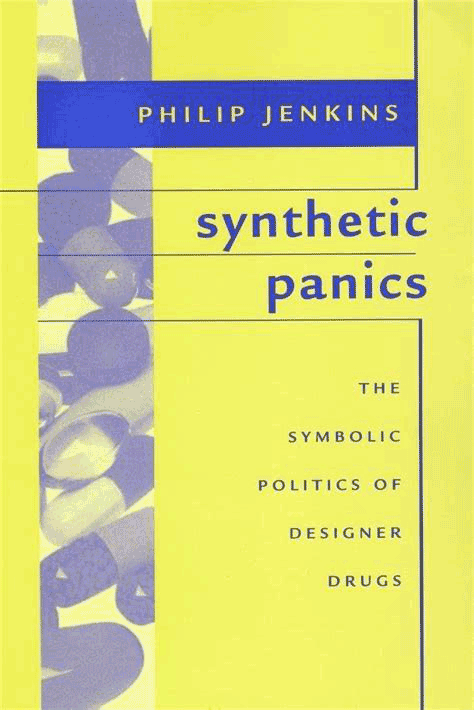

I have just finished reading the second half of your excellent book, "Synthetic Panics," and wished to share my comments. As I've mentioned, the book is excellent but very aggravating for me to read.
You see, I am a 64-year-old chronic depressive who has gone a lifetime now without godsend medicines because of prohibition and the War on Drugs. So when I read of the precise details by which the media and politicians bamboozle America on this topic, it infuriates me. It infuriates me because I don't see the Drug War as simply bad policy: I see it as a wrong way of looking at the world, one that causes all of the problems that it purports to solve and then some.
I hope that you will find these book-related musings interesting and will give me your thoughts after reading them. Please know that none of these comments are meant as criticism, implied or otherwise. They are simply the ideas that occurred to me while reading your highly informative book.
Thanks again for a great read!
Brian
Author's note: I am not trying to bash Libertarians in the piece that follows. But when Philip Jenkins talks about efforts to push back drug prohibition, he cites the views of Libertarians. That's why I am compelled to discuss the shortcomings of the Libertarian response to the Drug War.
1) LIBERTARIANISM: I personally feel that the Libertarian argument for drug legalization is very weak. It says essentially that people should have the right to go to the devil in their own way. But this is yielding enormous ground to the Drug Warrior by implying that there is no good reason for drug use other than to cater to the hedonistic propensity of slackers. There is no mention of the fact that the Inca considered the coca tree to be semi-divine, that a psychedelic substance inspired the Vedic-Hindu religion, or that William James said the study of consciousness required the investigation of altered states produced by "drugs." The philosophy of John Stuart Mill 1 (which Jenkins also cites) is equally problematic, at least in the way that it is employed in connection with the Drug War, for it tends to characterize drug use as a "victimless crime," thereby, again, yielding massive ground to the Drug Warriors by seeming to agree with them about the horribleness (the innate criminality, so to speak) of the politically defined substances that we call "drugs."
Milton Friedman himself misunderstood the Drug War entirely when he said in 1972 that "reasonable people" could be on either side of the legalization debate. Would reasonable people support a policy that censors academia 2 ? Would reasonable people discourage research on drugs that grow new neurons in the brain and hence could treat Alzheimer's 3 patients? Would reasonable people say that Americans can be thrown out of the workforce without trial merely for using substances of which politicians disapprove? Would reasonable people say that Americans have no natural right to the plants and fungi that grow at their very feet? The fact is no reasonable person can be in favor of the Drug War, once we take the time to spell out the many anti-democratic implications of such a social policy, like the way it has destroyed the rule of law in Latin America and empowered a self-styled "Drug War Hitler" in the Philippines. In fact, subsequent events have proven Milton Friedman to be as wrong as Bill Gates when he said that no one would need a personal computer at home. The Drug War ultimately led to the election of Donald Trump by removing millions of Blacks from the voting rolls. Given the close elections of our times, that wholesale sidelining of minority voters undoubtedly handed the 2016 election to Trump (and filled Congress with many of his supporters). That's the Drug War at work: no reasonable person can be in favor of it. And the Drug War isn't through with America yet. Should Trump win another election, it could very well be the end of democracy as we know it, and this would all be because of that Drug War about which Friedman told us that reasonable people could disagree!
2) THE INVISIBLE STAKEHOLDERS: This brings us to the second enormous problem that afflicts both Drug Warriors and many of their opponents, whether we're talking about Libertarians or neoliberals like Francis Fukuyama. In addition to downplaying (or more usually ignoring) the positive potential of drugs, both groups ignore all stakeholders in the drug legalization 4 debate except for potentially irresponsible young people. If a handful of that demographic are dying "drug-related deaths," then all other demographics in the world must pay the price, as prohibition keeps godsend medicines from the depressed, anxious, and those in physical pain. Yet these latter stakeholders, as numerous as they are, are always ignored in drug debates. Why? Because politicians respond only to drug problems that end up on the Six O'clock News. No one cares about the millions who suffer in silence in a private residence or care home merely because we have outlawed drugs based on our perception of their worst possible imaginable use. In a recent example, the Brits are getting ready to criminalize laughing gas 5 because of the substance being misused in certain London neighborhoods. The UK politicians see the stakeholders only as vulnerable young people: they are thereby throwing the depressed under the bus viz. a great though widely underused therapy. They are also outlawing the philosophical research into human consciousness that William James told us that we needed to investigate if we were to ever understand ultimate reality. Of course it never occurs to the politicians to teach safe use. SWAT trucks full of educators could descend on the affected regions to teach safe use; but safe use is what the government is committed to preventing because of its superstitious and anti-scientific demonization of "drugs" as somehow evil in and of themselves. They should acknowledge their puritanical debt to Mary Baker Eddy and thus come clean about their religious motivation in prosecuting this war on users.
3) THE ANTI-SCIENTIFIC PREMISE OF DRUG PROHIBITION: The assumption behind drug prohibition is an anti-scientific one: it says essentially the following: That if a psychoactive substance can cause a problem for anyone, then it must not be used by anyone, ever, anywhere, at any dose. If this standard were applied to "physical" medicine, then no drugs would ever be approved. The very idea that these drugs have no valid medical use is a philosophical and a political statement, not a scientific one. History shows us that the drugs we outlaw have enormous powerful uses; that's no doubt why the Drug Warriors fear them. These drugs have inspired entire religions. To say that they have no valid uses is politics and ideology, not science. Indeed, opium 6 was considered to be a panacea by Galen, Paracelsus and Avicenna. Even given a little exaggeration on their part, how could a candidate for panacea status have no positive uses whatsoever? Besides, does Mother Nature's bounty require approval by the government? The garden-loving Thomas Jefferson never thought so. That's why he was rolling in his grave when the DEA stomped onto Monticello 7 in 1987 and confiscated his poppy plants in violation of the natural law upon which he had founded America. John Locke was Jefferson's go-to man when it came to Natural Law, and Locke maintained that the bounty of Mother Nature was for the use of humankind and was not the property of government to dole out or withhold as it saw fit.
4) PERVERSE PRIORITIES: The outlawing of Ecstasy demonstrates the misplaced priorities of the Drug Warrior. The use of Ecstasy facilitated unprecedented peace on the UK dance floors. (See my article on "How the Drug War Killed Leah Betts.") >>> <<< And yet politicians do not want unprecedented peace; they needed only one supposedly "Ecstasy-related death" to appear on the Six O'clock News before they cracked down on Ecstasy use in the mid-'90s. And what was the result? As concert promoter Terry Stone reported in the documentary "United Nation," the dance floor had to be monitored by SPECIAL FORCES TROOPS as dancers switched to anger-facilitating drugs like alcohol. SPECIAL FORCES! Just imagine the perverted priorities implied by this situation: we live on the brink of nuclear destruction caused by hatred, in a world full of school shootings by haters, and yet Drug Warriors have done everything they can to demonize Ecstasy, a drug that brings folks of all backgrounds together in peace. You cite one Ecstasy user as saying that the drug brought him "joy," but what it really brought users was compassion -- and that's apparently the crime for which the macho Drug Warriors could never forgive it. This is the same perverse mindset that causes doctors to prescribe brain-damaging shock therapy for the depressed while refusing to give them godsend plant medicines that grow at their feet, the same mindset that will often allow doctors to prescribe medicines that will kill their depressed patient, while forbidding them from prescribing medicines that would make their patient want to live.

Ecstasy opponents keep hoping that they'll find a study that conclusively shows that the drug can be harmful; but here we must remember that when it comes to psychoactive drugs, a cost-benefit analysis about "using" involves not just a consideration of scientific facts, but also of the dreams and aspirations of a potential user. And scientists have no expertise in this area. It is the realm of the personal and subjective. So while science can tell us about potential harms, it can never answer the question of whether the use of a given substance survives a cost-benefit analysis in the life of the potential user. Moreover, there is a cost-benefit analysis to be made for society at large as well: "Is the risk of downsides reasonable given the fact that doing without such drugs would make school shootings and nuclear annihilation more likely?" Scientific "facts" are just part of the discussion, whereas Drug Warriors want those "facts" to be the whole story. That's why they're eager to dredge up some downside for Ecstasy, because in the Drug Warrior's mind, one swallow makes a summer, and one downside for Ecstasy means that the drug must be unavailable for anyone, anywhere, at any dose, for any reason, ever. "Follow the science," they say, failing to notice that science is political in the age of the Drug War, which can be clearly seen by the fact that almost all drug-related articles in academia are about abuse and misuse, rarely about positive use.
5) HARM REDUCTION: Harm reduction is a very problematic concept in the context of the Drug War. The constant talk about harm reduction helps reinforce the idea that drugs are indeed bad. Instead, we should be talking about BENEFIT MAXIMIZATION, or at very least SAFE USE. To focus on harm reduction is to yield much ground to the Christian Science prejudices of the Drug Warrior.
6) BENEFITS OF DRUG USE: We can imagine endless potential positive uses for drugs once we jettison the unscientific notion that drugs can be judged by their worst imaginable use. Psychedelics can be used to improve one's appreciation of music; Ecstasy can help haters learn compassion; speed and coke can help folks get through rough schedules and be prolific and detail-focused. In the properly predisposed users, morphine 8 can provide an almost surreal appreciation of Mother Nature's byzantine wonders (see "Tale of the Ragged Mountains" by Edgar Allan Poe). Yet Americans have been frightened into believing that these drugs can never be used wisely by infantile human beings9. But if this appears to be so, it is only because of America's attitude about drugs, which forbids discussion of safe use, meanwhile limiting our illegal access to only drugs chosen by dealers for financial and practical reasons, not with user safety in view. When all drugs are legal and regulated and safe use is taught, and cases of local misuse are responded to with education - rather than with campaigns by the DEA and media to parlay such incidents into a national crisis - then we can start to benefit from Mother Nature rather than demonizing her. And when I say "all drugs," I mean all drugs: not just the handful of drugs that we have been specifically taught to fear, but drugs like ibogaine and salvia - and the seemingly endless substances which, in a sane society, could serve as useful distractions and alternatives from drugs like heroin 10 and cocaine 1112 , should use of those latter substances become problematic for a given user.
Thanks again for the great book. You really helped me see how the DEA works with modern media to parlay local drug-related issues into national crises. Speaking of which, you might get a laugh out of my new Partnership for a Death Free America, wherein I parody this modern obsession with drug risks by extending prohibition advocacy to things like shopping carts and peanuts (both of which kill hundreds of people every year, many of them white young people with their whole futures ahead of them, bless them!!!) For there is at least one good thing about Drug Warriors: the more outrageously they crack down on "drugs," the more we can hold their feet to the fire with the use of reductio ad absurdum!
Author's Follow-up: August 4, 2023
A perennial protestor of mine told me today that there are no synthetic panics, that they are REAL! Of course, she hasn't read the book, but she apparently got the title down perfectly. She's one of those scientistic folks who thinks that we can talk meaningfully about things like addiction without mentioning the Drug War (which limits the quantity and quality of drugs while refusing to teach safe use).
But then she's in good company. Magazines like Science News and Scientific American regularly give us the latest "expert" ideas about happiness and human consciousness and ultimate reality, never mentioning the fact that we have outlawed almost all psychoactive substances and thereby limited our investigations to purely materialistic considerations. That's why you'll see plenty of pabulum about beating depression with dieting, meditation, jogging, ad nauseam -- from authors who seem to be completely unaware of the time-honored power of illegal drugs to improve mood on the QT (something that even high-schoolers know, for God's sake). Yet the materialist scratches his or her head: "Why is depression so hard to beat?" Answer: It's not. The Peruvian Indians beat it easily with the daily chewing of the coca leaf. Depression is hard to beat because the puritan Drug Warriors have decided that it SHOULD BE hard to beat. But materialists like my online nemesis want to redirect attention to brain chemistry and genetics, so they can puff themselves up professionally and say, "We will find the cause of depression -- step back and let science go to work!"
Yes, there are no doubt propensities for problematic drug use, but that's beside the point as long as we are outlawing godsend medicines, many of which are blazingly obvious treatments for depression when used wisely (something that the defeatist Drug Warrior claims that childish humanity can never do, a belief that, of course, is a self-fulfilling prophecy in the age of the Drug War).
Americans have been taught to judge drugs by their worst possible use. If we approached all substances this way, we would still be shouting "Fire bad!" like our prehistoric forebears.
Author's Follow-up:
December 31, 2025
I had to chime in again on New Year's Eve 2025 -- after reading about that naysayer from 2023, the one who said that there are things to panic about, indeed, when it comes to drugs.
Why doesn't she panic about the daily deaths caused by alcohol? Alcohol kills 178,000 every year in the United States alone. Why doesn't she panic about the fact that 1 in 4 American women are dependent on Big Pharma drugs for life? Answer: Because the government is not spending billions of dollars to make her think that such things are huge problems that she needs to panic over!!! That's why she isn't panicking!
The problem with panic is that it always ends up calling for counterproductive solutions. And prohibition is the most palpably counterproductive policy in the world. It not only does not prevent drug use but it makes it far deadlier than ever, meanwhile turning inner cities into no-go zones and causing civil wars overseas. It destroys the rule of law, incentivizes death and torture, and causes determined users to ingest tainted product of uncertain quality and quantity.
That's the problem with panic.
America needs to grow up and realize that all substances -- yes, even the ones we like to panic about -- have good potential uses for somebody, in some circumstance at some time, and that to outlaw them based on purely abstract considerations is anti-scientific and a violation of the right of human beings to heal.
Moreover, panic is all about ignoring stakeholders. It is a selfish panic. When such as the aforementioned plaintiff panics about drugs, she seeks to craft laws that will protect her children from a substance that could have been a godsend for the depressed, or those in pain, or those in hospice. Such people are selfish, too, in that they would outsource the dangers of drugs to minority communities. She is not keeping people safe. She is rendering the world totally unsafe, in the mistaken and massively selfish idea that she can thereby artificially protect her own loved ones from the fact that the world is full of psychoactive substances.
Panic is the problem. It causes prohibition and prohibition is a killer. We have known this since liquor prohibition and so the fact that we persevere with the prohibitionist mindset is totally inexcusable and proves that -- at some deep level -- we prefer violence and death to sanity when it comes to drugs, that we love to have a scapegoat upon which we can blame all problems. As Thomas Szasz wrote in Our Right to Drugs:
"Lacking the usual grounds on which people congregate as a nation, we [Americans] habitually fall back on the most primitive yet most enduring basis for group cohesion, namely, scapegoating." --Thomas Szasz 13

America needs to grow up and face the truth: that prohibition is a childish and counterproductive way to address social issues and that it's silly to blame inanimate things for our problems. Drugs do not cause problems. If people in our society have trouble using them safely, that tells us something about our society, not about drugs. It tells us that we haven't bothered to educate, that we haven't bothered to regulate, that we haven't bothered to use drugs as wisely as possible for the benefit of human beings. But Americans are in the most massive state of denial imaginable on this subject, so much so that we travel overseas in an attempt to eradicate the plants that we hold responsible for our troubles -- on soil that does not even belong to us! And so our attitude toward drugs today is pure caveman. In fact, saying things like "Fentanyl kills!" and "Oxy kills!" is philosophically equivalent to saying "Fire bad!" as did our paleolithic forebears. All such statements would have us fear dangerous substances rather than to learn how to use them as safely as possible for the benefit of humanity.
Discuss the issues raised in this essay about the hateful policy of drug prohibition.
1) Discuss the following elaboration of the points made above:
We should not determine our right to drugs based on the utilitarian considerations of the Libertarians any more than we should use such essentially quantitative standards to establish our right to free speech or to freedom of the press. There are some rights that are so basic that no freedom loving people have ever thought of abrogating them, at least until racist Drug Warriors in North America began associating particular drug use with particular hated demographics in the early 1900s. No right is more fundamental than our right to control our own health and our own mental state, and that is precisely what drug prohibition outlaws, largely by committing yet another sin of staggering proportions: that of denying us our free access to Mother Nature herself.
2) If people from the past could time-travel to the present, they would be astonished that the police spend so much time attempting to run interference between human beings and the medicinal plants and fungi that grow around them. Discuss. (See also this humorous 2-minute play about time-travel and drugs called Pity the Time Traveler.)
3) Resolved: that Drug Prohibition is a make-work program for law enforcement. Discuss.
4) Note that Philip Jenkins' book title does not mention the word drugs (although the subtitle does). Why is that so? Hint: consider such factors as censorship, self-censorship, and the prejudiced expectations of a readership that has been taught from childhood that drugs are evil, a readership that has been shielded by the media from positive news about drugs, a readership that has seen endless movies and sitcoms whose plots have been tweaked, sometimes by the White House itself, to conform to the drug-hating sensibilities of the west14.
5) Discuss the following citations in relation to the issues raised above:
"The right to chew or smoke a plant that grows wild in nature, such as hemp (marijuana), is anterior to and more basic than the right to vote." --Thomas Szasz, Our Right to Drugs --p xvi15
"Imagine how many people would have benefited during the past half-century had the government respected their autonomy and their right to self-medicate." --Jeffrey A. Singer, Your Body, Your Health Care --p. 9716
"'The poppy's central and indispensable position in our civilization makes access to it important, and thus forbidding public access to the poppy is staggeringly cruel.'" --Jim Hogshire, Opium for the Masses: Harvesting Nature's Best Pain Medication17
6) In the Hogshire quotation, the author speaks of the cruelty of outlawing the poppy. Discuss the cruelty of outlawing the coca plant, given that Sigmund Freud himself considered the coca alkaloid cocaine to be a virtual cure for human depression1819.
7) In the case of both opium and cocaine, the drugs were denounced, not just by racists but also by self-interested doctors, who stood to lose money, and perhaps even jobs, if these panaceas remained available to the public. And so they focused only on the rare downsides of misuse, exactly as if they were to judge alcohol by studying only alcoholics. Putting principle aside for a moment, are these doctors unaware of the statistical shallowness of their anti-drug arguments, especially the fact that the number of misusers whom they fret over are dwarfed by the number who could benefit from the drugs? Do the rights of the depressed count for so little that they are not even considered as stakeholders in drug debates.
The Thomas Jefferson Foundation is a drug war collaborator. They helped the DEA confiscate Thomas Jefferson's poppy plants in 1987.
You can get a Ph.D. in healthcare, and not learn a thing about the glaringly obvious benefits of drugs, as demonstrated by history, anecdote and common sense.
The FDA uses reductive materialism to justify and normalize the views of Cortes and Pizarro with respect to entheogenic medicine.
In Mexico, the same substance can be considered a "drug" or a "med," depending on where you are in the country. It's just another absurd result of the absurd policy of drug prohibition.
Drug prohibition is superstitious idiocy.
It is based on the following crazy idea:
that a substance that can be misused by a white young person at one dose for one reason must not be used by anybody at any dose for any reason.
And so, by ignoring all "up" sides to drugs, the DEA points to potential addiction as a knock-down argument for their prohibition. This is the logic of children (and uneducated children at that). It is a cost-benefit analysis that ignores all benefits.
The DEA is still saying that psilocybin has no medical uses and is addictive. They should be put on trial for crimes against humanity for using such lies to keep people from using the gifts of Mother Nature.
New article in Scientific American: "New hope for pain relief," that ignores the fact that we have outlawed the time-honored panacea. Scientists want a drug that won't run the risk of inspiring us.
I hope that scientists will eventually find the prohibition gene so that we can eradicate this superstitious way of thinking from humankind. "Ug! Drugs bad! Drugs not good for anyone, anywhere, at any dose, for any reason, ever! Ug!"
Prohibitionists are responsible for the 200,000-plus killed in the US-inspired Mexican drug war in the 21st century.