








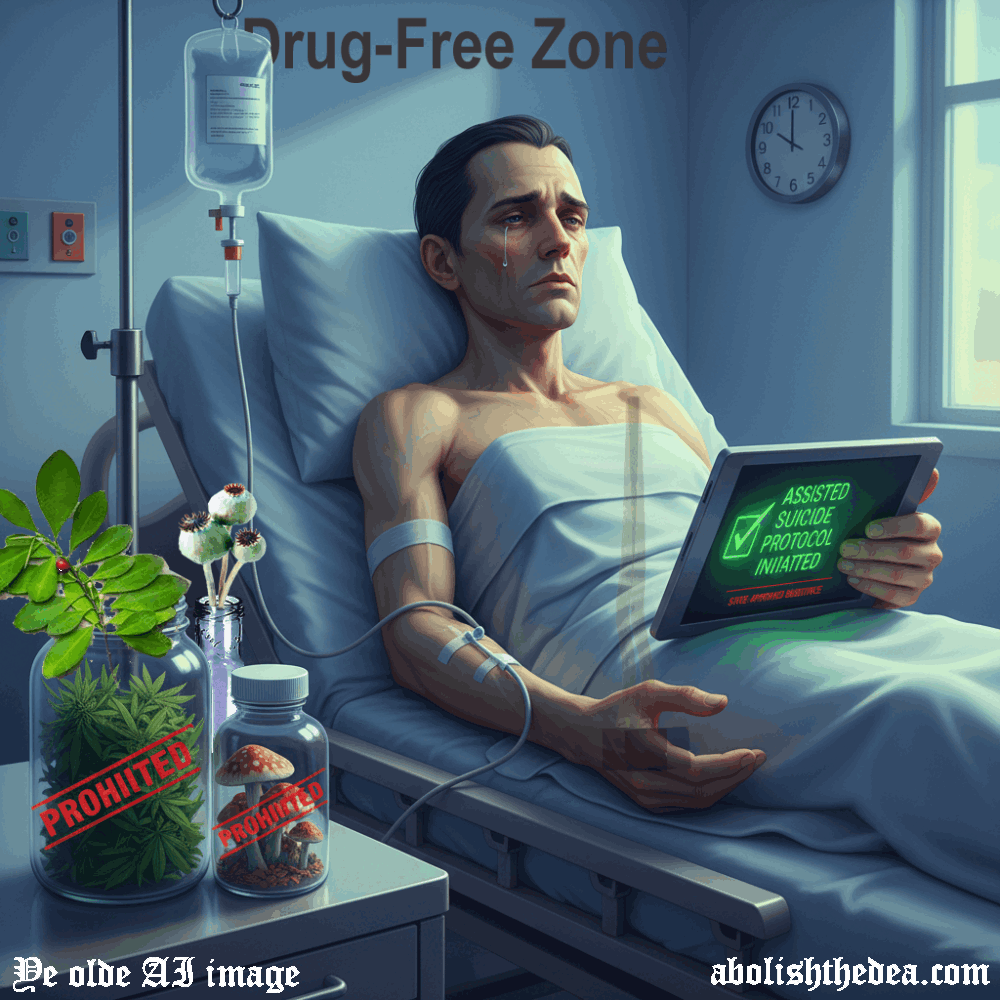
 When I first learned that North Americans like Claire Brosseau were demanding the right to assisted suicide on account of their depression, I was stunned. I simply could not understand how such westerners could "make that call" without realizing the obvious: namely, that it is drug prohibition which is keeping them from using drugs that could make them want to live! I could not understand how activists like Claire were not calling for an end to drug prohibition rather than demanding their right to die with the help of the state: the same state that was refusing to let them heal! Now that I am coming to my senses after that blow, like a boxer shaking off the effects of a left hook, I realize that assisted suicide for any reason is morally reprehensible insofar as the option is chosen in willful ignorance of the option-limiting policy of drug prohibition.
 My mind to me a kingdom is;
Such perfect joy therein I find
That it excels all other bliss
Which God or nature hath assign'd.
Laughing gas is the substance that gave William James his philosophy of reality. He concluded from its use that what we perceive is just a fraction of reality writ large. Yet his alma mater (Harvard) does not even MENTION laughing gas in their bio of the man.
Whether we judge people only by the words that they say or only by the substances of which they partake, we are ignoring the most important things: what they really mean and how they really behave.
Prohibitionists think that they merely have to use the word "drugs" to win an argument.
If Americans cannot handle the truth about drugs, then there is something wrong with Americans, not with drugs.
Rather than protesting prohibition as a crackdown on academic freedom, today's scientists are collaborating with the drug war by promoting shock therapy and SSRIs, thereby profiting from the monopoly that the drug war gives them in selling mind and mood medicine.
Antidepressants might be fine in a world where drugs were legal. Then it would actually be possible to get off them by using drugs that have inspired entire religions. In the age of prohibition, however, an antidepressant prescription is usually a life sentence.
If opium were legal, then most of the nostrums peddled by drug stores today would be irrelevant. (No wonder the drug war has staying power!)
We live in a make-believe world in the US. We created it by outlawing all potentially helpful psychological meds, after which the number-one cause of arrest soon became "drugs." We then made movies to enjoy our crackdown on TV... after a tough day of being drug tested at work.
In 1886, coca enthusiast JJ Tschudi referred to prohibitionists as 'kickers.' He wrote: "If we were to listen to these kickers, most of us would die of hunger, for the reason that nearly everything we eat or drink has fallen under their ban."
Prohibition never ended. Busybody Americans just gave alcohol a big Mulligan for killing 178,000 a year in America alone and then began fighting to outlaw everything else.


 (up)
(up)