



introduction to the Drug War Philosopher website at abolishthedea.com orange rss icon with stylized radio waves orange rss icon with stylized radio waves label reading 'add as a preferred source on Google' bird icon for twitter bird icon for twitter


back navigation arrow


Why Artificial Paradises Aren't Artificial

a philosophical analysis of Diary of a Drug Fiend by Aleister Crowley

by Brian Ballard Quass, the Drug War Philosopher

May 20, 2026


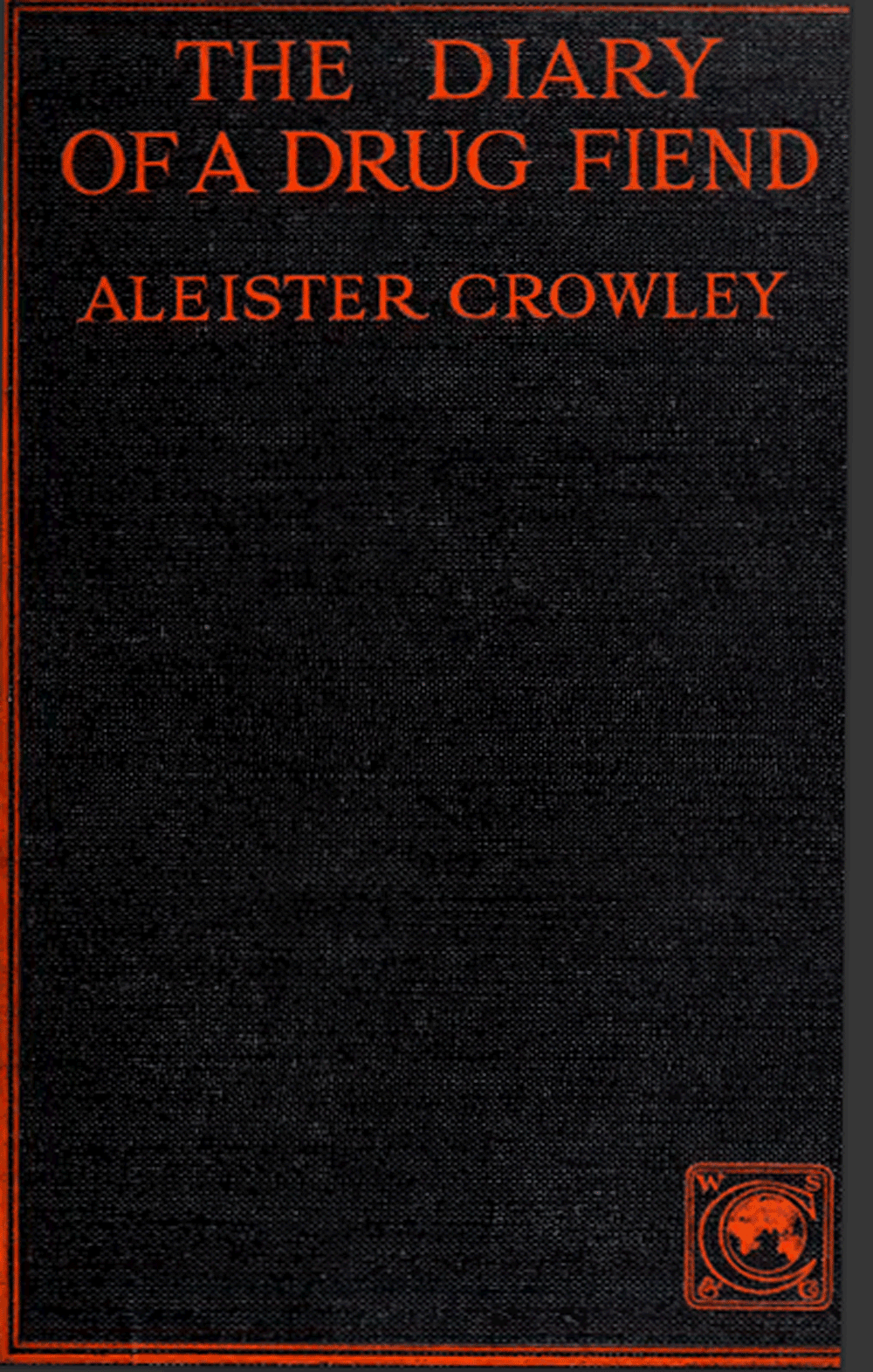
I continue to read "Diary of a Drug Fiend" by Aleister Crowley1. Not only am I reading it, but I am creating a full-cast audio performance of the book, using the latest in synthetic voices. I will be making that audiobook freely available to the entire Internet when completed as part of my ongoing efforts to educate indoctrinated westerners about common sense when it comes to drugs.

Why "Diary of a Drug Fiend"?

I used to think of the book as fringe literature, as a book with whose contents only the hard-core rebel would be familiar and whose very title the rest of us would only dare mention in an awed whisper, like the frightened hares that most of us have become on such subjects thanks to draconian drug laws. But that was before I understood how confused and silly the mainstream attitude was about drug use, how it was based on a raft of demonstrably false but self-serving assumptions, like the idea that scientists are the experts on psychoactive medicine and that even substances like laughing gas have no positive uses for the depressed. After spending the last seven years philosophically inspecting such attitudes and rebutting them at every turn, I now see that Crowley is actually the one-eyed man in the kingdom of the blind when it comes to drug attitudes. I would even call him the two-eyed man, based on the contents of this book alone, although there is at least one occasion on which, if I may be allowed to extend the optometric metaphor, I find that he himself could have benefited from a nice pair of reading glasses.

I am thinking in particular of the musings of the heroin-addicted Peter Pendragon in Book III after he was emotionally overwhelmed during detox by a musical performance of "With Muted Strings," an English-language translation of "Clair de Lune" by the French poet Verlaine. As Peter regrets what he sees as his drug-fueled distancing from the "natural" life as suggested by the poem, he draws some conclusions about drug use that must be challenged. I realize, of course, that we are dealing with a work of fiction here and that the viewpoints of Peter (especially in his most vulnerable moments) do not necessarily coincide with those of his creator, Aleister Crowley. The many characters of the "Diary" come at the subject from many points of view, after all. None are presented as necessarily speaking God's truth about drugs and drug use. Yet Peter's complaints in this case are precisely what one would expect to hear from the most rhetorically skilled of drug prohibition advocates, and so it will be instructive to parse them and to show wherein they are presumptuous, shallow and misleading, if not actually false. And so I present here the relevant portions of Peter's comments in which he holds his own hitherto enthusiastic use of cocaine and heroin up to moral criticism, contrasting it with the supposed "real" pleasures of a "natural" sobriety.

That was what nature had to offer ; this pure and ecstatic rapture was the birthright of mankind. But I, instead of being content with it as it was, had sought an artificial Paradise and bartered the reality of heaven for it....

But in our chemical substitute for natural stimulus, our despair could be sung by no nightingale.... Was it still possible to return ? Had we forfeited for ever our inheritance for a mess of beastlier pottage than ever Esau guzzled ?

I had sold my master, my True Will, for thirty pieces of poisonous copper, smeared with the slime of quicksilver. And all I had bought was a field of blood in which I might hang myself and — all my bowels gushed out.


Wow! Nietzsche was right: Westerners may have stopped believing in Christianity but that does not stop them from re-imagining their lives in the form of moralistic parables.

MISUSE ULTRA

Before responding to the substance of this quotation, however, we must recognize the fact that Peter and his wife, Lou, used heroin and cocaine in the most irresponsible manner imaginable, without any regard for potential overdose or dependency. It never seemed to occur to the couple that the overuse of ANY substance could, at some point, become problematic. In light of this backstory, we see that Peter is basically holding "drugs" responsible for outcomes that are actually the result of wildly irresponsible behavior. He is implying that if he has problems with using heroin non-stop, then heroin is an evil thing at any dose and in any usage pattern whatsoever. This is mere childishness, however. It's as if I were to eat a whole wedding cake and then complain that wedding cakes do nothing but spoil the appetite, make one fat, and give one diabetes -- and not just for myself, but for everyone! Then I could wax poetic while listening to a poem by Verlaine, invoking a world in which I would be satisfied with eating grapes off the vine and drinking whole milk from my own contented cows and by bathing in my own pure spring water!

THROWING THE BABY OUT

It's also never clear what Peter is complaining about. At some points, he clearly calls out his villain, saying, for instance, that "heroin dulls all physical sensation, leaving only the dull intolerable craving," but in other contexts he seems to be complaining about drugs in general, which is, of course, the mother of all extrapolations, even for a Brit who lived several decades before the ethnobotanical investigations of Richard Schultes, to say nothing of the clinical trials of chemist Alexander Shulgin. The average Chinese opium smoker in the early 19th century did not live with "dull intolerable cravings," notwithstanding the lurid imaginations of the elite members of the British Anti-Opium society, most of whom had never been to China in their life. And yet here is Peter categorically declaiming against drugs based on his own meagre and culture-specific experience of just two substances: namely, heroin and cocaine. He is basically scapegoating a whole pharmacopoeia of psychoactive medicines in an attempt to justify his own behavior, thereby running roughshod over the millions who could use such drugs wisely and for good purposes. Imagine, for instance, a deeply depressed 70 year old. Peter is basically saying to such a sufferer: "Live on in pain, my friend, because my life is proof of the fact that drugs have no beneficial uses for you whatsoever, trust me!"

SOBER AS JUDGE OR AS A YOGI?

Peter essentially praises "sobriety" as providing him with a true, natural view of life, thereby allowing him to experience everything that it means to be human. But this is a psychologically shallow view. To say one is sober is merely to say that they are living life with the help of their (more or less) default brain chemistry; whether that brain chemistry is beneficial for them is another question entirely. There are 49,000 suicides a year in the United States, most of whom departed this life as sober as a judge. This is something that our protagonist himself seemed to have originally grasped in Book I, when he spoke as follows:

I think a lot too much ; so did Shakespeare. That’s what worked him up to write those wonderful things about sleep. I’ve forgotten what they were ; but they impressed me at the time. I said to myself, “ This old bird knew how dreadful it is to be conscious.”


Peter stops short of explicitly drawing what would seem to be the logical conclusion from such musings in Book I: namely, that drug use makes sense as a way of overriding the paralyzing over-ratiocination of the human mind. At least we can see what he is driving at. And yet here in Book III, he does an about-face on the subject by praising supposedly "drug-free" ratiocination as the be-all and end-all of "true" human happiness.


ARTIFICIAL? SAYS WHO?

And there is another issue with Peter's lament. He derisively speaks of drugs as creating "artificial" paradises, but the term "artificial" here is a highly problematic adjective from a philosophical point of view. In what sense is an experience artificial? According to the filter theory of Bergson, we human beings are constructed to see only what we need to see for practical purposes. Our default biochemistry selects elements out of the raw chaos of a presumed atomic substrate that materialists call "the real world." But our default human perception does not show us all there is in that world; we see only the utilitarian view vouchsafed us by a handful of imperfect sense organs.

As Maupassant writes in Le Horla:

Our eyes are unable to perceive what is either too small or too great, too near to or too far from us; we can see neither the inhabitants of a star nor of a drop of water; our ears deceive us, for they transmit to us the vibrations of the air in sonorous notes... Oh! If we only had other organs which could work other miracles in our favor, what a number of fresh things we might discover around us!"


I submit that we do not need other organs to discover fresh things around us; what we actually need are other brain chemistries, and for that purpose, we need drugs. And where do we find these drugs? Well, it turns out that they are found all around us, in trees and plants and bushes and mushrooms and mycelium -- and even in ourselves. These facts alone should convince us that drug use is normal and must have benefits if wisely undertaken. Our brain is actually built to respond to such substances. Surely, that should make drug use natural enough for us. Unfortunately, the non-Christian Christians of our time feel compelled to impose a moral scheme onto Mother Nature's psychoactive offerings, viewing the plethora of brain-changing chemicals as nothing but a moral trap designed (by Nature or by God) to lead human beings astray. God may have said that his creation was good, but Peter and company beg to differ, essentially telling us that a proper Bible would be one that threatens blessings or hell based on the plant medicines that one chooses to consume.

Peter derides drug use as "a chemical substitute for natural stimulus," and yet human beings are biochemical creatures. We are on drugs all the time. To say that it is immoral for us to alter that default chemistry is a mere statement of faith, not a proposition that is susceptible of any kind of proof. (To be precise, it is the faith of Mary Baker Eddy and her religion of Christian Science.)

Finally, a related anecdote:

A friend of mine has dogwood trees in his backyard. After ingesting psilocybin mushrooms on a breezy day, he sees the leaves of those trees actively working together as an organic whole, moving about in a kind of frenzied order, as if they were determined, as a unit, to call attention to their collective existence -- "Hey, we're here, guys!" -- to dominate the landscape, like one of those know-it-all grade schoolers who is straining to hold up his arms as high as possible in class so that the teacher will call on him and him alone. Is this an artificial view of the world that my friend is experiencing on a breezy afternoon? Perhaps so. But one could just as well argue that the artificial view is the one that looks on the world as a bunch of separate and unrelated inputs, without any larger sense of wholeness, interdependency or meaning to the scene.

I think that does it. I have now addressed all of the philosophical scruples that gave me pause when reading Sir Peter's lament above. Unfortunately, I was given pause by something King Lamus said as well, just after the conclusion of the lament in question, so bear with me as I lay down the law on the detox king as well. It will be remembered that Peter concluded his sententious commentary by opining that drug prohibition actually made some kind of sense after all when you stopped to think about it:

Of course, we must have restrictions about love and drink and drugs. It is quite obvious how frightfully people would abuse their liberty if they had it.


Now, I give King Lamus high marks for immediately disagreeing with this uncharacteristic statement of Peter's, and yet I was disappointed in the way that Lamus subsequently went on to defend drug legalization on merely utilitarian grounds. For all his trend-bucking insights about drug use, King Lamus has yet to realize that the outlawing of drugs is the outlawing of our right to heal, psychologically speaking, in light of which fact, utilitarian arguments are inappropriate and unnecessary. A freedom-loving people does not feel the need to justify free speech on utilitarian grounds, but rather they hold this truth to be self-evident, that free speech is a natural freedom. Neither do we need to justify our right to care for our own health on utilitarian grounds. As freedom-loving people, we hold that right to be self-evident as well. And this, of course, is why it is so hard to argue convincingly against drug prohibition: because all those who favor that policy are necessarily ignoring a self-evident truth to begin with -- and if they do not believe what is self-evident, then how does one go about convincing them of anything else?

This, then, concludes my criticism of Peter's self-pitying harangue in Book III of Diary of a Drug Fiend. This essay is dedicated to those who are arguing on the front lines in favor of drug legalization, so that they can better recognize and rebut the shallow arguments of their opponents, without being thrown onto the backfoot by their use of sophisms and half-truths.


Key Takeaways:


Notes:

1: Arthur Crowley. “Full Text of ‘the Diary of a Drug Fiend.’” 1922. Archive.org. 2017. https://archive.org/stream/b29826433/b29826433_djvu.txt. (up)


read more essays here


Ten Tweets

against the hateful war on US


In "The Book of the Damned," Charles Fort writes about the data that science has damned, by which he means "excluded." The fact that drugs can inspire and elate is one such fact, although when Fort wrote his anti-materialist broadside, drug prohibition was in its infancy.

Wade Davis wrote in Rolling Stone that cocaine was outlawed because 400 people consumed toxic doses worldwide. SO WHAT?! 178,000 people die from alcohol every year in America alone.

Properly speaking, MDMA has killed no one at all. Prohibitionists were delighted when Leah Betts died because they were sure it was BECAUSE of MDMA/Ecstasy. Whereas it was because of the fact that prohibitionists refuse to teach safe use.

If psychoactive drugs had never been criminalized, science would never have had any reason or excuse for creating SSRIs that muck about unpredictably with brain chemistry. Chewing the coca leaf daily would be one of many readily available "miracle treatments" for depression.

We're living in a sci-fi dystopia called "Fahrenheit 452", in which the police burn thought-expanding plants instead of thought-expanding books.

That's why we damage the brains of the depressed with shock therapy rather than let them use coca or opium. That's why many regions allow folks to kill themselves but not to take drugs that would make them want to live. The Drug War is a perversion of social priorities.

So he writes about the mindset of the deeply depressed, reifying the condition as if it were some great "type" inevitably to be encountered in humanity. No. It's the "type" to be found in a post-Christian society that has turned up its scientific nose at psychoactive medicine.

I can't believe people. Somebody's telling me that "drugs" is not used problematically. It is CONSTANTLY used with a sneer in the voice when politicians want to diss somebody, as in, "Oh, they're in favor of DRUGS!!!" It's a political term as used today!

Why don't those politicians understand what hateful colonialism they are practicing? Psychedelics have been used for millennia by the tribes that the west has conquered -- now we won't even let folks talk honestly about such indigenous medicines.

What attracts me about "drug dealers" is that they are NOT interested in prying into my private life. What a relief! With psychiatry, you are probed for pathological behavior on every office visit. You are a child. To the "drug dealer," I am an adult at least.


Click here to see All Tweets against the hateful War on Us


back navigation arrow


No cookies, no ads.


Attention, Teachers and Students: Read an essay a day by the Drug War Philosopher and then discuss... while it's still legal to do so!

The Partnership for a Death Free America is a proud sponsor of The Drug War Philosopher website @ abolishthedea.com. Updated daily.

Copyright 2025, Brian Ballard Quass Contact: quass@quass.com

tombstone for American Democracy, 1776-2024, RIP (up)