








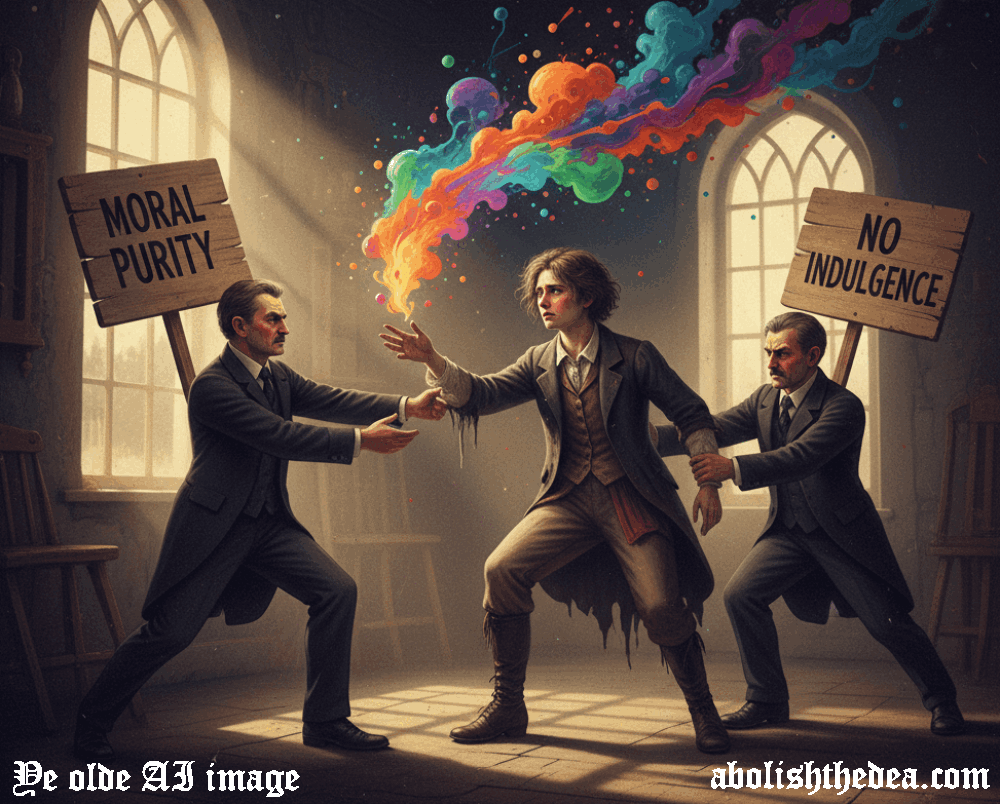
 Normally, I would consider it bad form for essayists to tell you that they are "feeling down today." It would be a case of what we used to call TMI as kids: "too much information." But this admission by a drug-war philosopher is highly relevant to his essays given that the lack of motivation referred to has been brought about by drug policy, which outlaws all substances that could help one to transcend this feeling and so be productive in life. This is why I call drug prohibition a meta injustice, because it does far worse than censor you as to what you can talk about: it seeks to limit the amount of passion and zeal that you can devote to your cause as a naysayer against the status quo.
Someday the world will realize that Freud's real achievement was his discovery of the depression-busting power of cocaine.
Laughing gas is the substance that gave William James his philosophy of reality. He concluded from its use that what we perceive is just a fraction of reality writ large. Yet his alma mater (Harvard) does not even MENTION laughing gas in their bio of the man.
Many psychedelic fans are still drug warriors at heart. They just think that a nice big exception should be carved out for the drugs that they're suddenly finding useful.
How would we even KNOW that outlawed drugs have no positive uses? We first have to incorporate them in a sane, empathic and creative way to find that out, and the drug war makes such a sensible approach absolutely impossible.
Kids should be taught in grade school that prohibition is wrong.
The "acceptable risk" for psychoactive drugs can only be decided by the user, based on what they prioritize in life. Science just assumes that all users should want to live forever, self-fulfilled or not.
Classic prohibitionist gaslighting, telling me that "drugs" is a neutral term. What planet are they living on?
Scientists are not the experts on psychoactive medicines. The experts are painters and artists and spiritualists -- and anyone else who simply wants to be all they can be in life. Scientists understand nothing of such goals and aspirations.
The "scheduling" system is completely anti-scientific and anti-patient. It tells us we can make a one-size-fits-all decision about psychoactive substances without regard for dosage, context of use, reason for use, etc. That's superstitious tyranny.
If daily drug use and dependency are okay, then there's no logical or scientific reason why I can't smoke a nightly opium pipe.
Normally, I would consider it bad form for essayists to tell you that they are "feeling down today." It would be a case of what we used to call TMI as kids: "too much information." But this admission by a drug-war philosopher is highly relevant to his essays given that the lack of motivation referred to has been brought about by drug policy, which outlaws all substances that could help one to transcend this feeling and so be productive in life. This is why I call drug prohibition a meta injustice, because it does far worse than censor you as to what you can talk about: it seeks to limit the amount of passion and zeal that you can devote to your cause as a naysayer against the status quo.
Someday the world will realize that Freud's real achievement was his discovery of the depression-busting power of cocaine.
Laughing gas is the substance that gave William James his philosophy of reality. He concluded from its use that what we perceive is just a fraction of reality writ large. Yet his alma mater (Harvard) does not even MENTION laughing gas in their bio of the man.
Many psychedelic fans are still drug warriors at heart. They just think that a nice big exception should be carved out for the drugs that they're suddenly finding useful.
How would we even KNOW that outlawed drugs have no positive uses? We first have to incorporate them in a sane, empathic and creative way to find that out, and the drug war makes such a sensible approach absolutely impossible.
Kids should be taught in grade school that prohibition is wrong.
The "acceptable risk" for psychoactive drugs can only be decided by the user, based on what they prioritize in life. Science just assumes that all users should want to live forever, self-fulfilled or not.
Classic prohibitionist gaslighting, telling me that "drugs" is a neutral term. What planet are they living on?
Scientists are not the experts on psychoactive medicines. The experts are painters and artists and spiritualists -- and anyone else who simply wants to be all they can be in life. Scientists understand nothing of such goals and aspirations.
The "scheduling" system is completely anti-scientific and anti-patient. It tells us we can make a one-size-fits-all decision about psychoactive substances without regard for dosage, context of use, reason for use, etc. That's superstitious tyranny.
If daily drug use and dependency are okay, then there's no logical or scientific reason why I can't smoke a nightly opium pipe.


 (up)
(up)