








 WARNING: This is an essay that will only be of interest to the philosophically minded, and then only to members of the subset of that category who believe that one can be a philosopher in this life without the say-so of the academic establishment.
The Drug War shows us that American democracy is fundamentally flawed. Propaganda and fearmongering has persuaded Americans to give up freedoms that are clearly enunciated in the U.S. Constitution. We need a new democracy in which a Constitution actually matters.
The proof that psychedelics work has always been extant. We are hoodwinked by scientists who convince us that efficacy has not been "proven." This is materialist denial of the obvious.
Daily opium use is no more outrageous than daily antidepressant use. In fact, it's less outrageous. It's a time-honored practice and can be stopped with a little effort and ingenuity, whereas it is almost impossible to get off some antidepressants because they alter brain chemistry.
Today's Washington Post reports that "opioid pills shipped" DROPPED 45% between 2011 and 2019..... while fatal overdoses ROSE TO RECORD LEVELS! Prohibition is PUBLIC ENEMY NUMBER ONE.
The whole drug war is based on the anti-American idea that the way to avoid problems is to lie and prevaricate and persuade people not to ask questions.
We drastically limit drug choices, we refuse to teach safe use, and then we discover there's a gene to explain why some people have trouble with drugs. Science loves to find simple solutions to complex problems.
Drug prohibition has resulted in hundreds of thousands of completely unnecessary deaths thanks to totally preventable drug overdoses!
Prohibition is wrong root and branch. It seeks to justify the colonial disdain for indigenous healing practices through fearmongering.
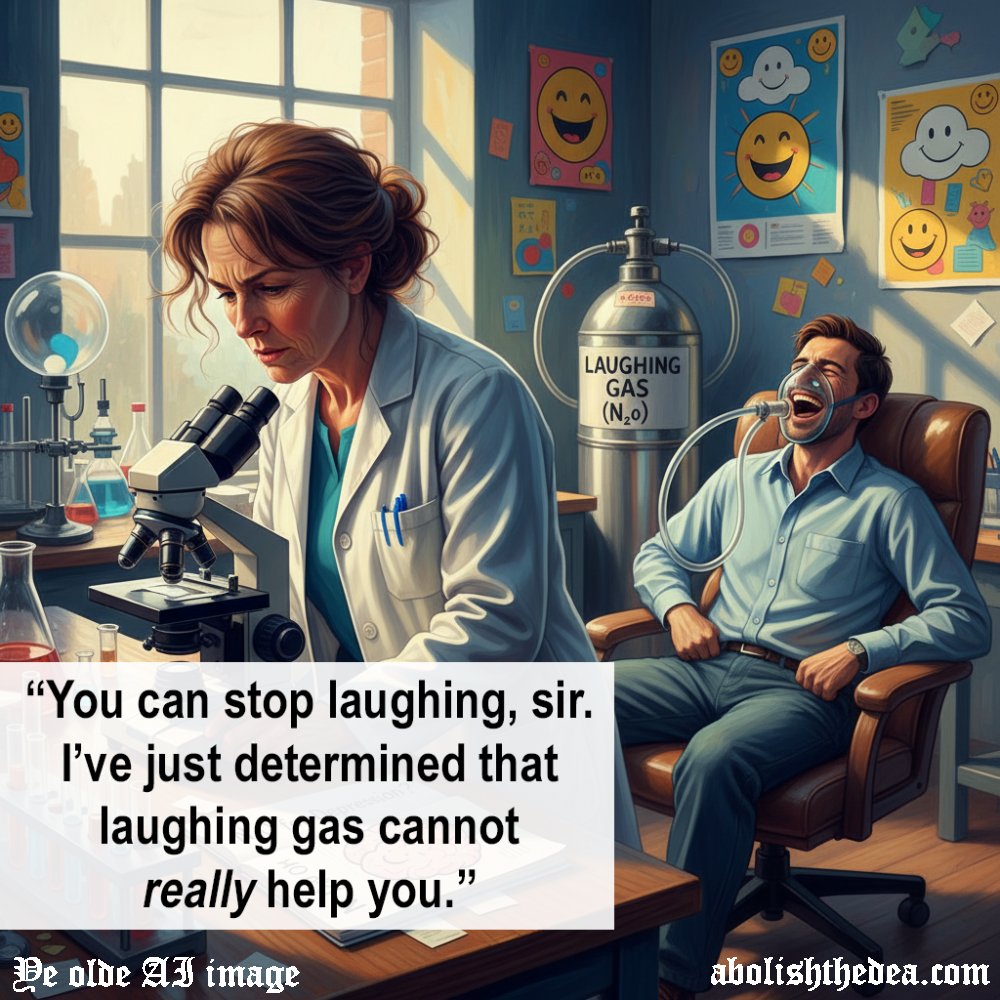
Scientists hold holistically working drugs to reductionist standards, thereby practicing a sort of pharmacological colonialsm.
If I have no right to mother nature's bounty, then I surely have no right to manmade guns. If hysterical fearmongering justifies the eradication of the Fourth Amendment, then the Second Amendment should go as well.
WARNING: This is an essay that will only be of interest to the philosophically minded, and then only to members of the subset of that category who believe that one can be a philosopher in this life without the say-so of the academic establishment.
The Drug War shows us that American democracy is fundamentally flawed. Propaganda and fearmongering has persuaded Americans to give up freedoms that are clearly enunciated in the U.S. Constitution. We need a new democracy in which a Constitution actually matters.
The proof that psychedelics work has always been extant. We are hoodwinked by scientists who convince us that efficacy has not been "proven." This is materialist denial of the obvious.
Daily opium use is no more outrageous than daily antidepressant use. In fact, it's less outrageous. It's a time-honored practice and can be stopped with a little effort and ingenuity, whereas it is almost impossible to get off some antidepressants because they alter brain chemistry.
Today's Washington Post reports that "opioid pills shipped" DROPPED 45% between 2011 and 2019..... while fatal overdoses ROSE TO RECORD LEVELS! Prohibition is PUBLIC ENEMY NUMBER ONE.
The whole drug war is based on the anti-American idea that the way to avoid problems is to lie and prevaricate and persuade people not to ask questions.
We drastically limit drug choices, we refuse to teach safe use, and then we discover there's a gene to explain why some people have trouble with drugs. Science loves to find simple solutions to complex problems.
Drug prohibition has resulted in hundreds of thousands of completely unnecessary deaths thanks to totally preventable drug overdoses!
Prohibition is wrong root and branch. It seeks to justify the colonial disdain for indigenous healing practices through fearmongering.
Scientists hold holistically working drugs to reductionist standards, thereby practicing a sort of pharmacological colonialsm.
If I have no right to mother nature's bounty, then I surely have no right to manmade guns. If hysterical fearmongering justifies the eradication of the Fourth Amendment, then the Second Amendment should go as well.


 (up)
(up)